Exploring the Purpose and Impact of Augmented Reality
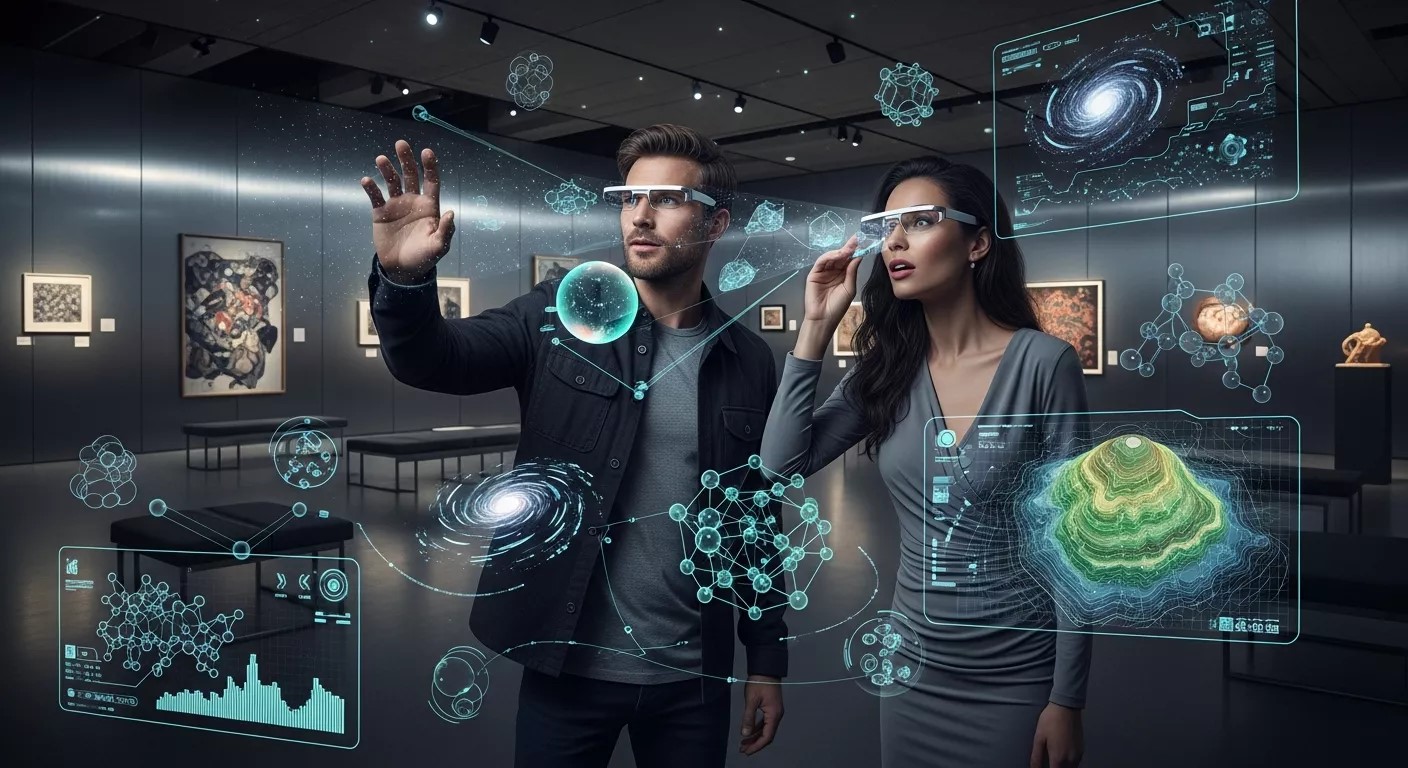
Augmented Reality has moved far beyond being a futuristic buzzword or a short-lived tech trend. Today, it sits at the center of how humans interact with digital information, physical environments, and decision-making systems. To truly understand the main goal of augmented reality, it’s important to look beyond surface-level explanations like “overlaying digital objects on the real world” and explore the deeper psychological, functional, and societal purposes it serves.
Modern users don’t just want information they want clarity, context, immersion, and emotional connection. Augmented Reality exists to bridge the cognitive gap between abstract data and real-world understanding, transforming how humans perceive, learn, work, and interact with their surroundings.
Understanding Augmented Reality Beyond Technology
Augmented Reality is not merely a visual enhancement tool. It is a perception-shaping system that blends digital intelligence with real-world environments to improve human comprehension and engagement.
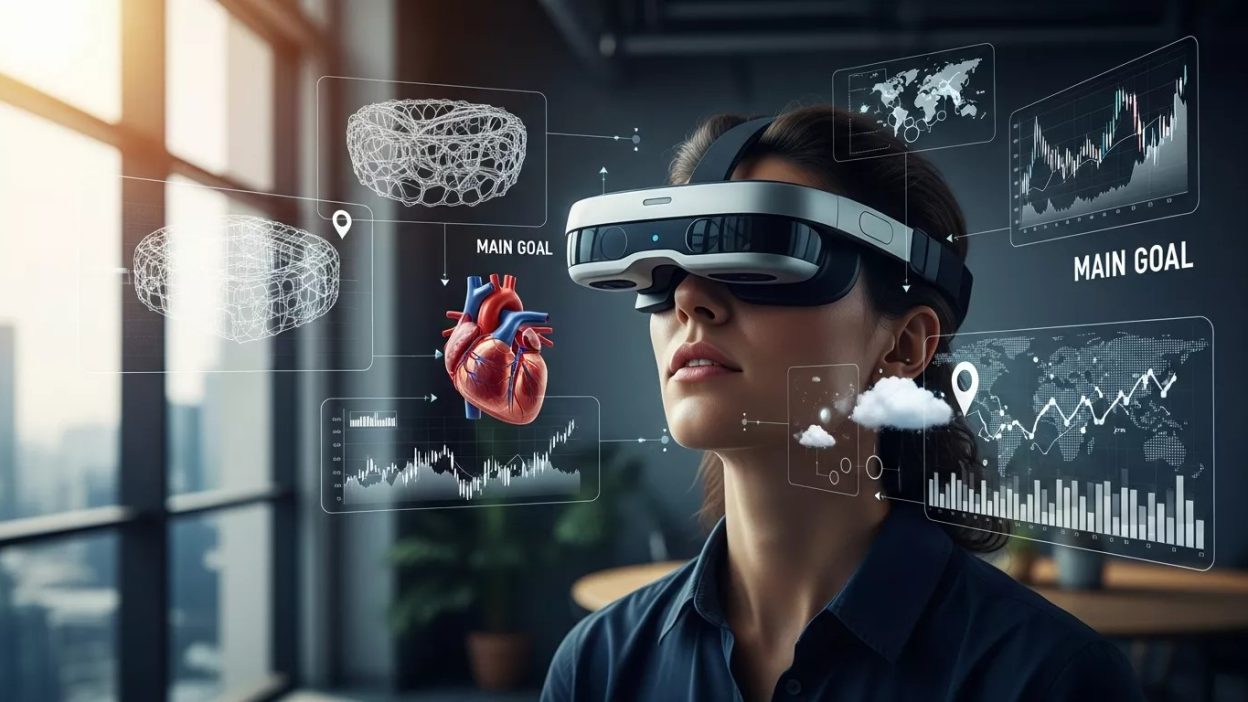
At its core, the main goal of augmented reality is to enhance human reality rather than replace it. Unlike virtual environments that isolate users, AR operates within familiar spaces, adding layers of meaning, guidance, and insight where they matter most.
This distinction is critical because human psychology responds more effectively to contextual information than abstract data. When digital content appears anchored to physical objects or environments, the brain processes it as more trustworthy, actionable, and memorable.
Why Humans Need Augmented Reality Today
Information Overload and Cognitive Fatigue
Modern humans are overwhelmed with data. Dashboards, screens, reports, and notifications constantly compete for attention. Augmented Reality solves this by delivering information only when and where it is needed.
Instead of forcing users to interpret symbols, charts, or manuals, AR translates complexity into intuitive visual cues. This aligns directly with the main goal of augmented reality: reducing cognitive friction while improving decision accuracy.
Contextual Intelligence
Humans understand things better when information appears in context called Contextual Intelligence. Augmented Reality places instructions, data, or simulations directly onto real-world objects, eliminating the mental effort required to imagine abstract concepts.
This contextual delivery transforms passive observation into active understanding.
The Psychological Foundation of Augmented Reality
Human perception relies heavily on spatial awareness, pattern recognition, and visual memory. Augmented Reality leverages these natural cognitive strengths instead of working against them.
Embodied Cognition and AR
Embodied cognition theory suggests that humans learn best through physical interaction with their environment. AR supports this by allowing users to interact with digital elements as if they were part of the physical world.
This explains why the main goal of augmented reality aligns so well with learning, training, and skill development across industries.
Emotional Engagement and Trust
When information feels integrated into reality, users are more likely to trust it. Augmented visuals anchored to physical spaces feel less intrusive and more authentic, increasing emotional engagement and reducing skepticism.
The Core Purpose of Augmented Reality Systems
Enhancing Decision-Making
One of the most practical outcomes tied to the main goal of augmented reality is better decision-making. Whether in healthcare, engineering, retail, or education, AR enables users to see consequences before they occur.
This predictive visualization reduces risk, saves time, and improves confidence.
Improving Human Performance
AR doesn’t aim to replace human intelligence it augments it. By delivering real-time guidance, visual overlays, and adaptive feedback, it enhances precision, efficiency, and learning speed.
This makes AR especially valuable in high-stakes environments where errors are costly.
Augmented Reality in Research
Augmented Reality in Research has fundamentally changed how scientists collect, visualize, and interpret data. Traditional research often relies on flat screens, static models, and abstract simulations. AR transforms these limitations by allowing researchers to interact with complex datasets spatially.
For example, molecular structures, astronomical data, or biomechanical models can be explored in three dimensions within real environments. This spatial interaction leads to new insights that are difficult to achieve through conventional visualization tools.
In research environments, the main goal of augmented reality becomes the acceleration of discovery by turning invisible patterns into visible experiences.
Educational Transformation Through Augmented Reality
Learning by Seeing and Doing
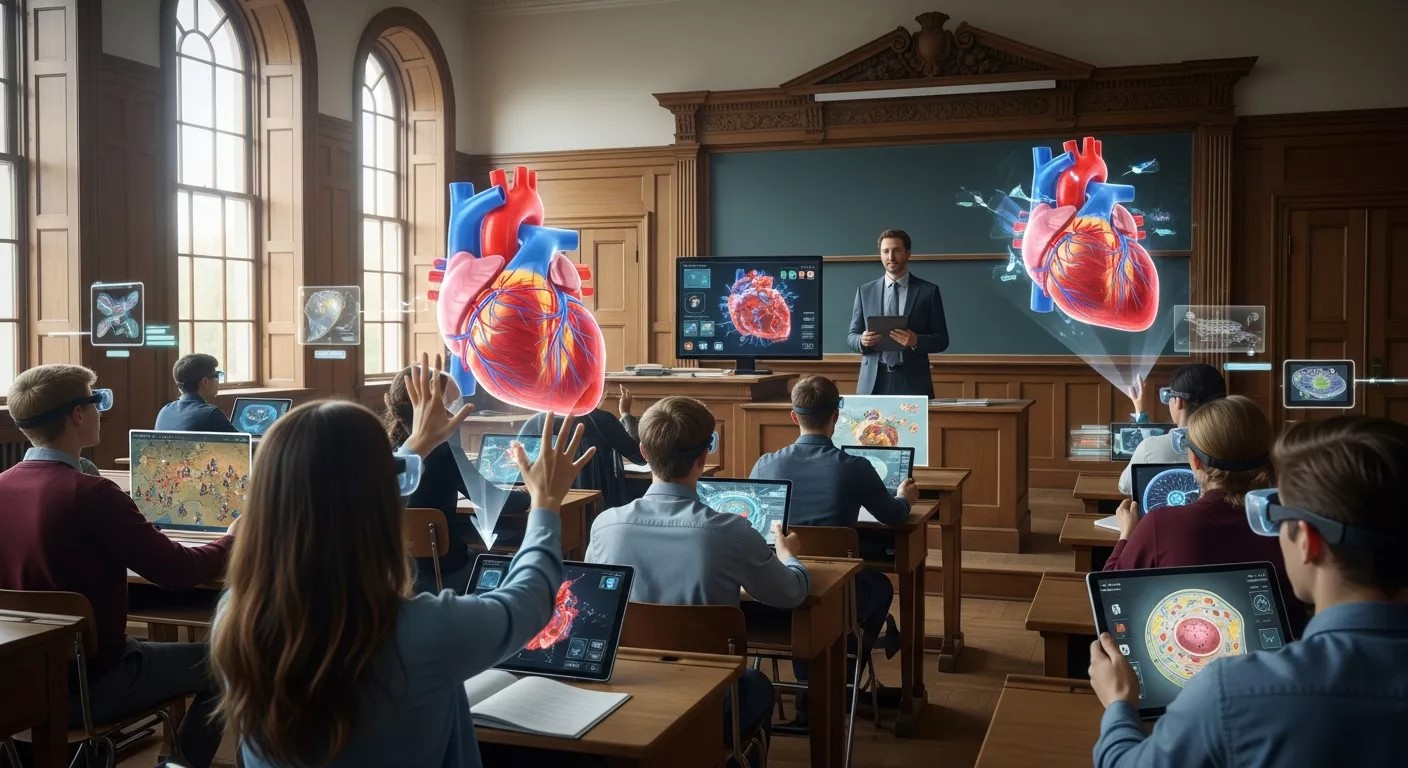
Education systems struggle with engagement and retention. AR addresses this by making learning experiential rather than theoretical.
Students can explore historical events, biological systems, or engineering principles within their physical classrooms. This method aligns perfectly with how the human brain retains information.
Reducing Learning Gaps
By adapting content to real-time user behavior, AR supports personalized learning. It provides immediate feedback and contextual assistance, reducing frustration and increasing confidence.
Here, the main goal of augmented reality is to democratize understanding, regardless of learning style or background.
Augmented Reality and Mental Health
Augmented Reality and Mental Health is an emerging field with profound implications. Mental health challenges often involve perception, emotional regulation, and environmental triggers—all areas where AR can provide support.
AR-based therapies can guide users through grounding exercises, exposure therapy, or mindfulness practices within real-world settings. By blending therapeutic guidance with familiar environments, users feel safer and more in control.
In this context, the main goal of augmented reality is emotional empowerment rather than technological novelty.
Healthcare and Clinical Applications
Precision and Safety
In healthcare, AR enhances surgical planning, diagnostics, and patient education. Surgeons can visualize anatomical structures overlaid onto patients, improving accuracy and reducing risk.
Patient Understanding
Patients often struggle to understand medical information. AR allows doctors to explain conditions visually, improving comprehension and trust.
The main goal of augmented reality in healthcare is to improve outcomes by aligning medical expertise with human understanding.
Augmented Reality for Smart Cities
Augmented Reality for Smart Cities represents a shift in how urban environments are designed, managed, and experienced. Cities are complex systems with invisible infrastructures like data flows, energy networks, and transportation systems.
AR makes these invisible layers visible to planners, engineers, and citizens alike. Traffic patterns, pollution levels, and emergency routes can be visualized in real time within the physical cityscape.
This transparency supports smarter decisions and more inclusive urban governance.
Augmented Reality in Urban Planning
Augmented Reality in Urban Planning allows stakeholders to experience proposed developments before construction begins. Instead of relying on blueprints or static renders, planners can walk through future buildings and public spaces at full scale.
This immersive preview reduces costly mistakes and improves collaboration between architects, governments, and communities.
Here, the main goal of augmented reality is proactive problem-solving rather than reactive correction.
Enterprise and Workplace Transformation
On-the-Job Guidance
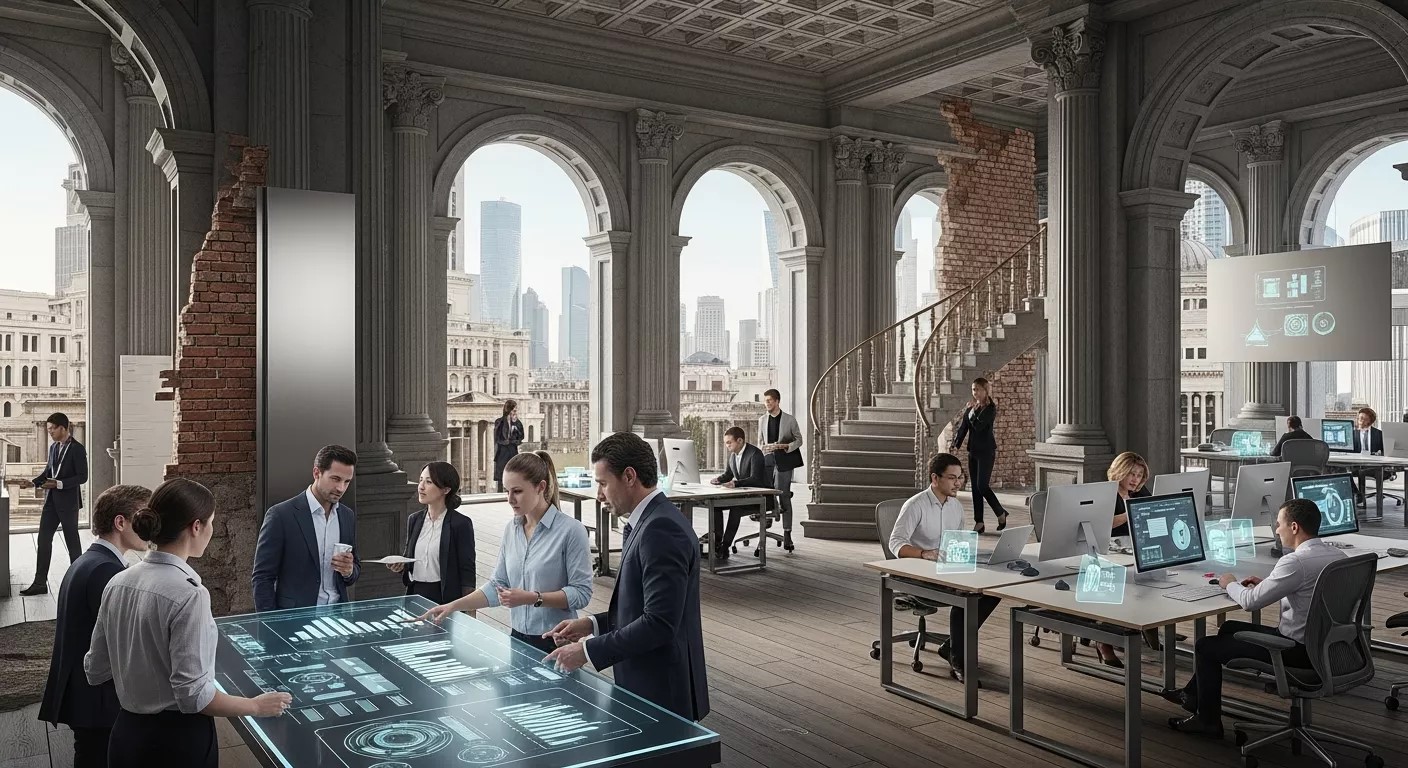
AR-powered workflows provide step-by-step visual instructions in real time. This reduces training time and minimizes errors in complex tasks.
Knowledge Retention
By embedding instructions directly into the work environment, employees learn through repetition and context, leading to long-term skill retention.
The main goal of augmented reality in enterprise settings is operational efficiency without sacrificing human autonomy.
Retail and Consumer Experience Evolution
Augmented Reality reshapes how consumers interact with products. Virtual try-ons, spatial previews, and interactive packaging reduce uncertainty and increase confidence.
Consumers no longer imagine how a product fits into their lives—they see it.
This experiential clarity supports informed purchasing decisions and stronger brand trust.
Industrial and Manufacturing Impact
Predictive Maintenance
AR assists technicians by highlighting faults, displaying diagnostics, and guiding repairs in real time.
Design and Prototyping
Engineers can visualize and test designs at scale before physical production, saving resources and time.
In industrial contexts, the main goal of augmented reality is precision, foresight, and operational resilience.
Data Visualization and Decision Intelligence
Modern data is complex and multidimensional. AR transforms raw data into spatial experiences, allowing users to identify trends and anomalies intuitively.
Instead of interpreting spreadsheets, decision-makers can explore data landscapes within physical spaces.
This shifts analytics from passive review to active exploration.
Social Interaction and Collaboration
AR supports shared experiences in physical spaces, enabling collaborative problem-solving and creative expression.
Remote teams can interact with the same augmented objects, breaking down geographical barriers without removing the human element.
The main goal of augmented reality here is meaningful connection, not isolation.
Ethical and Human-Centered Design Considerations
Augmented Reality must be designed responsibly. Overuse, distraction, and data misuse can undermine trust.
Human-centered AR focuses on enhancing awareness rather than overwhelming users. Transparency, consent, and contextual relevance are essential.
The long-term success of AR depends on aligning innovation with human values.
The Future Direction of Augmented Reality
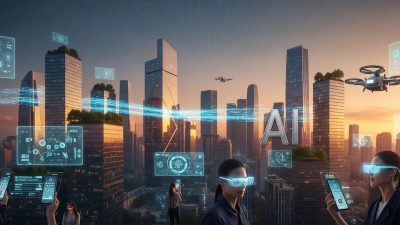
As AI, spatial computing, and wearable devices evolve, AR will become more adaptive, intuitive, and invisible. The technology will fade into the background while its impact becomes more profound.
Future AR systems will anticipate needs, respond to emotions, and adapt to environments dynamically.
At every stage of this evolution, the main goal of augmented reality remains consistent: to make reality more understandable, actionable, and humane.
Why Understanding of Augmented Reality Matters Today
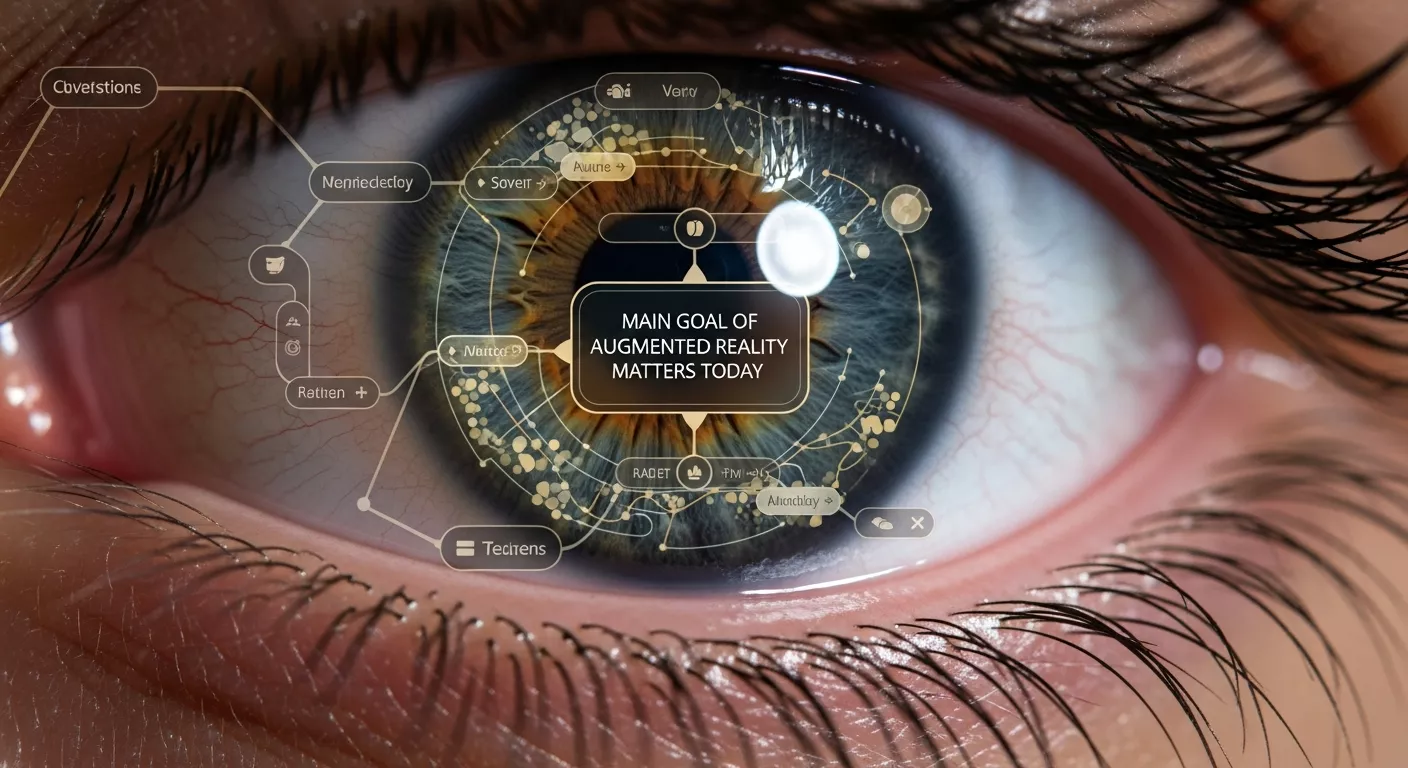
The rapid adoption of immersive technologies has made it essential to clearly define the main goal of augmented reality in today’s digital ecosystem. As users interact with increasingly complex systems, clarity and context have become more valuable than raw information.
Rather than replacing physical reality, the main goal of augmented reality is to enhance it by layering meaningful digital insights onto real-world environments. This approach aligns with modern human behavior, where people expect technology to adapt to them—not the other way around.
The Psychological Foundation Behind Augmented Reality
How Human Perception Shapes the Main Goal of Augmented Reality
Human brains are wired to understand visual and spatial information faster than text or numbers. Because of this, the main goal of augmented reality is deeply connected to how humans naturally process their surroundings.
By presenting data within physical context, augmented systems reduce cognitive overload and increase comprehension. This makes information feel more intuitive, actionable, and trustworthy.
Emotional Engagement and Contextual Awareness
Another key aspect of the main goal of augmented reality is emotional connection. When digital elements appear anchored in real environments, users feel more engaged and less disconnected from the experience.
This emotional grounding increases trust, focus, and long-term retention of information.
The Functional Purpose of Augmented Reality Systems
Enhancing Real-Time Decision Making
In many industries, decisions must be made quickly and accurately. The main goal of augmented reality in these situations is to provide real-time visual guidance that improves confidence and reduces errors.
From medical diagnostics to technical maintenance, augmented overlays help users see critical information exactly when it matters.
Reducing Complexity in Everyday Tasks
Another practical expression of the main goal of augmented reality is simplifying complex processes. Instead of relying on manuals or external screens, users receive step-by-step assistance directly within their environment.
This reduces mental strain and improves task performance.
The Main Goal of Augmented Reality in Knowledge and Learning Systems
Supporting Experiential Learning Models
Traditional learning methods often struggle to maintain engagement. Here, the main goal of augmented reality is to transform passive learning into interactive exploration.
Students and professionals can visualize abstract concepts in real-world settings, improving understanding and memory retention.
Closing Knowledge Gaps Through Context
By adapting content to user behavior and environment, the main goal of augmented reality becomes accessibility. Learners with different backgrounds or abilities can access information in ways that suit them best.
The Role of Augmented Reality in Modern Digital Environments
Bridging Physical and Digital Experiences
As digital and physical worlds increasingly overlap, the main goal of augmented reality is to create seamless transitions between the two. Users no longer need to mentally switch contexts when accessing information.
This continuity supports productivity, creativity, and satisfaction.
Improving Interaction With Smart Technologies
Smart devices generate vast amounts of data. The main goal of augmented reality is to translate this data into visual cues that humans can easily interpret within their surroundings.
This turns complex systems into intuitive experiences.
How the Main Goal of Augmented Reality Evolves With Technology
Integration With Artificial Intelligence
As AI becomes more advanced, the main goal of augmented reality expands to include predictive and adaptive experiences. Systems can anticipate user needs and adjust information delivery accordingly.
This evolution enhances personalization without increasing cognitive load.
Preparing for Future Human-Centered Interfaces
Looking ahead, the main goal of augmented reality remains human-centric. Future interfaces will prioritize awareness, usability, and ethical design over visual excess.
Augmented Reality will continue to serve as a bridge between human intent and digital intelligence.
Conclusion
Augmented Reality continues to evolve as a human-centered technology that enhances how people interpret and interact with their surroundings. By aligning digital insights with real-world context, it supports clearer understanding, smarter decisions, and more meaningful everyday experiences across industries and environments.
Frequently Asked Questions (FAQ)
What problem does augmented reality aim to solve?
Augmented Reality addresses the gap between complex digital information and real-world understanding by presenting data in context, helping users interpret, learn, and act without switching away from their physical environment.
How is augmented reality different from virtual reality?
While virtual reality replaces the physical world with a fully digital one, augmented reality enhances the real environment by adding digital elements, allowing users to stay connected to their surroundings.
Why is augmented reality considered human-centered technology?
Augmented Reality is designed around human perception and behavior, using visual context and spatial awareness to reduce cognitive load and make information more intuitive and accessible.
Can augmented reality improve learning and skill development?
Yes, augmented reality supports experiential learning by allowing users to visualize and interact with concepts in real-world settings, which improves understanding, retention, and practical skill application.
Is augmented reality only useful for advanced industries?
No, augmented reality is increasingly used in everyday applications such as education, retail, healthcare, navigation, and workplace training, making it relevant for both individuals and organizations.
How will augmented reality evolve in the future?
Future augmented reality systems will become more adaptive and intelligent, integrating with AI and real-time data to deliver personalized, context-aware experiences while remaining seamless and unobtrusive.