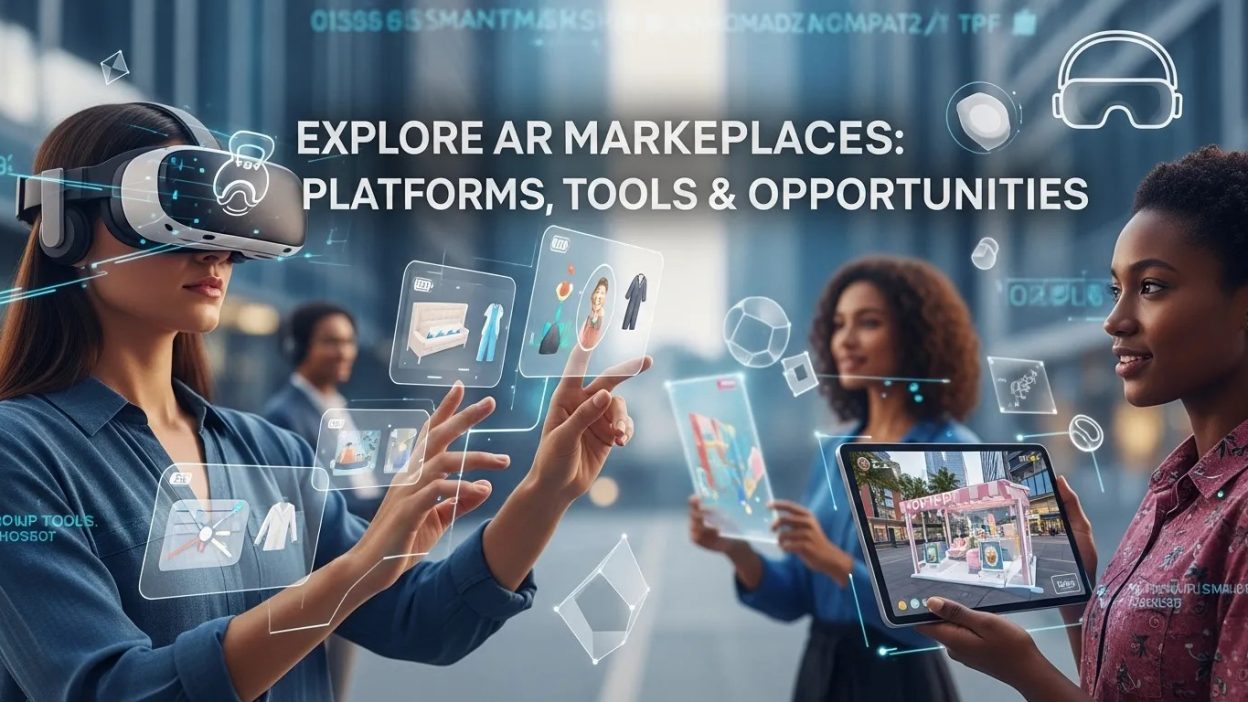
AR Marketplaces offer access to holograms, AI intelligence, healthcare applications, and chatbot-driven marketing tools. They enable businesses to innovate efficiently, enhance user engagement, and adopt immersive AR experiences, bridging creators, platforms, and consumers in one seamless ecosystem.
Introduction to AR Marketplaces
Augmented reality has rapidly evolved from a futuristic concept to a practical tool shaping industries today. Among the most transformative aspects of this evolution are AR Marketplaces, platforms where creators, developers, and businesses converge to access, buy, and sell immersive content. These marketplaces serve as a hub for innovation, enabling companies to integrate cutting-edge AR solutions without building everything from scratch.
In recent years, the demand for AR Marketplaces has surged, driven by the proliferation of AR-compatible devices, increased mobile usage, and the growing need for interactive experiences in sectors like retail, education, and entertainment. Businesses now recognize the importance of not just adopting AR but leveraging marketplaces to discover pre-built assets, templates, and interactive modules that can accelerate deployment and reduce costs.
Why AR Marketplaces Are Essential for Businesses
The value of AR Marketplaces lies in accessibility and diversity. Startups and established enterprises alike can browse a variety of AR applications, tools, and modules designed to fit specific business needs. These platforms often include features for integration with existing software, collaboration tools for development teams, and analytics dashboards for performance tracking.
An often overlooked but critical aspect is AR Privacy and Security. As companies increasingly rely on AR solutions to interact with customers and handle sensitive data, ensuring secure transactions and safe handling of AR content becomes crucial. Leading AR marketplaces provide secure environments with user authentication, encrypted transactions, and compliance with data privacy regulations, helping businesses protect both their intellectual property and customer information.
Key Features of Modern AR Marketplaces
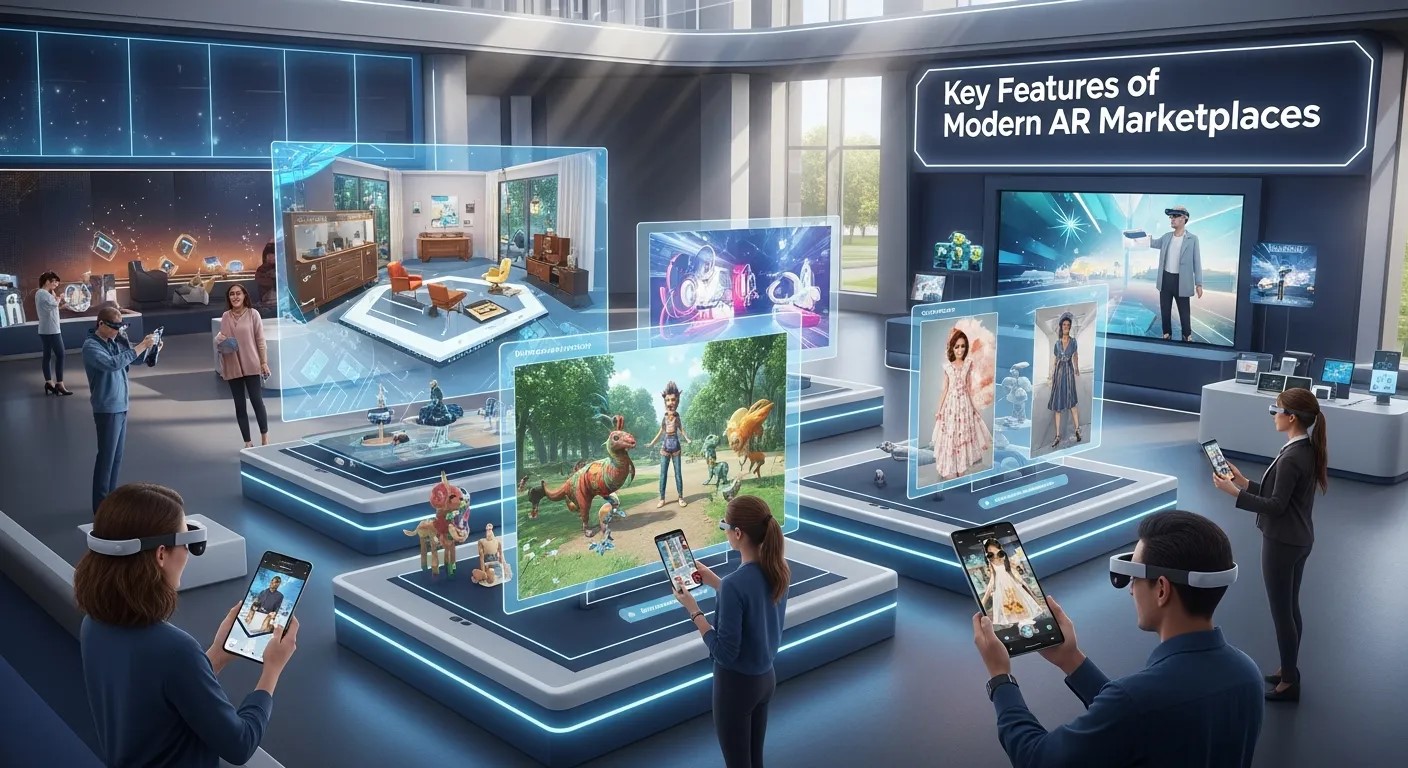
Modern AR Marketplaces offer a variety of functionalities that go beyond simply hosting AR content. Some of the key features include:
| Feature | Description | Benefit |
|---|---|---|
| Asset Libraries | Pre-built 3D models, animations, and AR scenes | Speeds up development and reduces costs |
| Integration Tools | SDKs and APIs for software compatibility | Easy incorporation into existing apps |
| Analytics & Metrics | Track usage, engagement, and ROI | Data-driven decision-making |
| Collaboration Tools | Team management and project sharing | Facilitates remote AR development |
| Security & Compliance | Encryption, user authentication, and privacy protocols | Protects sensitive data and IP |
These features make AR Marketplaces a vital ecosystem for both AR developers and businesses seeking to enhance customer experiences.
Types of AR Marketplaces
AR marketplaces are diverse, catering to different segments and purposes. Broadly, they can be categorized into:
-
Consumer-Oriented Marketplaces – Platforms focused on games, entertainment, and social AR content. Users can download AR filters, interactive games, and personalized holograms.
-
Enterprise-Oriented Marketplaces – Designed for professional applications, these include industrial training modules, marketing tools, and AR simulations. Integration with existing enterprise software is often prioritized.
-
Creator-Focused Marketplaces – Platforms that empower independent AR developers and artists to showcase and sell their creations. These marketplaces often provide monetization options, licensing agreements, and collaboration opportunities.
By providing specialized experiences for different audiences, AR Marketplaces ensure that both consumers and professionals find value while fostering a vibrant AR ecosystem.
Exploring AR Hologram Technology in Marketplaces
One of the most exciting innovations transforming AR Marketplaces is AR Hologram Technology. This technology allows digital objects to appear three-dimensional and interactable in real-world environments, bridging the gap between imagination and reality. Through AR marketplaces, businesses and creators can access a wide variety of holographic assets, from lifelike product demos to interactive educational models.
How AR Hologram Technology Works
At its core, AR Hologram Technology combines computer vision, spatial mapping, and device sensors to project virtual objects into a physical space. Users can view these holograms through smartphones, AR glasses, or dedicated AR displays. The advanced capabilities available in AR Marketplaces allow creators to easily source holographic models or upload their own designs, making the technology accessible even to those without deep technical expertise.
Key technical components include:
-
3D Modeling: Creating accurate holographic representations of objects or characters.
-
Spatial Mapping: Ensuring holograms align correctly with the physical environment.
-
Real-Time Rendering: Maintaining fluid, responsive interactions as users move around the scene.
-
Device Compatibility: Optimizing holograms for different AR devices and platforms.
By leveraging these technologies, AR Marketplaces serve as a bridge for businesses and developers to deploy high-quality holographic content efficiently.
Applications of Hologram Technology in Various Industries
The potential applications of AR Hologram Technology are vast, spanning multiple industries:
-
Retail and E-commerce: Brands can showcase products as interactive holograms, allowing customers to explore details, visualize sizes, and make informed purchasing decisions.
-
Education and Training: Medical students, engineers, and other professionals can study complex structures in 3D, enhancing comprehension and retention.
-
Entertainment: Holographic concerts, games, and interactive storytelling experiences bring immersive engagement to consumers.
-
Marketing and Branding: Companies can use holograms in experiential campaigns to captivate audiences at events, social media platforms, or in-store promotions.
AR marketplaces simplify access to these applications by providing ready-to-use holographic content, templates, and tools for customization.
Benefits of Using AR Marketplaces for Hologram Deployment
Utilizing AR Marketplaces for hologram technology comes with several advantages:
-
Cost Efficiency: Businesses avoid building holograms from scratch, saving both time and money.
-
Speed of Deployment: Pre-built assets and integration tools accelerate project timelines.
-
Scalability: Holographic content can be scaled across multiple platforms, devices, and campaigns.
-
Innovation Access: Marketplaces keep users updated with the latest AR innovations, ensuring competitive advantage.
By combining AR Hologram Technology with the structured ecosystem of AR Marketplaces, organizations gain an unparalleled opportunity to enhance user experiences and unlock new business value.
AR in Healthcare: Transforming Patient Care Through Marketplaces

The healthcare sector has been one of the most transformative beneficiaries of AR Marketplaces, offering innovative solutions that enhance patient care, training, and operational efficiency. Through these platforms, hospitals, clinics, and medical professionals can access a wide variety of AR applications tailored specifically for healthcare, ranging from anatomy visualization to surgical simulations.
Applications of AR in Healthcare
Medical Training and Education: AR applications available on AR Marketplaces allow medical students and professionals to explore human anatomy in interactive 3D models. They can manipulate organs, simulate procedures, and practice complex surgical techniques without risk to patients.
Surgical Assistance: Surgeons can use AR overlays during operations to visualize critical structures beneath the skin or monitor patient vitals in real-time. AR content from marketplaces can be integrated with hospital systems, providing step-by-step guidance or AI-driven recommendations.
Patient Engagement: AR applications can help explain diagnoses, treatment plans, or rehabilitation exercises to patients in a visual and interactive manner. Accessing these tools through AR Marketplaces ensures healthcare providers have the latest educational content without extensive development overhead.
Remote Consultation and Telemedicine: With the rise of virtual healthcare, AR-enabled platforms from marketplaces allow physicians to conduct remote examinations or guide patients in real-time using interactive 3D models.
Benefits of AR Marketplaces for Healthcare Providers
Healthcare professionals gain significant advantages by leveraging AR Marketplaces:
-
Access to Specialized Tools: Marketplaces offer a wide range of healthcare-specific AR apps without the need to develop solutions internally.
-
Cost-Effective Implementation: Purchasing or licensing AR content from marketplaces is often more economical than creating bespoke applications.
-
Continuous Innovation: Providers can stay updated with the latest AR tools, including holograms, procedural simulations, and AI-driven insights.
-
Enhanced Patient Outcomes: Interactive and immersive AR content improves comprehension, adherence, and engagement among patients.
Case Study: Surgical Simulation
A major teaching hospital integrated AR applications sourced from a leading AR Marketplace to train surgical residents. Using 3D holographic models of complex procedures, residents could practice multiple times before performing real surgeries. The hospital reported a 30% reduction in training time and improved surgical accuracy, highlighting the tangible benefits of marketplace-driven AR solutions in healthcare.
Challenges and Considerations
While AR in Healthcare provides immense value, there are considerations that healthcare providers must address:
-
Regulatory Compliance: AR content must comply with healthcare regulations and patient privacy standards.
-
Data Security: Integration with patient data systems requires robust encryption and secure authentication protocols, ensuring sensitive information remains protected.
-
Device Compatibility: Not all AR applications are optimized for every device, so careful evaluation is required before implementation.
By accessing vetted, high-quality AR applications through AR Marketplaces, healthcare providers can mitigate these challenges while delivering next-generation patient care and training solutions.
AR Intelligence: Smarter Experiences Through Marketplaces
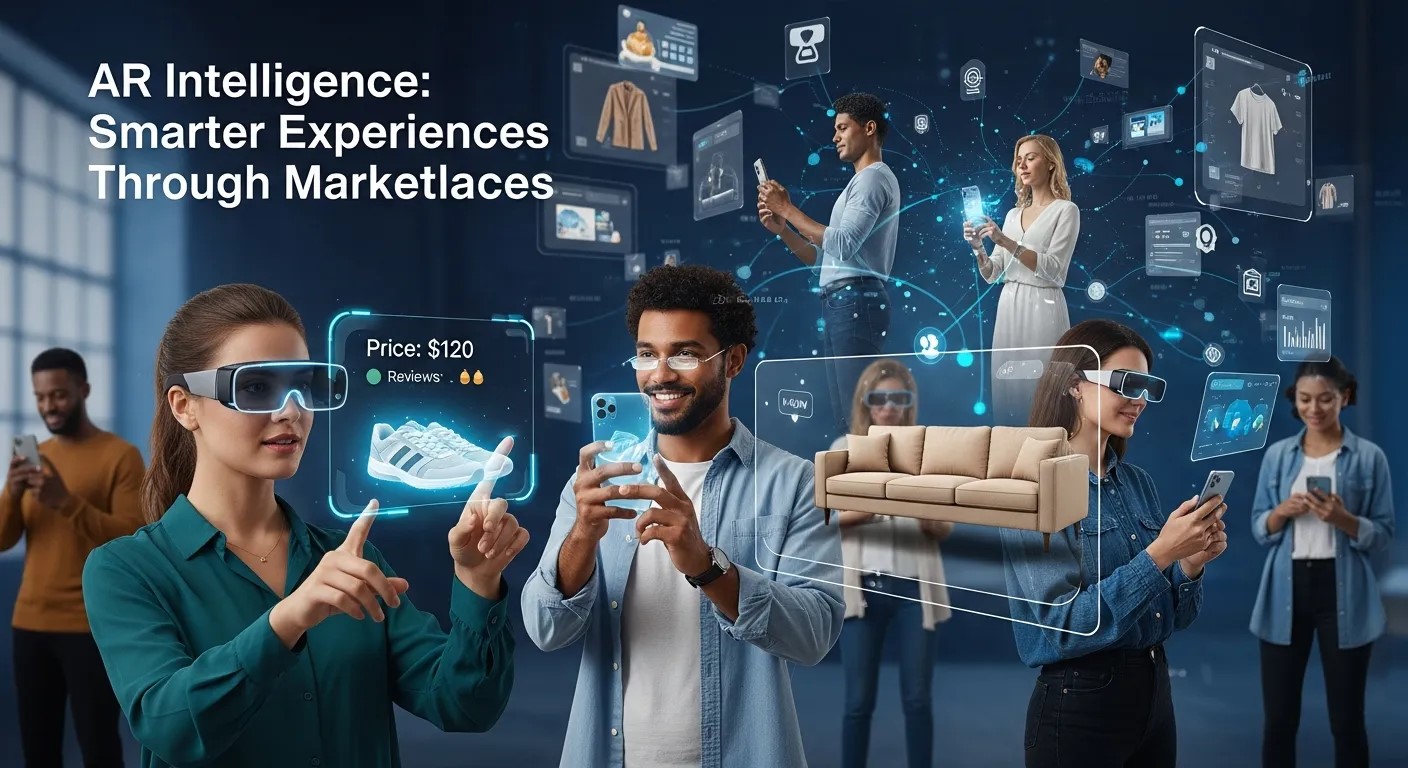
The integration of AR Intelligence has elevated AR Marketplaces from simple content hubs to sophisticated ecosystems capable of delivering personalized and data-driven experiences. AR Intelligence combines machine learning, computer vision, and contextual analytics to create applications that adapt to user behavior, environment, and preferences.
What is AR Intelligence?
At its core, AR Intelligence refers to augmented reality systems that utilize AI and analytics to enhance functionality and decision-making. These systems can recognize objects, predict user interactions, optimize visual overlays, and even automate complex workflows. When AR Intelligence is paired with AR Marketplaces, businesses gain immediate access to intelligent AR applications that can improve efficiency, engagement, and ROI without the need for deep technical expertise.
Applications of AR Intelligence in AR Marketplaces
-
Personalized Retail Experiences: AR applications integrated with intelligence can suggest products based on a customer’s previous interactions or current context. Marketplaces provide access to AR apps that adapt displays dynamically to individual users, enhancing shopping engagement.
-
Interactive Learning and Training: AR Intelligence allows training modules to adjust in real-time, offering feedback based on user performance. Through AR Marketplaces, organizations can deploy intelligent training tools in sectors like healthcare, manufacturing, and logistics.
-
Data-Driven Marketing: Businesses can track how users interact with AR content, allowing marketers to optimize campaigns. Intelligent AR applications sourced from marketplaces provide analytics dashboards that highlight engagement metrics, popular content, and user behavior patterns.
-
Operational Optimization: Companies can use AR Intelligence applications for tasks such as equipment maintenance or workflow management. AR overlays provide contextual guidance based on real-time sensor data, enhancing accuracy and reducing errors.
Benefits of Combining AR Marketplaces and AR Intelligence
-
Rapid Access to Smart Applications: Marketplaces enable businesses to tap into pre-built intelligent AR solutions without extensive development.
-
Enhanced Decision-Making: Intelligent AR tools provide actionable insights that drive better outcomes across marketing, training, and operations.
-
Scalability: Intelligent AR applications can adapt to multiple users, devices, and environments, supporting enterprise-level deployment.
-
Cost Efficiency: Using AR Intelligence solutions from marketplaces reduces the need for custom development while maintaining innovation.
Examples of AR Intelligence in Marketplaces
Several leading AR marketplaces now offer intelligence-powered applications, such as:
-
Smart Retail Displays: Automatically adjusting AR product presentations based on demographic data or in-store traffic.
-
Predictive Maintenance Tools: AR overlays guide technicians while sensors detect potential equipment failures before they occur.
-
Adaptive Educational Modules: Learning applications that dynamically change difficulty levels according to student performance.
By leveraging AR Intelligence through AR Marketplaces, organizations can create AR experiences that are not only immersive but also contextually relevant, actionable, and highly engaging.
Integrating AI Chatbots and Marketing Funnels with AR Marketplaces
The intersection of AI Chatbot Marketing Funnels and AR Marketplaces is creating new opportunities for businesses to engage customers in immersive, interactive ways. AR applications combined with intelligent chatbots can guide users through experiences, answer questions, and drive conversions without manual intervention.
How AI Chatbot Marketing Funnels Work in AR
An AI Chatbot Marketing Funnel leverages conversational AI to guide a user through a sequence of actions, from awareness to conversion. When integrated with AR applications sourced from marketplaces, these funnels become highly visual and interactive:
-
Awareness Stage: AR applications can showcase products or services in 3D, providing an engaging first touchpoint. The chatbot greets the user, explains features, and answers questions in real-time.
-
Consideration Stage: The chatbot can recommend complementary products or experiences based on user interactions with AR content. For example, in an AR furniture app from a marketplace, the chatbot might suggest matching items or layouts for a room.
-
Conversion Stage: AI-driven chatbots can facilitate purchases directly within the AR environment or guide users to the checkout process seamlessly.
By combining AI Chatbot Marketing Funnels with AR Marketplaces, businesses can create a frictionless, engaging customer journey that feels both personalized and immersive.
Role of Chatbots in Brand Marketing
Chatbots in Brand Marketing have become essential tools for enhancing customer engagement, loyalty, and retention. When paired with AR applications, these chatbots can deliver experiences that are both memorable and measurable:
-
Interactive Product Demos: Users can interact with a holographic product while the chatbot highlights key features.
-
Event Engagement: AR-based virtual events or experiences are enhanced by chatbots guiding users, answering FAQs, and providing additional content.
-
Personalized Recommendations: Chatbots analyze user behavior in AR environments and deliver tailored suggestions, increasing the likelihood of conversion.
-
Lead Generation and Follow-Up: Data collected from interactions in AR environments can be used by chatbots to nurture leads through targeted messaging and automated campaigns.
Benefits of Integrating Chatbots with AR Marketplaces
-
Enhanced User Engagement: Combining visual AR experiences with interactive chatbots keeps users engaged longer.
-
Streamlined Marketing Funnels: Chatbots guide users through each step of the funnel, ensuring that no opportunity is lost.
-
Data-Driven Insights: Interaction data from AR apps and chatbots provides brands with actionable intelligence for optimizing campaigns.
-
Cost Efficiency: Using pre-built AR content from marketplaces and AI chatbots reduces development costs and speeds up deployment.
Example Scenario
Imagine a fashion brand leveraging an AR Marketplace to offer virtual try-ons of clothing. An integrated AI chatbot can:
-
Greet the user and provide style tips.
-
Suggest complementary outfits based on the AR interaction.
-
Offer exclusive promotions and guide the user to purchase.
This combination creates a seamless, interactive experience that transforms traditional marketing into an immersive journey, boosting both engagement and conversion rates.
The Future of AR: Collaborative, Immersive, and Marketplace-Driven
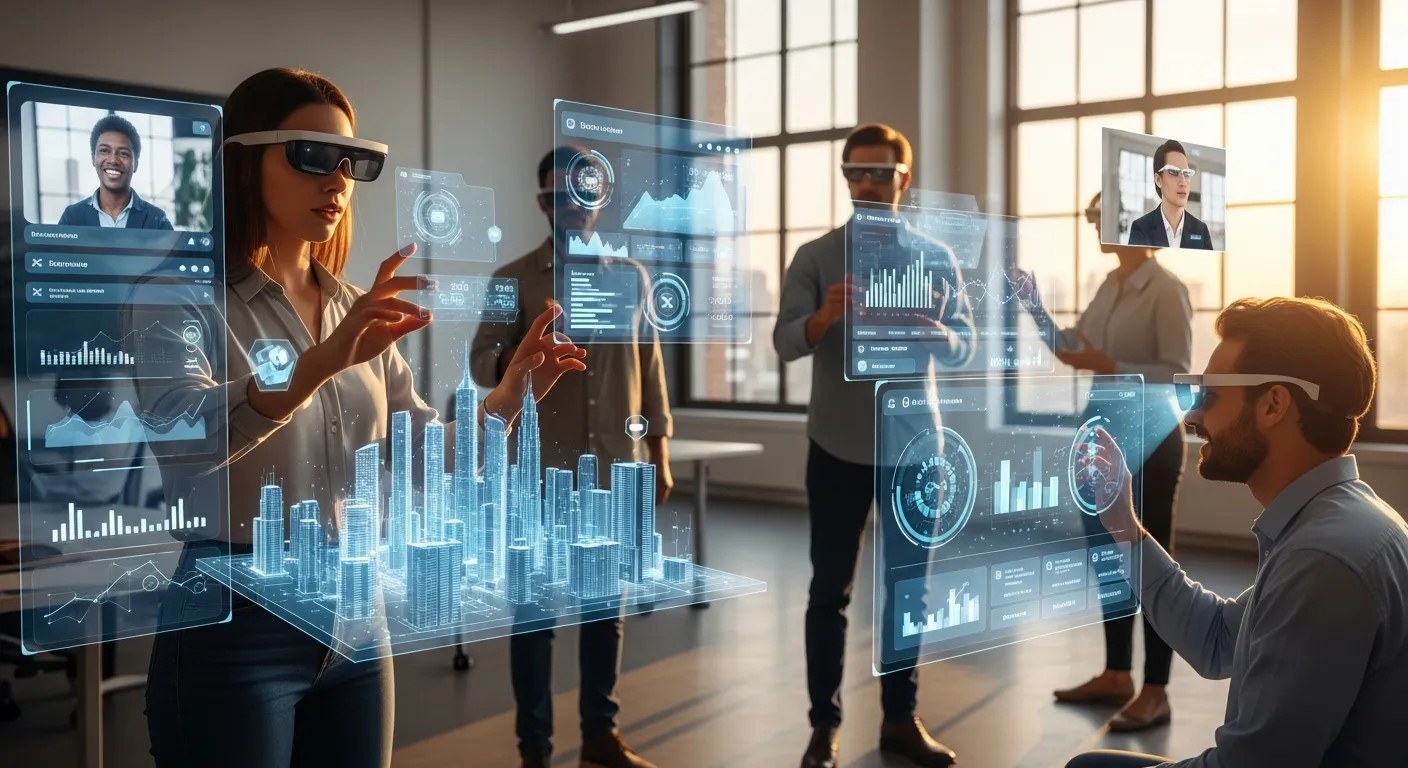
AR Marketplaces are redefining how businesses, developers, and creators interact with augmented reality. By offering access to holograms, intelligent AR tools, healthcare applications, and AI-powered marketing solutions, these platforms streamline innovation while ensuring cost efficiency and scalability. As AR technology evolves, marketplaces will continue to bridge the gap between creators and end-users, providing secure, versatile, and immersive experiences. Businesses that leverage these platforms can stay ahead of the competition, deliver personalized engagement, and explore new avenues for growth. The future of AR is collaborative, interactive, and marketplace-driven.
Conclusion
AR Marketplaces are revolutionizing the way businesses and creators interact with augmented reality, providing streamlined access to tools, platforms, and immersive content. From healthcare innovations and holographic technology to AI-powered marketing funnels and intelligent AR applications, these marketplaces empower organizations to innovate faster, reduce costs, and deliver personalized experiences. By leveraging pre-built assets, secure environments, and intelligent tools, companies can enhance engagement, improve operational efficiency, and stay competitive in a rapidly evolving digital landscape. As AR continues to grow, marketplaces will remain central to connecting creators, businesses, and users in a vibrant, interactive ecosystem.
Frequently Asked Questions (FAQs)
What are AR Marketplaces?
Platforms where AR content, tools, and applications are bought, sold, or shared for commercial and creative use.
How do AR Marketplaces benefit businesses?
They reduce development costs, provide pre-built assets, and offer AI-driven tools to enhance engagement and efficiency.
Can AR Marketplaces be used in healthcare?
Yes, for training, surgical simulations, patient engagement, and telemedicine applications.
What is AR Intelligence?
Intelligent AR systems use AI and analytics to create adaptive, context-aware, and interactive AR experiences.
How are chatbots integrated with AR?
AI chatbots guide users through marketing funnels, answer questions, and enhance engagement within AR environments.