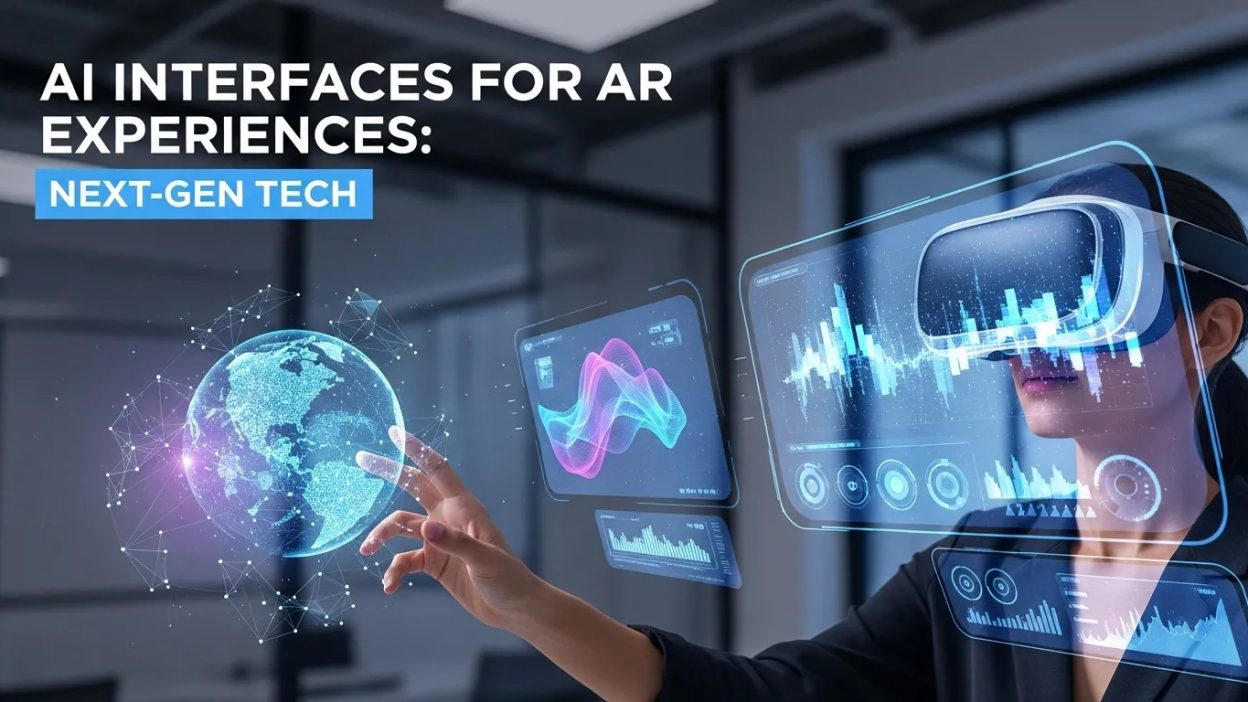
AI Interfaces for AR enable interactive, immersive, and adaptive experiences. With technologies like computer vision, facial tracking, and edge computing, these AI-driven interfaces are revolutionizing industries while ensuring ethical, personalized, and responsive AR interactions.
Introduction The Rise of AI Interfaces for AR
The landscape of augmented reality (AR) is evolving at an unprecedented pace. Among the key drivers of this transformation are AI interfaces, which are redefining how users interact with digital content in real-world environments. AI Interfaces for AR have moved beyond simple overlay functions to deliver immersive, interactive experiences that feel intuitive and natural. From enhancing gaming experiences to providing enterprise-level solutions, these interfaces are bridging the gap between human cognition and machine intelligence.
This evolution is powered by a combination of technologies that seamlessly integrate into AR platforms. One of the most critical aspects is computer vision in AR, enabling devices to understand spatial relationships and interpret the physical environment. This allows virtual objects to behave in realistic ways, responding to movement, lighting, and even occlusions. For businesses and developers, the potential applications of AI interfaces are vast, from training simulations to marketing activations.
Moreover, AR facial tracking has emerged as a significant feature in modern AR applications. By analyzing facial expressions and micro-movements, AR systems can deliver personalized interactions in real-time. This capability not only enhances entertainment and social media experiences but also enables professional applications, such as virtual try-ons and emotion-driven analytics. By combining these features with AI Interfaces for AR, developers are crafting environments that feel responsive and intelligent, blurring the lines between physical and digital worlds.
Key Components Driving AI Interfaces in AR

To understand why AI Interfaces for AR are transformative, it’s essential to look at the underlying components that make them possible. Beyond computer vision and facial tracking, edge technologies play a crucial role in performance and responsiveness. Edge computing in AR ensures that complex AI models can run locally on devices, minimizing latency and creating smoother interactions. This is particularly important for AR experiences that require real-time feedback, such as collaborative workspaces or high-speed gaming environments.
Another emerging focus is the ethical dimension of AI in AR applications. Ethical AI in AR emphasizes responsible data usage, privacy protection, and algorithmic fairness. As AR experiences become more integrated into daily life, developers must ensure that these systems operate transparently and respect user autonomy. Incorporating ethical AI principles into AR platforms enhances user trust and ensures long-term adoption.
In commercial contexts, chatbots in B2B marketing are increasingly paired with AR applications to create interactive product demos and customer engagement tools. By integrating conversational AI into AR environments, businesses can offer guided experiences, provide instant support, and personalize interactions without relying solely on static content. Similarly, AI conversational commerce is beginning to transform retail, allowing users to explore virtual showrooms, receive personalized recommendations, and make purchases within immersive AR spaces. These integrations showcase how AI interfaces are not just technical enhancements they are business enablers.
Designing Seamless AI Interfaces for AR
Effective AI Interfaces for AR require careful attention to human-centered design. Unlike traditional software, AR interfaces must account for spatial dynamics, user ergonomics, and cognitive load. Developers must ensure that digital elements align naturally with physical surroundings while remaining accessible and intuitive. The balance between functionality and simplicity is critical—too much information can overwhelm the user, while too little can limit engagement.
Interaction paradigms are also evolving. Gesture recognition, voice commands, and eye-tracking technologies are becoming standard features in next-gen AR platforms. By leveraging computer vision in AR, these inputs are interpreted accurately, enabling hands-free navigation and more immersive control schemes. This creates a fluid, intuitive experience that encourages exploration and experimentation. For example, AR educational apps can adapt content based on user attention, while enterprise applications can streamline workflows with minimal training requirements.
Applications Across Industries
The impact of AI Interfaces for AR extends across numerous sectors. In healthcare, AR interfaces enhance surgical precision, provide interactive training simulations, and support remote consultations. By combining AI-driven insights with immersive visualization, medical professionals can improve outcomes while reducing risk. Similarly, industrial applications leverage AR for maintenance, quality control, and training, using real-time overlays to guide technicians and reduce errors.
Retail and marketing are also being transformed. AR-enabled apps allow customers to visualize products in their own space, try on virtual clothing, or interact with branded experiences. By incorporating AR facial tracking, these experiences become more personalized, increasing engagement and conversion rates. Meanwhile, AI conversational commerce tools within AR environments allow users to ask questions, receive recommendations, and complete transactions seamlessly, enhancing customer satisfaction and loyalty.
Education and training benefit greatly from AI-powered AR. Interactive simulations enable students to explore complex concepts in a hands-on manner, enhancing retention and understanding. Edge-enabled AR devices ensure that these experiences are smooth and responsive, even in bandwidth-limited environments. Moreover, integrating ethical AI in AR ensures that sensitive educational data is handled responsibly, maintaining trust between institutions, instructors, and learners.
Technological Innovations Fueling Growth
Several technological innovations are accelerating the adoption of AI Interfaces for AR. Real-time 3D mapping, powered by sophisticated algorithms, allows AR applications to render environments accurately. Edge computing in AR ensures that these computations occur near the user, reducing lag and improving interactivity. Advanced sensors, including LiDAR and depth cameras, enhance spatial awareness, enabling precise placement and tracking of virtual objects.
Natural language processing (NLP) is another critical innovation. Through AI-driven dialogue systems, AR interfaces can understand and respond to user queries in real-time. This integration of conversational AI enriches experiences, whether in training simulations, customer engagement, or entertainment. For instance, users can receive step-by-step guidance in complex tasks, interact with virtual instructors, or explore immersive storytelling narratives, all within an AI-powered AR environment.
The convergence of AI and AR also supports adaptive experiences. Interfaces can learn from user behavior, preferences, and interactions, creating personalized environments that evolve over time. This adaptability enhances engagement, satisfaction, and long-term usage. By maintaining a human-centric design approach, developers ensure that these technologies augment, rather than complicate, user experiences.
Advanced Design Strategies for AI Interfaces in AR

Designing effective AI Interfaces for AR requires more than just integrating AI and AR technologies—it involves a deep understanding of human behavior, cognitive load, and spatial interaction. A well-crafted interface anticipates user intent, simplifies complex operations, and ensures immersive engagement. By leveraging computer vision in AR, developers can track user gestures, movements, and environment changes in real-time, enabling responsive and adaptive interactions.
One of the most powerful tools in modern AR design is AR facial tracking. When paired with AI Interfaces for AR, facial tracking allows systems to detect emotions, attention, and engagement levels, creating personalized experiences. Imagine a virtual assistant in an AR environment that adapts its guidance based on the user’s facial cues, providing extra help if the user looks confused, or speeding up if they appear confident. This type of responsiveness enhances usability and creates a natural, human-centered experience.
Integrating Edge Computing in AR for Performance
A key challenge for high-performance AR experiences is latency. Slow response times can break immersion and reduce engagement. Here, edge computing in AR becomes essential. By processing AI computations closer to the user, these systems minimize lag and ensure that AI Interfaces for AR respond instantly to interactions. This capability is crucial for applications in gaming, industrial maintenance, and live training scenarios, where even milliseconds matter.
Edge-enabled AR also supports real-time collaborative environments. Multiple users can interact with shared virtual objects without noticeable delays, opening up opportunities for remote teamwork, design reviews, and live AR workshops. In these scenarios, AI Interfaces for AR act as the connective tissue between users and digital content, ensuring smooth, synchronized experiences.
Ethical AI Considerations in AR
As AI Interfaces for AR become more intelligent and pervasive, ethical considerations cannot be overlooked. Ethical AI in AR emphasizes responsible data collection, privacy protection, and transparent algorithmic decisions. Users must trust that their interactions, facial data, and environmental scans are handled securely and respectfully. By embedding ethical AI principles from the design phase, developers create not only safer experiences but also build credibility and long-term user loyalty.
For instance, AR retail experiences powered by AI conversational commerce can collect personal preferences to offer product recommendations. If handled ethically, this data personalization improves engagement without compromising privacy. The same approach applies in education, healthcare, and enterprise training, where sensitive information can be leveraged to optimize learning or workflow outcomes while maintaining strict ethical standards.
Cross-Industry Use Cases for AI Interfaces in AR
Healthcare
In healthcare, AI Interfaces for AR are revolutionizing diagnostics, treatment planning, and surgical precision. By overlaying critical patient data onto physical environments, AR systems guided by AI help surgeons visualize anatomy and procedural steps. Computer vision in AR ensures accurate alignment of virtual models, reducing risks and improving outcomes. Additionally, AR facial tracking can monitor patient reactions and stress levels during treatments, enabling more empathetic care.
Industrial Applications
Manufacturing, logistics, and field service industries benefit significantly from AI Interfaces for AR. Technicians can receive step-by-step visual guidance on complex machinery, reducing errors and downtime. Edge computing in AR ensures that these instructions appear instantly, even in remote locations with limited network connectivity. By incorporating chatbots in B2B marketing, companies can deliver interactive training modules or equipment demos to clients in AR, enhancing both operational efficiency and customer engagement.
Retail and Marketing
The retail sector has embraced AI Interfaces for AR to deliver immersive shopping experiences. Customers can try on virtual clothing, explore product placements, or interact with branded environments. Using AR facial tracking, these interactions can be personalized based on customer reactions, increasing engagement and satisfaction. AI conversational commerce allows users to ask questions, get tailored recommendations, and complete purchases seamlessly within the AR interface, merging the digital and physical shopping journey.
Education and Training
Education is another area where AI Interfaces for AR are transforming traditional methods. Interactive simulations, powered by AI, allow students to explore complex concepts in anatomy, physics, or chemistry in three dimensions. Edge computing in AR ensures smooth rendering, while ethical AI in AR safeguards student data. Additionally, chatbots in B2B marketing inspired conversational interfaces can serve as virtual tutors, answering questions and guiding learners through lessons, creating a more interactive and adaptive educational environment.
Enhancing Immersion with AI-Driven AR
Immersion is the hallmark of successful AR experiences. AI Interfaces for AR enhance immersion by making interactions intuitive and intelligent. Gesture controls, voice recognition, and eye-tracking create hands-free navigation that feels natural. The integration of computer vision in AR enables objects to respond to occlusions, lighting, and spatial constraints, making virtual elements behave as if they truly exist in the physical space.
Real-time personalization is another layer of immersion. AR facial tracking allows systems to adapt content dynamically—smiling at user satisfaction, providing hints when confusion is detected, or adjusting difficulty based on engagement. Similarly, AI conversational commerce can guide users in retail or service experiences, making each interaction feel tailored and responsive. In essence, AI Interfaces for AR act as both the brain and the nervous system of these immersive worlds, seamlessly connecting user intent to actionable digital responses.
AI Interfaces for AR in Enterprise Collaboration
Enterprise environments are leveraging AI Interfaces for AR to improve collaboration, decision-making, and productivity. Interactive dashboards in AR allow teams to visualize data in 3D, manipulate virtual objects, and make informed decisions faster. Edge computing in AR supports multiple simultaneous users in shared spaces, while ethical AI in AR ensures that sensitive corporate data is protected. For remote teams, AI conversational commerce inspired chatbots facilitate communication and guidance, blending conversational AI with immersive interfaces.
Technical Challenges and Solutions
Developing robust AI Interfaces for AR involves addressing several technical challenges. Latency, processing power, and sensor accuracy are among the top concerns. Edge computing in AR mitigates latency, while advancements in GPU and mobile chipsets allow for more sophisticated AI algorithms on devices. Computer vision in AR continues to improve, offering precise environment mapping and object recognition even in challenging conditions.
Maintaining user engagement without overwhelming cognitive load is another challenge. Here, AR facial tracking helps monitor user attention and adjust interface complexity accordingly. Adaptive AI models within the interface can prioritize relevant content, minimize distractions, and provide contextual guidance. These solutions ensure that AI Interfaces for AR are not just functional, but also enjoyable and intuitive to use.
Emerging Technologies Shaping AI Interfaces for AR

The future of AI Interfaces for AR is being shaped by several cutting-edge technologies. Developers are leveraging computer vision in AR to make virtual objects interact seamlessly with the physical world. By detecting surfaces, objects, and user movement in real-time, AI-powered interfaces ensure a fluid and immersive AR experience. These intelligent systems can adjust visual overlays dynamically, enhancing realism and user engagement.
Personalized Experiences Through Facial Recognition
Another major trend is AR facial tracking. By analyzing micro-expressions and engagement patterns, AI Interfaces for AR can tailor experiences to individual users. For example, an educational AR app might provide hints when a student shows confusion, or a retail AR tool could recommend products based on attention and reactions. These subtle adaptations create more intuitive and human-centered interfaces, making AR interactions feel natural rather than mechanical.
Edge Computing for Real-Time Performance
Latency is a critical concern in immersive AR. Edge computing in AR enables AI processing to occur locally on the device, allowing AI Interfaces for AR to respond instantly to user interactions. This capability is particularly important for collaborative AR applications in enterprise environments, where multiple users interact with the same virtual content simultaneously. Real-time responsiveness elevates user satisfaction and maintains the illusion of a seamless AR world.
Ethical AI and Responsible Design
As AI Interfaces for AR become more intelligent, ethical AI in AR ensures that personal data, facial metrics, and behavioral information are handled responsibly. Developers are increasingly focused on transparent data usage, informed consent, and algorithmic fairness. Integrating ethical principles helps build trust, especially in sensitive applications like healthcare, education, and B2B enterprise solutions.
Conversational and Commercial Integration
The integration of chatbots in B2B marketing and AI conversational commerce is transforming how users interact with AR environments. Within immersive interfaces, AI-driven conversational agents can guide users, answer questions, and even facilitate purchases without leaving the AR platform. AI Interfaces for AR are no longer just visual overlays they are interactive, intelligent systems that engage users on multiple levels.
Conclusion
AI Interfaces for AR are transforming how we interact with digital content, making augmented reality more immersive, responsive, and human-centered. By combining computer vision in AR, AR facial tracking, and edge computing in AR, developers can create intelligent systems that adapt to user behavior in real time. Ethical considerations ensure privacy and trust, while integrations like chatbots in B2B marketing and AI conversational commerce enhance engagement and commercial value. Across industries from healthcare to retail and education these next-generation interfaces are not just technological innovations; they are reshaping the way humans experience digital and physical worlds together.
Frequently Asked Questions (FAQ)
What are AI Interfaces for AR?
They are AI-powered systems that enhance augmented reality by enabling adaptive, intelligent, and interactive digital overlays in real-world environments.
How does computer vision support AI Interfaces for AR?
It allows AR systems to detect objects, surfaces, and user movements, making virtual content behave naturally and responsively.
Why is edge computing important in AR?
Edge computing reduces latency by processing data locally, ensuring real-time interactions and smoother AR experiences.
Can AI Interfaces for AR be used in business?
Yes. Applications include chatbots in B2B marketing, immersive product demos, interactive training, and AI conversational commerce solutions.
How is ethical AI applied in AR?
Ethical AI ensures privacy, transparent data use, and fairness in AI-driven AR experiences, building trust and user safety.