Marketing has evolved dramatically over the past decade, but few technologies have created as much excitement or confusion as augmented reality (AR). While many businesses still view AR as a futuristic novelty, forward-thinking marketers are already using it to create immersive experiences that attract, engage, and delight customers in ways traditional marketing simply cannot match.
What Makes AR Different from Traditional Marketing

Traditional inbound marketing relies on content like blog posts, videos, and social media to draw customers in. AR takes this concept several steps further by creating three-dimensional, interactive experiences that customers can engage with using their smartphones or tablets.
The key difference lies in immersion. While a product video shows you what something looks like, AR lets you place that product in your living room, try it on virtually, or interact with it as if it were physically present. This level of engagement creates stronger emotional connections between customers and brands.
Consider how furniture retailer IKEA transformed its marketing approach with the IKEA Place app. Instead of relying solely on catalogs and showroom visits, customers can now visualize how furniture will look in their actual homes. This AR experience doesn’t just market products—it solves a real problem customers face when shopping for furniture online.
Core Ways AR Enhances Inbound Marketing
Interactive Product Demonstrations
AR enables brands to showcase products in ways that were previously impossible. Beauty brands like Sephora and L’Oréal use AR filters to let customers try on makeup virtually. This creates an engaging experience while addressing a major barrier to online cosmetics purchases—uncertainty about how products will look.
These interactive demonstrations work because they provide immediate value to customers. Rather than asking people to imagine how a product might work for them, AR lets them experience it firsthand. This builds confidence and reduces purchase hesitation.
Location-Based Experiences
Augmented reality can turn physical locations into marketing channels. Retail stores, restaurants, and entertainment venues use AR to create discoverable experiences that encourage social sharing and word-of-mouth marketing.
Pokémon GO demonstrated the power of location-based AR marketing when businesses saw foot traffic increase simply by being designated as PokeStops or hosting Pokémon GO events. Smart marketers recognized that AR could drive real-world visits and began incorporating location-based AR elements into their own strategies.
Educational Content That Engages
Complex products or services often require extensive explanation. AR can make educational content more digestible and memorable by allowing customers to visualize abstract concepts or see products in action.
Automotive companies use AR to let customers explore car features, see cutaway views of engines, or visualize different color options. This educational approach builds expertise and trust while keeping customers engaged longer than traditional content formats.
Building AR Into Your Content Strategy
Start With Customer Pain Points
The most successful AR marketing campaigns solve real problems for customers. Before jumping into AR development, identify specific challenges your customers face that could be addressed through interactive, visual experiences.
If you sell home improvement products, customers might struggle to visualize how materials will look in their space. If you offer complex software, users might need help understanding features and workflows. AR can address these challenges while naturally showcasing your products or services.
Create Shareable Moments
AR experiences are inherently social. People love sharing unique, interactive content with their networks. Design your AR campaigns with shareability in mind by including elements that are visually striking, fun to use, or genuinely helpful.
Snapchat and Instagram filters succeed because they’re designed for sharing. Your AR marketing should follow similar principles—create experiences that people want to show others, and your reach will extend far beyond your initial audience.
Integrate With Existing Campaigns
AR doesn’t need to replace your current marketing efforts. The most effective approach is integrating AR elements into existing campaigns to enhance rather than overhaul your strategy.
Add AR components to product launches, seasonal campaigns, or educational content series. This approach allows you to test and refine your AR marketing while maintaining the content strategies that already work for your business.
Overcoming Common AR Marketing Challenges
Technical Barriers and Accessibility
Not every customer has the latest smartphone or feels comfortable with new technology. Successful AR marketing campaigns account for these limitations by ensuring experiences work across a range of devices and providing clear instructions for users.
Keep AR experiences simple and intuitive. The goal is to enhance your marketing message, not create frustration for users who struggle with the technology. Always provide alternative ways to access the same information for customers who prefer traditional content formats.
Cost and Development Concerns
Many businesses assume AR marketing requires massive budgets and technical expertise. While complex AR experiences can be expensive, simple implementations are increasingly accessible.
Social media platforms offer built-in AR creation tools, and numerous third-party services provide templates and easy-to-use development platforms. Start small with basic AR filters or simple product visualization tools before investing in custom development.
Measuring Success and ROI
Traditional marketing metrics don’t always translate directly to AR campaigns. Develop new measurement frameworks that account for engagement time, interaction rates, and the unique user behaviors that AR enables.
Track metrics like session duration, feature usage within AR experiences, and conversion rates from AR interactions. These insights will help you optimize future campaigns and demonstrate the value of AR to stakeholders.
Enhancing Customer Trust Through AR Experiences
Augmented reality plays a powerful role in building customer trust by increasing transparency and reducing uncertainty. When users can visualize products in real-world environments or interact with them virtually, they feel more confident in their purchasing decisions. AR minimizes the gap between expectation and reality, which is a major cause of dissatisfaction and returns. By allowing customers to “experience before they buy,” brands demonstrate honesty and customer-centricity. Over time, these trust-building experiences strengthen brand credibility, encourage repeat interactions, and foster long-term loyalty—key outcomes for any inbound marketing strategy.
AR as a Tool for Storytelling and Brand Identity
AR enables brands to move beyond static messaging and tell stories in interactive, immersive ways. Instead of simply describing brand values or product benefits, AR allows users to explore narratives through engagement. For example, a brand can use AR to showcase its sustainability process, product journey, or behind-the-scenes craftsmanship. This interactive storytelling creates emotional connections and makes brand messages more memorable. When customers actively participate in a story, they feel more connected to the brand. AR-driven storytelling strengthens brand identity and differentiates businesses in competitive markets.
Long-Term Engagement and Community Building With AR
Beyond one-time interactions, AR can support long-term engagement and community growth. Brands can design recurring AR experiences such as seasonal filters, interactive challenges, or loyalty-based AR rewards that encourage repeated participation. These experiences turn passive audiences into active brand communities. Social sharing further amplifies reach and invites new users into the ecosystem. Over time, AR-driven engagement builds familiarity, emotional investment, and advocacy. By consistently offering interactive value, businesses can transform AR from a novelty into a sustainable inbound marketing channel that nurtures lasting relationships.
Industry Applications and Success Stories
Retail and E-commerce
Online retailers use AR to reduce return rates and increase customer confidence. By allowing customers to virtually try products or see them in context, AR addresses major barriers to online shopping.
Warby Parker’s virtual try-on feature helped establish the company as an innovative leader in online eyewear sales. Customers could see how glasses looked on their faces without visiting a physical store, removing friction from the purchase process.
Real Estate and Architecture
Real estate professionals use AR to offer virtual property tours and help clients visualize renovations or furniture placement. This application is particularly valuable for high-consideration purchases where customers need extensive information before making decisions.
Healthcare and Education
Medical device companies and healthcare providers use AR to explain complex procedures or demonstrate product benefits. Educational institutions create AR experiences that make abstract concepts tangible and memorable.
Future Trends in AR Marketing
AI-Powered Personalization
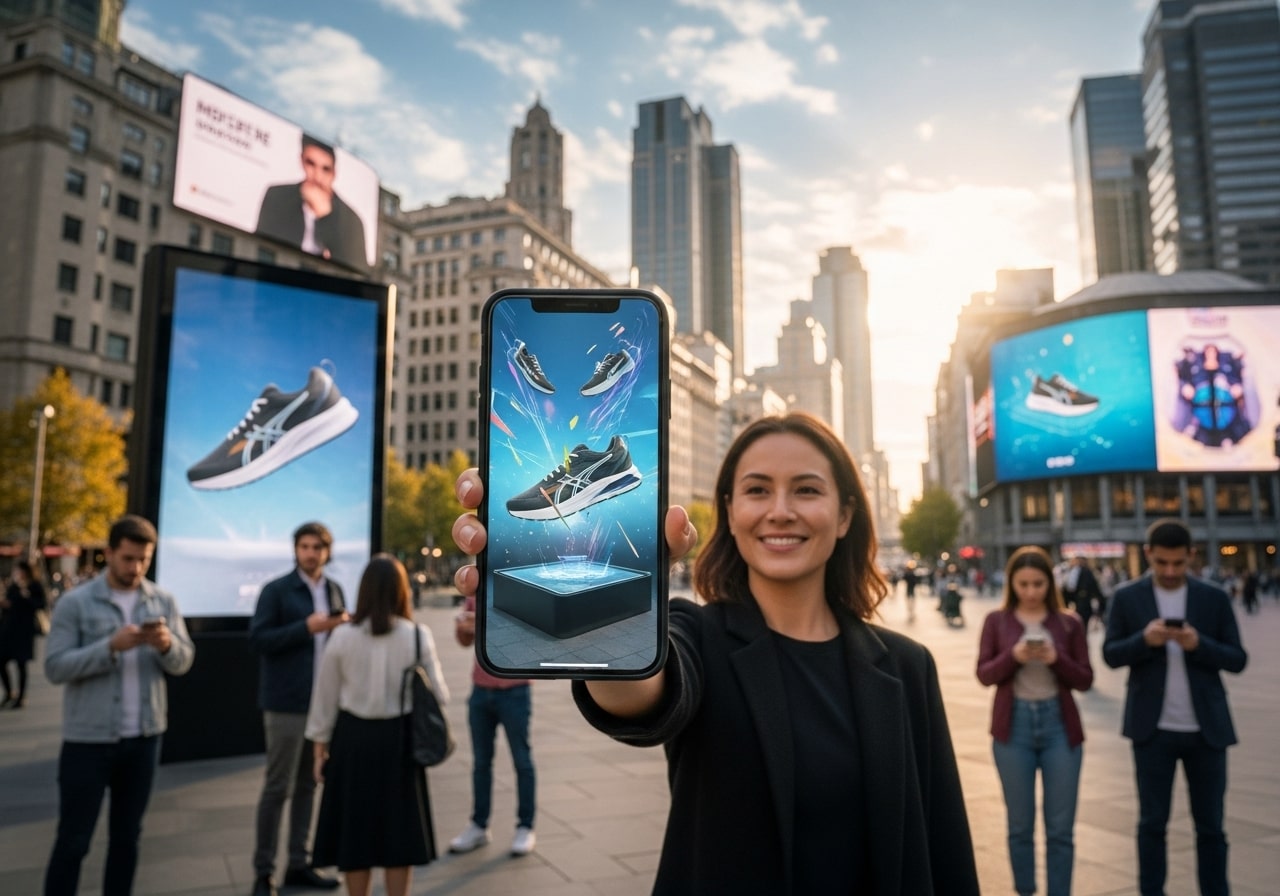
Artificial intelligence is making AR experiences more personalized and relevant. Future AR marketing will adapt in real-time based on user preferences, behavior patterns, and contextual information.
Cross-Platform Integration
AR experiences are becoming more seamless across different devices and platforms. This evolution will make it easier for businesses to create consistent AR marketing campaigns that reach customers wherever they engage with content.
Advanced Analytics and Attribution
Better measurement tools are emerging that help marketers understand the true impact of AR campaigns on customer behavior and business outcomes. These improvements will make it easier to justify AR investments and optimize campaign performance.
Getting Started With Your AR Strategy
Begin by auditing your current content to identify opportunities where AR could add value. Look for situations where customers need to visualize products, understand complex concepts, or make decisions based on how something will fit their specific needs.
Start with simple implementations using existing platforms and tools. Test different approaches with small segments of your audience to understand what resonates before scaling successful campaigns.
Most importantly, focus on creating genuine value for your customers. The most successful AR marketing doesn’t feel like marketing at all—it feels like a helpful tool that happens to showcase your brand’s expertise and products.
The Reality of AR’s Marketing Impact
Augmented reality is reshaping inbound marketing strategies by creating new possibilities for customer engagement and education. While the technology continues to evolve, the fundamental principle remains constant: successful marketing provides value to customers while building relationships with brands.
AR represents an opportunity to differentiate your brand in crowded markets by offering experiences that competitors cannot easily replicate. As the technology becomes more accessible and customers grow more comfortable with AR interactions, businesses that establish expertise now will have significant advantages over those that wait.
The question isn’t whether AR will become a standard part of marketing strategies—it’s whether your business will be ready to leverage its potential when your customers expect these interactive experiences as part of their journey with your brand.
Frequently Asked Questions (FAQ)
1. What is augmented reality (AR) in marketing?
Augmented reality in marketing uses digital elements—such as 3D objects, animations, or overlays—placed into the real world through smartphones, tablets, or AR-enabled devices. It allows customers to interact with products and content in an immersive way.
2. How does AR improve inbound marketing?
AR enhances inbound marketing by increasing engagement, improving understanding, and creating memorable experiences. Instead of passively consuming content, users actively interact with products or information, which builds stronger emotional connections and trust.
3. Do customers need special devices to use AR marketing?
Most AR marketing experiences work on standard smartphones or tablets. Many campaigns use web-based AR or social media filters, eliminating the need for specialized hardware.
4. Is AR marketing expensive to implement?
AR marketing can be affordable, especially when starting with simple tools like social media filters or template-based AR platforms. Costs vary depending on complexity, but many businesses can start small and scale over time.
5. Which industries benefit most from AR marketing?
Retail, e-commerce, real estate, education, healthcare, beauty, and automotive industries benefit greatly from AR marketing, particularly where visualization and product interaction improve decision-making.
6. Can AR help increase conversions?
Yes. AR reduces uncertainty by letting users visualize or interact with products before purchasing, which often leads to higher conversion rates and lower return rates.
7. How do you measure the success of AR marketing campaigns?
Success can be measured using engagement time, interaction rates, feature usage, conversion rates, and post-AR customer behavior. These metrics provide insights beyond traditional clicks and impressions.
8. Is AR suitable for small businesses?
Absolutely. Small businesses can use lightweight AR solutions such as Instagram or Snapchat filters, QR-based AR experiences, or simple 3D product previews to engage customers effectively.
9. How does AR fit into existing marketing strategies?
AR works best when integrated into current campaigns, enhancing product launches, educational content, or seasonal promotions rather than replacing traditional marketing efforts.
10. What is the future of AR in marketing?
The future of AR marketing includes AI-powered personalization, cross-platform experiences, improved analytics, and deeper integration with e-commerce and social media, making AR a standard tool in modern marketing strategies.