Edge computing in AR enables low-latency, intelligent, and privacy-aware augmented reality experiences. By combining local processing, AI frameworks, and ethical principles, industries achieve immersive, adaptive, and real-time AR applications that transform healthcare, retail, manufacturing, and smart city operations.
The Evolution of AR and Computing Needs
Augmented Reality (AR) has reshaped the way humans interact with digital information, bridging the gap between the physical and virtual worlds. Applications in gaming, healthcare, retail, and industrial operations increasingly demand real-time processing of massive data streams. Traditional cloud-based solutions often introduce latency that can disrupt immersive experiences, making instantaneous responsiveness difficult. This is where edge computing in AR plays a transformative role, bringing computational power closer to the user and significantly reducing delays.
The convergence of AR and advanced computing frameworks has unlocked possibilities that were once considered futuristic. AR devices now not only overlay digital objects in the real world but also interpret context, adapt to user behavior, and optimize performance dynamically. However, to meet these expectations, the underlying infrastructure must handle complex algorithms without overloading bandwidth or processing resources. Edge computing in AR addresses these challenges by processing data near its source, ensuring seamless interactions and higher efficiency.
How Edge Computing Enhances AR Performance

Reducing Latency and Improving Responsiveness
One of the biggest hurdles in AR adoption is latency. Even minimal delays can disrupt user experiences, especially in applications like surgical AR simulations or interactive industrial training. By leveraging edge computing in AR, devices can perform critical computations locally rather than relying solely on remote cloud servers. This reduces round-trip time, enabling smoother graphics rendering, faster object recognition, and real-time environmental mapping.
Furthermore, edge nodes can dynamically distribute computational workloads based on network conditions, device capabilities, and user requirements. This decentralized processing model ensures consistent performance, even when users are mobile or connected through bandwidth-limited networks.
Optimizing Data Bandwidth Usage
AR systems generate enormous amounts of data, including 3D models, sensor readings, and user interactions. Transmitting all of this to the cloud for processing is both inefficient and expensive. Edge computing in AR allows selective data processing at local nodes, sending only essential information to centralized servers when necessary. This optimization reduces network congestion and operational costs while maintaining high-quality user experiences.
For example, in AR-enhanced industrial maintenance, real-time analysis of equipment conditions can occur at the edge, enabling predictive alerts without overwhelming corporate servers. This approach aligns with modern enterprise needs where speed, accuracy, and cost-efficiency are all critical.
Enabling Intelligent AR Applications
With computation closer to the user, AR applications can become more intelligent and adaptive. By integrating frameworks such as Federated Learning in AR, devices can learn collectively from distributed datasets without compromising privacy. Edge computing nodes process local interactions, contributing to a global AI model that continuously improves performance. This capability allows AR systems to provide personalized experiences while respecting user confidentiality.
Similarly, Transfer Learning in AR benefits from edge architectures. Pre-trained AI models can be deployed to local nodes, enabling devices to adapt to specific environments or user preferences quickly. Edge computing ensures that these adaptations occur without delays, creating AR experiences that are not only immersive but context-aware and highly responsive.
Enhancing User Experience with Adaptive Interfaces
AR user interfaces must respond intuitively to human behavior. By leveraging AI Adaptive AR UX, edge-enabled devices can adjust visual overlays, notifications, and interactive elements in real time. This adaptability enhances usability in complex scenarios such as AR-assisted logistics, where workers rely on dynamic guidance to navigate warehouses or manage inventory efficiently.
Edge computing ensures that these adaptive interactions remain fluid, even in environments with inconsistent connectivity. As AR systems become smarter, the seamless collaboration between local processing and cloud integration becomes vital for delivering high-quality experiences.
Supporting Ethical and Privacy-Aware AR
As AR applications expand, so do concerns regarding data privacy and ethical AI use. Ethical AI in AR emphasizes responsible processing of user data, transparency in decision-making, and fairness in personalized experiences. Edge computing supports these principles by keeping sensitive data local whenever possible, reducing exposure to centralized servers, and ensuring compliance with privacy regulations.
In healthcare AR applications, for instance, patient-specific visualizations can be processed entirely on hospital-based edge nodes, maintaining confidentiality while enabling advanced diagnostics and training.
Use Cases Across Industries
1. Healthcare:
Surgeons and medical trainees benefit from AR overlays during procedures, supported by edge nodes that process real-time imaging and sensor inputs. Instant feedback enhances precision while safeguarding patient data.
2. Retail and E-Commerce:
In-store AR experiences can showcase virtual products in real environments. Edge nodes reduce latency, providing smoother interactive demos. Retailers exploring AI Conversational Commerce can also integrate intelligent AR assistants for personalized shopping guidance.
3. Manufacturing and Logistics:
Edge-enabled AR assists workers with assembly lines, equipment maintenance, and inventory management. Interactive guides respond instantly to user actions, improving efficiency and reducing errors.
4. Gaming and Entertainment:
High-fidelity AR gaming experiences rely on edge computing to render complex graphics and track player movements in real time, eliminating lag that could disrupt gameplay.
Technical Architectures of Edge-Enabled AR Systems
Edge Nodes and AR Devices
The backbone of edge computing in AR lies in the network of edge nodes strategically placed close to end users. These nodes—ranging from on-premises servers to localized micro data centers—handle computationally intensive tasks that were traditionally cloud-bound. AR devices, such as smart glasses or headsets, communicate directly with these nodes to offload heavy processing while maintaining minimal latency.
For example, in urban AR navigation, edge nodes can process real-time traffic data, environmental mapping, and user input without relying on distant cloud servers. This localized approach ensures that AR overlays are responsive, accurate, and reliable even in high-density urban areas.
Hybrid Cloud-Edge Models
Many AR applications benefit from a hybrid architecture, where edge computing in AR handles immediate processing while cloud servers manage large-scale data aggregation and long-term AI model training. This hybrid model balances speed and scalability, providing both real-time responsiveness and access to global insights.
Incorporating Federated Learning in AR, hybrid models allow multiple edge nodes to collaboratively train AI systems without exposing raw user data. This synergy between cloud and edge ensures AR systems evolve intelligently while preserving privacy—a key consideration in enterprise and consumer applications.
Network Optimization for Real-Time AR
Latency reduction is not just about local processing; network architecture plays a crucial role. Edge nodes are typically positioned near 5G or fiber-optic networks to ensure ultra-low latency connections. By routing AR data intelligently between devices, edge nodes, and cloud servers, system designers can minimize jitter and prevent visual lag in AR overlays.
For immersive training simulations, where split-second decisions can impact outcomes, network optimization enabled by edge computing in AR ensures that every virtual interaction is synchronized seamlessly with the real world.
AI Integration in Edge AR Systems

Contextual and Personalized Experiences
AR is no longer a static overlay of digital objects—it adapts to context, environment, and user behavior. With AI Adaptive AR UX, edge nodes process sensor inputs, environmental changes, and user interactions to deliver personalized experiences.
For instance, in retail AR, shoppers may receive product suggestions directly on smart glasses. Edge processing ensures that recommendations are updated in real time based on user location, purchase history, and current preferences. This dynamic adaptation enhances engagement without introducing latency that could disrupt the experience.
Transfer Learning and Local Adaptation
Deploying Transfer Learning in AR at edge nodes allows pre-trained AI models to adapt to new environments efficiently. Rather than retraining models centrally, localized adaptation ensures that AR systems recognize unique patterns in specific locations or user groups.
For example, an industrial AR application may encounter machinery layouts that differ from factory to factory. Edge nodes can quickly adapt visual recognition models to these variations, ensuring that guidance overlays remain precise and contextually accurate.
Ethical AI in Edge AR
As AI capabilities expand, ethical considerations become critical. Ethical AI in AR frameworks rely on edge processing to minimize privacy risks. By keeping sensitive computations local, AR systems reduce exposure to centralized databases, aligning with data protection regulations like GDPR.
In healthcare AR applications, this approach ensures that patient data is processed securely on hospital edge servers, while still enabling advanced AI-driven diagnostics. Ethical AI also guides adaptive interactions, preventing bias in personalized AR recommendations or educational content.
Emerging Applications of Edge Computing in AR
Conversational AR and AI Assistants
Edge computing supports intelligent AR assistants capable of real-time communication. By integrating AI Conversational Commerce, businesses can provide users with interactive guidance or sales support directly through AR devices.
For example, a customer in a furniture store could interact with an AR assistant that answers product questions, simulates placement in a room, and even processes purchases instantly. Edge processing ensures the conversation is fluid and responsive, without relying solely on cloud servers.
AR in Remote Collaboration
In corporate environments, edge-enabled AR facilitates real-time collaboration between remote teams. Engineers and designers can share visual data, annotate objects, and receive instant feedback. By processing video streams and 3D models at the edge, teams experience low-latency collaboration even across distant locations.
This approach complements Chatbots in B2B Marketing, where AR-assisted sales representatives can engage clients through interactive demonstrations, provide contextual insights, and support decision-making processes without delays.
Industrial and Smart City Applications
Smart factories and cities increasingly rely on AR for operational efficiency. Edge nodes process sensor inputs, IoT signals, and user interactions to deliver actionable insights. Workers equipped with AR headsets receive step-by-step guidance for complex tasks, while city planners use AR overlays to visualize infrastructure projects in real time.
By integrating edge computing in AR with predictive maintenance, environmental monitoring, and safety protocols, organizations can enhance productivity, reduce errors, and respond proactively to dynamic conditions.
Comparing Cloud vs. Edge AR Processing
| Feature | Cloud-Only AR | Edge-Enabled AR |
|---|---|---|
| Latency | Higher, depends on network | Ultra-low, local processing |
| Bandwidth Usage | High, sends all data to cloud | Optimized, selective data transfer |
| Privacy | Centralized, higher exposure risk | Local processing, better data privacy |
| AI Adaptation | Slow, requires retraining in cloud | Fast, supports transfer learning locally |
| Real-Time Responsiveness | Limited by network | High, seamless user experience |
This table highlights how edge computing in AR outperforms traditional cloud-only approaches, particularly for latency-sensitive applications.
Future Trends in Edge Computing for AR

5G and Beyond: Unlocking Next-Level AR Experiences
The synergy between edge computing in AR and 5G networks is redefining immersive experiences. Ultra-low latency, high bandwidth, and edge-enabled processing allow AR devices to render complex environments in real time without depending solely on powerful local hardware.
With edge computing in AR, applications like collaborative industrial design and live AR sports overlays benefit from instant processing of high-resolution video, sensor data, and AI computations. As networks evolve toward 6G, edge computing in AR will support multi-user holographic experiences and advanced real-time AI simulations previously considered impossible.
Integration with IoT and Smart Environments
AR experiences become richer when integrated with IoT ecosystems. Sensors in industrial machinery, smart homes, and public infrastructure produce continuous data streams. Edge computing in AR ensures this data is analyzed locally, enabling real-time interactions and immediate feedback.
For example, AR maintenance applications can monitor machinery, predict failures, and provide technicians with visual overlays—all through edge computing in AR, ensuring sensitive data remains secure while boosting operational efficiency. This approach naturally complements Ethical AI in AR principles.
Advanced AI Capabilities at the Edge
Edge-enabled AR systems are increasingly incorporating sophisticated AI frameworks, such as Federated Learning in AR, to improve personalization and predictive insights. Localized model training at edge nodes allows devices to learn from user interactions without sharing raw data. With edge computing in AR, these adaptive systems evolve dynamically while maintaining low latency and high contextual relevance.
Moreover, Transfer Learning in AR deployed at edge nodes ensures AI models can quickly adjust to new environments or devices. Edge computing in AR guarantees that these updates occur in real time, supporting intelligent, responsive AR applications across industries.
Performance Benchmarks and Metrics
Measuring Latency and Responsiveness
Performance metrics are essential for evaluating the impact of edge computing in AR. Key indicators include:
-
Frame rendering time, ensuring smooth overlays without stutter
-
Object recognition latency, measuring real-time responsiveness
-
Network round-trip time, critical for cloud-edge hybrid architectures
By using edge computing in AR, applications consistently achieve lower latency and higher responsiveness compared to cloud-only solutions, enhancing user experiences in gaming, training, and industrial scenarios.
Bandwidth Efficiency and Data Management
Edge computing in AR optimizes network efficiency by processing data locally and sending only essential information to the cloud. Metrics to track include:
-
Percentage reduction in data transfer
-
Edge node CPU/GPU utilization
-
System throughput and scalability
These metrics demonstrate how edge computing in AR enables high-performance applications that are both cost-efficient and scalable for enterprise deployment.
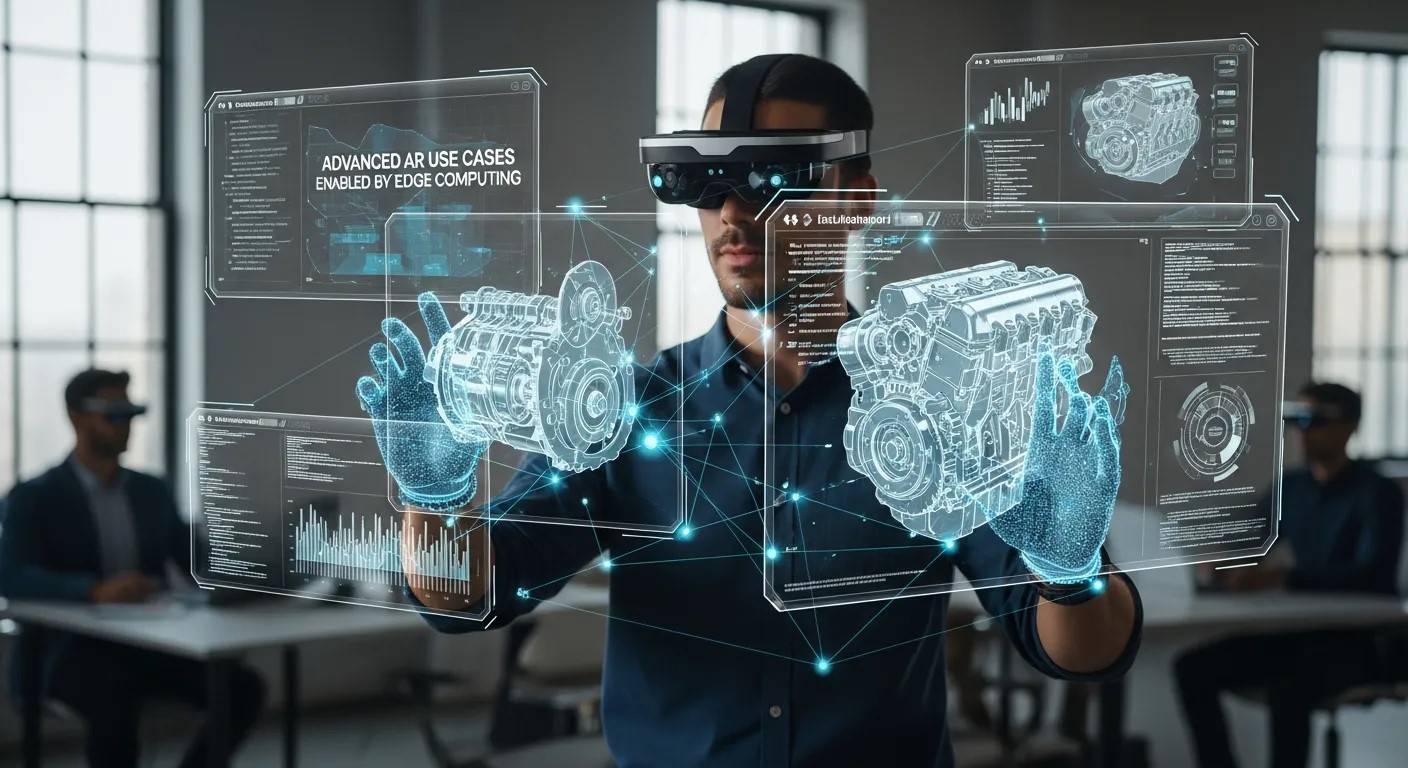
Advanced AR Use Cases Enabled by Edge Computing
Retail and Conversational Commerce
Retailers leverage edge computing in AR to power AI Conversational Commerce, offering instant interactive guidance and personalized experiences. Customers can virtually try products, receive contextual recommendations, and interact with intelligent assistants—without perceptible lag.
Edge processing ensures that AR overlays are smooth and responsive, while AI conversational engines adapt recommendations dynamically. This approach creates highly engaging, real-time retail experiences.
Industrial Training and Remote Guidance
Workforce training is transformed by edge computing in AR. Trainees interact with AR overlays showing detailed schematics and procedural steps, while supervisors provide instant remote guidance.
By combining AI Adaptive AR UX with edge processing, training systems adapt to individual skill levels and environmental variables. Edge computing in AR ensures these adjustments occur in real time, maximizing learning outcomes and operational efficiency.
Healthcare and Medical Applications
In healthcare, AR overlays assist surgeons and trainees in real-time procedures. Edge computing in AR ensures critical imaging and data analysis occurs locally, preserving privacy and reducing latency.
Ethical AI in AR frameworks work hand-in-hand with edge nodes, enabling sensitive data to remain secure while allowing adaptive, context-aware guidance during surgeries or diagnostics.
Smart Cities and Urban Planning
Smart cities employ edge computing in AR to process real-time environmental data, traffic patterns, and IoT signals, delivering actionable insights to planners and citizens.
AR overlays enable urban planning simulations, infrastructure monitoring, and public engagement. By leveraging edge computing in AR, cities achieve dynamic responsiveness, predictive insights, and privacy-conscious data management, reshaping urban living.
AR Applications Leveraging Edge Computing
| Industry | Use Case | Edge Benefits | AI Integration |
|---|---|---|---|
| Retail | Virtual try-ons | Reduced latency, seamless UX | AI Conversational Commerce |
| Manufacturing | Equipment maintenance | Real-time guidance, error reduction | AI Adaptive AR UX |
| Healthcare | Surgery overlays | Immediate processing, privacy | Ethical AI in AR |
| Smart Cities | Urban monitoring | Localized analytics, predictive insights | Federated Learning in AR |
| Education | Interactive labs | Adaptive training, low-latency simulation | Transfer Learning in AR |
Conclusion
Edge computing in AR is transforming the way augmented reality applications operate, delivering low-latency, high-performance, and privacy-conscious experiences across industries. By processing data closer to users, edge nodes enable real-time responsiveness for healthcare, retail, industrial, and smart city applications. Advanced AI integrations, including Federated Learning in AR, Transfer Learning in AR, and AI Adaptive AR UX, enhance personalization and predictive capabilities. Ethical frameworks ensure secure and responsible deployment, while AI Conversational Commerce and Chatbots in B2B Marketing illustrate practical business applications. As network infrastructures evolve, edge computing in AR will remain central to scalable, intelligent, and immersive experiences.
Frequently Asked Questions (FAQs)
What is edge computing in AR?
Edge computing in AR refers to processing data locally on devices or nearby nodes, reducing latency and enabling real-time AR interactions without relying solely on cloud servers.
How does edge computing enhance AR performance?
By offloading processing to local edge nodes, AR systems achieve faster rendering, improved responsiveness, lower bandwidth usage, and better privacy compliance.
What industries benefit most from edge computing in AR?
Healthcare, retail, manufacturing, smart cities, and education benefit significantly due to latency-sensitive operations and the need for adaptive, context-aware AR applications.
How is AI integrated with edge computing in AR?
AI frameworks like Federated Learning in AR, Transfer Learning in AR, and AI Adaptive AR UX run on edge nodes to deliver intelligent, personalized, and privacy-aware AR experiences.
What future trends will impact edge computing in AR?
Integration with 5G/6G, IoT ecosystems, ethical AI frameworks, and conversational AR interfaces will further enhance scalability, intelligence, and real-time adaptability.