How Augmented Reality Is Blending Into Real Life
Augmented Reality is no longer confined to experimental labs, gaming demos, or short-lived marketing gimmicks. In today’s experience-first digital economy, Augmented Reality Use Cases are actively influencing how people live, learn, work, and make decisions. What once felt futuristic is now becoming part of everyday environments, reshaping real lives in practical and measurable ways.
Modern users expect technology to feel invisible, intuitive, and genuinely helpful rather than complex or distracting. This shift in new-generation human psychology has accelerated the adoption of AR-powered solutions across industries where clarity, engagement, and real-time context matter most. From homes and cities to healthcare and emotional well-being, these applied AR scenarios are turning into functional layers of reality rather than visual novelty.
Understanding real-world AR implementation today means recognizing how digital intelligence blends with physical environments to solve meaningful problems. This is why adoption is no longer driven by curiosity alone, but by efficiency, value creation, and human-centered design principles.
The Evolution of Practical AR Applications
Early AR experiences focused mainly on visual overlays without contextual awareness. While impressive at first glance, those early implementations lacked persistence, adaptability, and emotional relevance. As a result, many initial Augmented Reality Use Cases struggled to sustain long-term engagement.
Today, applied AR has evolved into intelligent, context-aware systems supported by artificial intelligence, spatial computing, and real-time data Analysis. Modern solutions understand environments, anticipate intent, and adapt content dynamically based on user behavior. This evolution has transformed AR from a curiosity-driven technology into a problem-solving interface.
The shift is subtle but powerful. Instead of forcing people to learn new systems, today’s AR adapts naturally to human behavior, surroundings, and expectations.
How Augmented Reality Works in Everyday Environments
To understand why these implementations have such real impact, it helps to briefly look at how AR functions in real-world conditions. AR systems gather input through cameras, sensors, and spatial data. Artificial intelligence then interprets surfaces, objects, depth, and motion in real time.
Once the environment is understood, digital elements are anchored to the physical world and respond to lighting, movement, and interaction. This foundation allows Augmented Reality Use Cases to support tasks that require precision, trust, and consistency in live settings.
Augmented Reality in Smart Homes
One of the fastest-growing adoption areas is Augmented Reality in Smart Homes, where AR enhances control, clarity, and convenience. Instead of navigating complex apps, residents visualize information directly inside their living spaces.
Energy usage, device setup guidance, and furniture placement previews become spatially intuitive. These AR-driven home experiences reduce friction and empower users to make informed decisions without technical complexity.
Healthcare and Patient-Centered AR Experiences
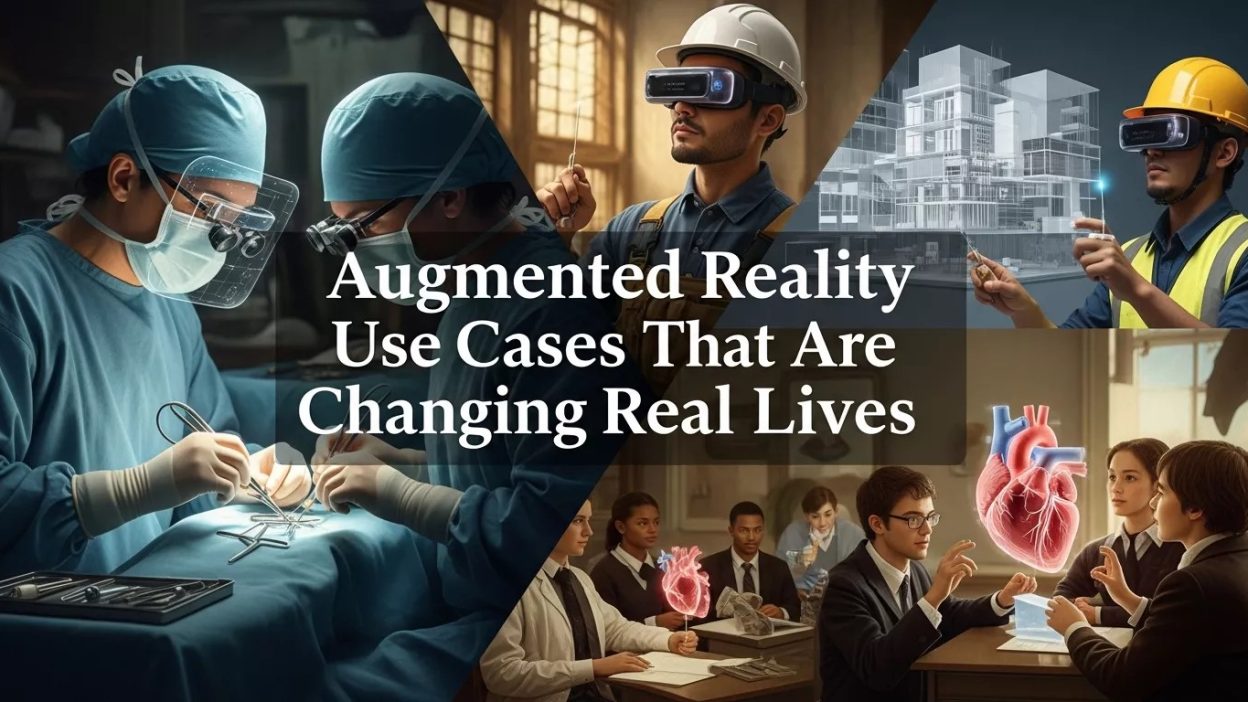
Healthcare represents one of the most meaningful application domains. AR supports medical training, diagnostics, and patient education while improving accuracy and communication.
Doctors visualize anatomy in three dimensions, nurses receive procedural guidance, and patients better understand treatment plans through interactive overlays. These Augmented Reality Use Cases help reduce errors, improve engagement, and enhance outcomes.
Rehabilitation and therapy programs also benefit from guided AR exercises with real-time feedback, keeping patients motivated during recovery.
Augmented Reality and Mental Health Support

A growing and sensitive application area is Augmented Reality and Mental Health, where AR is explored as a supportive and non-invasive tool. These implementations focus on exposure therapy, stress reduction, mindfulness, and emotional regulation.
Controlled simulations help manage anxiety, while calming visual cues and breathing guidance integrate seamlessly into real environments. Rather than replacing human care, AR-based mental health tools complement it naturally.
Learning and Education Through AR
Education has embraced AR to move beyond passive learning. Interactive visualization helps students explore complex concepts through direct experience.
Science experiments, historical reconstructions, and adaptive learning paths improve retention and engagement. These learning-focused Augmented Reality Use Cases align with how the brain processes spatial and visual information, making education more intuitive.
Augmented Reality in Urban Planning
Augmented Reality in Urban Planning allows architects, planners, and communities to visualize future developments before construction begins. Stakeholders explore proposed infrastructure at real scale within real environments.
This approach improves transparency, collaboration, and decision-making. Potential issues can be identified early, reducing costly revisions and increasing public trust.
Augmented Reality for Smart Cities
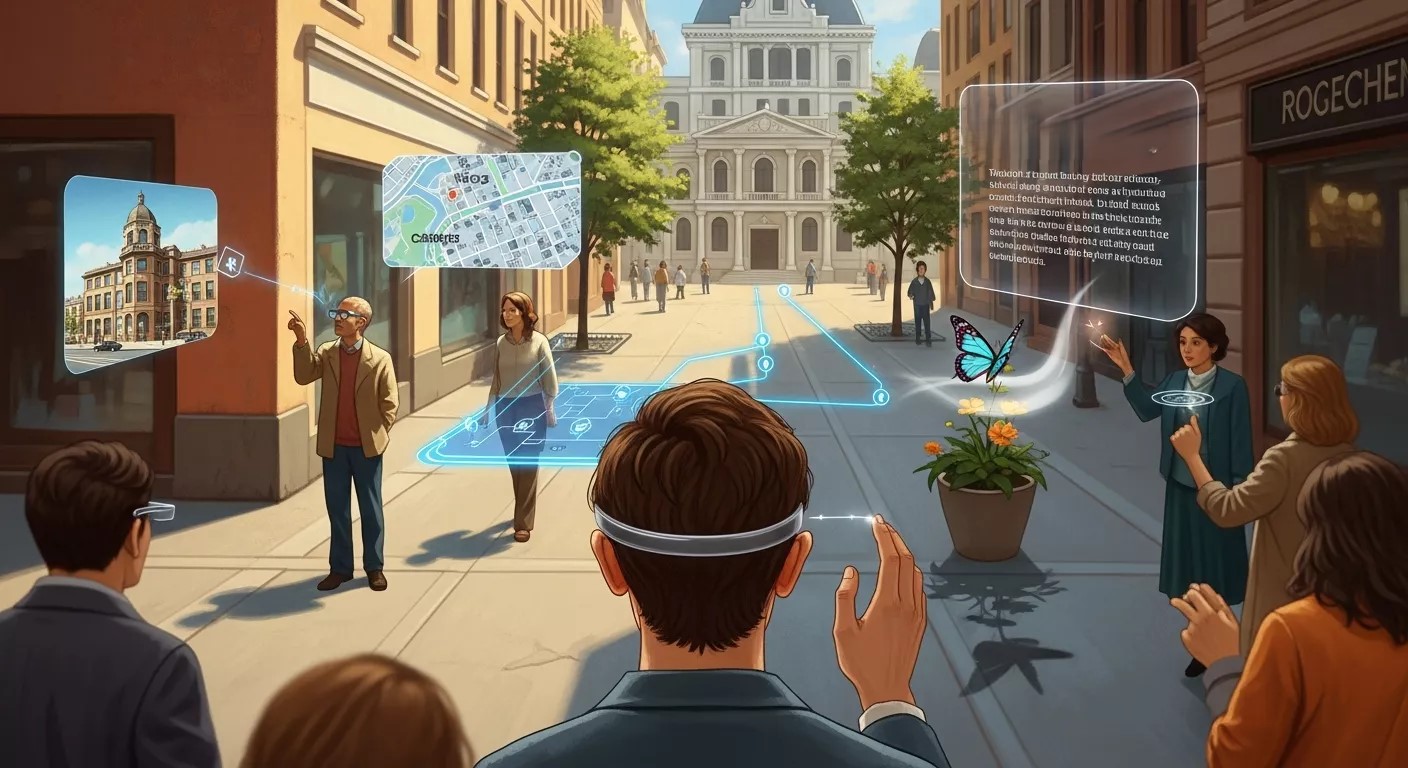
Closely related is Augmented Reality for Smart Cities, where AR becomes an interface for complex urban data. Traffic flow, environmental metrics, public services, and emergency systems are visualized directly within city spaces.
Citizens receive contextual guidance, while field workers access infrastructure data in real time. These Augmented Reality Use Cases help cities become more navigable, responsive, and human-centric.
Retail, Commerce, and Consumer Confidence
Retail is one of the most visible domains of AR adoption. Virtual try-ons, interactive product previews, and immersive packaging experiences help consumers make confident choices.
By experiencing products in context, customers reduce uncertainty, lower return rates, and build stronger trust with brands.
AR in the Enterprise and Workforce Enablement
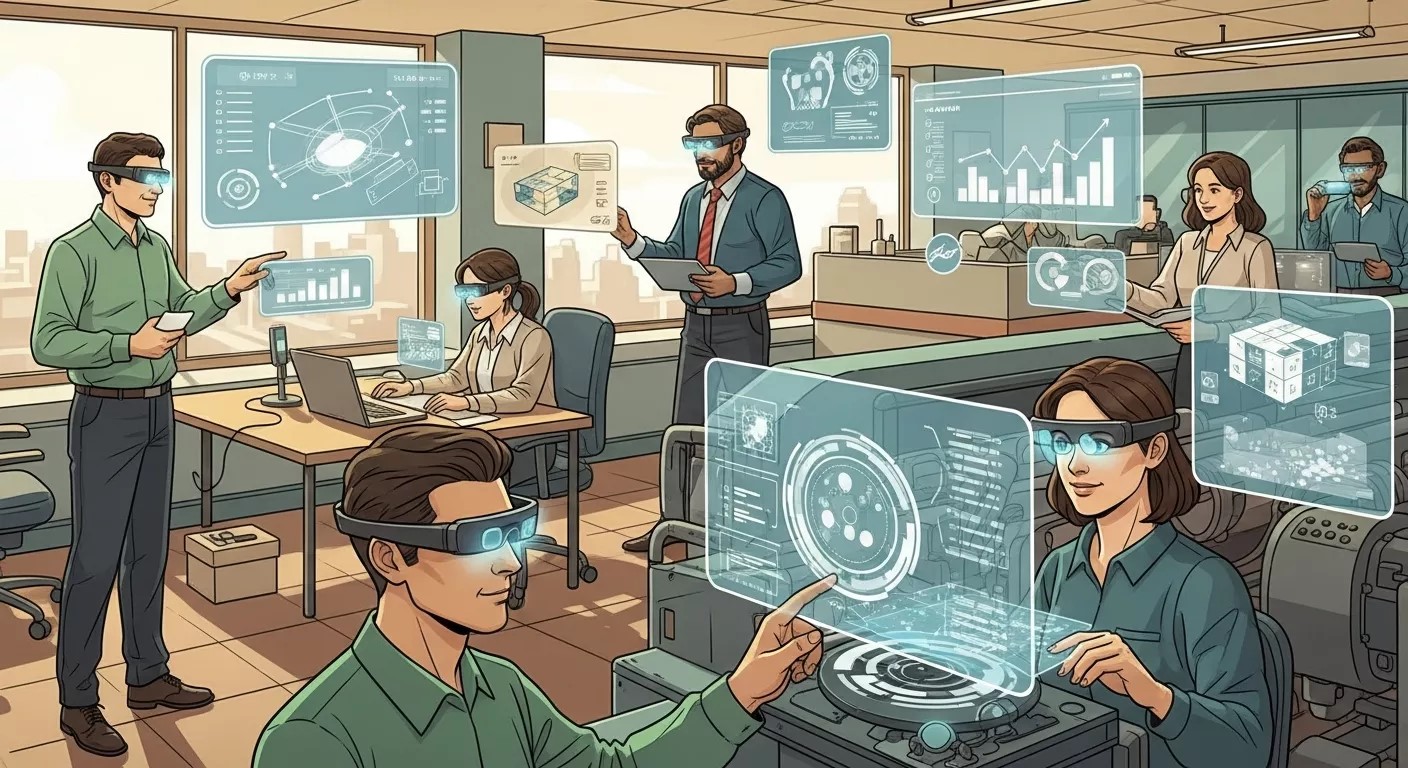
In professional environments, AR improves efficiency and collaboration. Workers receive contextual instructions, remote assistance, and live feedback without interrupting workflows.
Manufacturing, logistics, and maintenance benefit from hands-free guidance that reduces errors and training time. These enterprise-focused Augmented Reality Use Cases enhance human capability rather than replacing it.
The Psychology Behind AR Adoption
The success of AR is deeply connected to human psychology. Presenting information exactly where it is needed reduces cognitive load and increases focus.
When technology feels supportive instead of intrusive, adoption becomes natural. This psychological alignment explains why practical AR solutions achieve long-term usage rather than short-term novelty.
Ethics, Trust, and Responsible AR Design
As AR becomes more integrated into daily life, ethical considerations grow. Visual and spatial data must be handled with transparency and consent.
Responsible design builds trust, especially in sensitive areas like healthcare, education, and emotional well-being. Sustainable adoption depends on ethical implementation.
The Growing Influence
From individual decision-making to city-scale systems, Augmented Reality Use Cases are reshaping how humans interact with information. AR is no longer a separate digital layer but an extension of reality itself.
As technology matures, these applications will become more personalized, intelligent, and deeply embedded. Their true power lies not in visual effects, but in supporting human understanding and real-world action.
Real-Time Decision Making
One of the strongest advantages of modern AR systems is their ability to support real-time decision-making. Augmented Reality Use Cases in this area focus on delivering the right information at the exact moment it is needed.
In fast-moving environments such as healthcare, logistics, emergency response, and industrial operations, delayed information can lead to costly mistakes. Augmented Reality Use Cases solve this by overlaying live data directly onto the physical environment. Users do not need to pause, switch screens, or interpret abstract dashboards.
By embedding insights into real-world context, Augmented Reality Use Cases reduce hesitation, improve accuracy, and increase confidence during critical moments.
Customer Support and Service Experience
Customer support is evolving from reactive problem-solving to proactive experience management. Augmented Reality Use Cases play a major role in this transition by enabling visual guidance and contextual assistance.
Through AR-powered support, customers can point their device at a product and receive instant visual instructions. Support teams can guide users remotely by seeing what they see and overlaying solutions in real time. These Augmented Reality Use Cases reduce frustration, shorten resolution time, and lower support costs.
More importantly, Augmented Reality Use Cases transform customer service into an empowering experience rather than a stressful one.
Product Design and Prototyping
Product design traditionally requires multiple iterations, physical prototypes, and long feedback cycles. Augmented Reality Use Cases simplify this process by allowing designers and stakeholders to visualize products in real-world scale before production.
Teams can explore materials, dimensions, and usability within actual environments. Design flaws are identified earlier, reducing waste and development costs. These Augmented Reality Use Cases also improve collaboration, as non-technical stakeholders can understand designs intuitively.
By shortening feedback loops, Augmented Reality Use Cases accelerate innovation while improving design quality.
Data Visualization and Analytics
Raw data alone rarely leads to understanding. Augmented Reality Use Cases in data visualization convert complex datasets into spatial, visual experiences that humans can grasp quickly.
Instead of reading charts on screens, users see trends, patterns, and anomalies mapped onto real-world environments. These Augmented Reality Use Cases are especially valuable in operations management, urban analytics, and scientific research.
By aligning data with physical context, Augmented Reality Use Cases reduce cognitive overload and improve insight-driven decision-making.
Safety, Compliance, and Risk Reduction
Safety-focused implementations represent some of the most practical Augmented Reality Use Cases today. AR can highlight hazards, display compliance instructions, and guide users through safe procedures in real time.
In construction sites, factories, and laboratories, Augmented Reality Use Cases help prevent accidents by making invisible risks visible. Workers receive warnings, checklists, and guidance without breaking focus.
These Augmented Reality Use Cases demonstrate how AR directly protects lives while improving operational discipline.
Personalized User Experiences
Personalization is no longer optional in digital experiences. Augmented Reality Use Cases excel at delivering personalization because they adapt content based on environment, behavior, and context.
From customized learning paths to location-aware recommendations, ensure that users receive relevant information rather than generic content. This adaptive behavior aligns with modern expectations of speed and relevance.
Personalized Augmented Reality Use Cases increase engagement, satisfaction, and long-term adoption.
Bridge Between Physical and Digital Worlds

At a strategic level, all successful Augmented Reality Use Cases serve one core purpose: bridging the gap between physical reality and digital intelligence.
Instead of forcing users to enter digital spaces, AR brings digital understanding into physical environments. This shift changes how people perceive technology—not as a separate tool, but as an invisible assistant.
These foundational signal a long-term transformation in how humans interact with information.
Conclusion
Augmented Reality has moved beyond novelty and entered everyday life through practical, human-focused applications. Today’s Augmented Reality use cases are improving how people learn, heal, navigate, work, and interact with their environments in meaningful ways.
As AR continues to integrate intelligence, spatial awareness, and ethical design, its real value lies in simplifying complexity and supporting better decisions. The future of technology belongs to experiences that feel natural—and augmented reality is shaping that future, one real-life use case at a time.
Frequently Asked Questions (FAQ)
What are Augmented Reality Use Cases in simple terms?
Augmented Reality Use Cases refer to real-world applications where digital information is layered onto physical environments to enhance understanding, decision-making, or interaction. These use cases go beyond visuals and focus on solving practical human problems through context-aware experiences.
How are Augmented Reality Use Cases different from Virtual Reality?
Virtual Reality creates a fully digital environment that replaces the real world, while Augmented Reality Use Cases enhance the real world by adding digital elements on top of it. AR keeps users grounded in reality while improving perception and understanding.
Why are Augmented Reality Use Cases growing so fast today?
The growth is driven by improved mobile hardware, AI-powered software, and changing user psychology. Modern users prefer intuitive, real-time assistance, and Augmented Reality Use Cases deliver value without forcing users to leave their physical environment.
How do Augmented Reality Use Cases impact everyday life?
From navigation and shopping to learning and healthcare, Augmented Reality Use Cases make information more accessible and actionable. They reduce confusion, save time, and help users make better decisions in real-world situations.
Are Augmented Reality Use Cases expensive to implement?
The cost depends on complexity and scale. Web-based and mobile AR solutions have significantly lowered entry barriers. Many Augmented Reality Use Cases can now be implemented incrementally without large infrastructure investments.
How are Augmented Reality Use Cases used in healthcare?
In healthcare, AR supports training, diagnostics, rehabilitation, and patient education. Augmented Reality Use Cases help medical professionals visualize complex data and assist patients in understanding treatments more clearly and confidently.
Can Augmented Reality Use Cases support mental health and well-being?
Yes. Augmented Reality Use Cases are being explored for exposure therapy, mindfulness, stress reduction, and emotional regulation. AR integrates supportive experiences into real environments, making mental health tools feel less intrusive and more human.
What role does AI play in modern Augmented Reality Use Cases?
AI enables environment recognition, intent prediction, personalization, and real-time adaptation. Without AI, many advanced Augmented Reality Use Cases would lack accuracy, responsiveness, and contextual relevance.
Are Augmented Reality Use Cases safe in terms of privacy?
Privacy depends on responsible design. Ethical Augmented Reality Use Cases prioritize data minimization, transparency, and user consent. Trust-focused platforms are essential for long-term adoption, especially in sensitive sectors.
How do Augmented Reality Use Cases help education and learning?
AR transforms abstract concepts into interactive experiences. Augmented Reality Use Cases improve engagement, retention, and curiosity by aligning with visual and spatial learning patterns rather than passive content consumption.
Will Augmented Reality Use Cases replace traditional interfaces?
Rather than replacing interfaces, AR complements them. Augmented Reality Use Cases reduce dependency on screens by embedding information directly into environments, creating more natural and efficient interactions.
What is the future potential of Augmented Reality Use Cases?
Future Augmented Reality Use Cases will be more intelligent, persistent, and personalized. As AR blends seamlessly into daily life, it will become a foundational layer of human–technology interaction rather than a standalone feature.