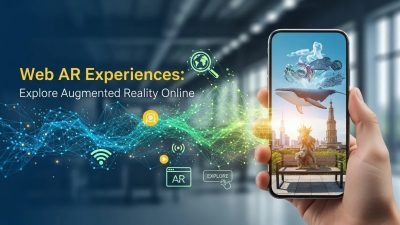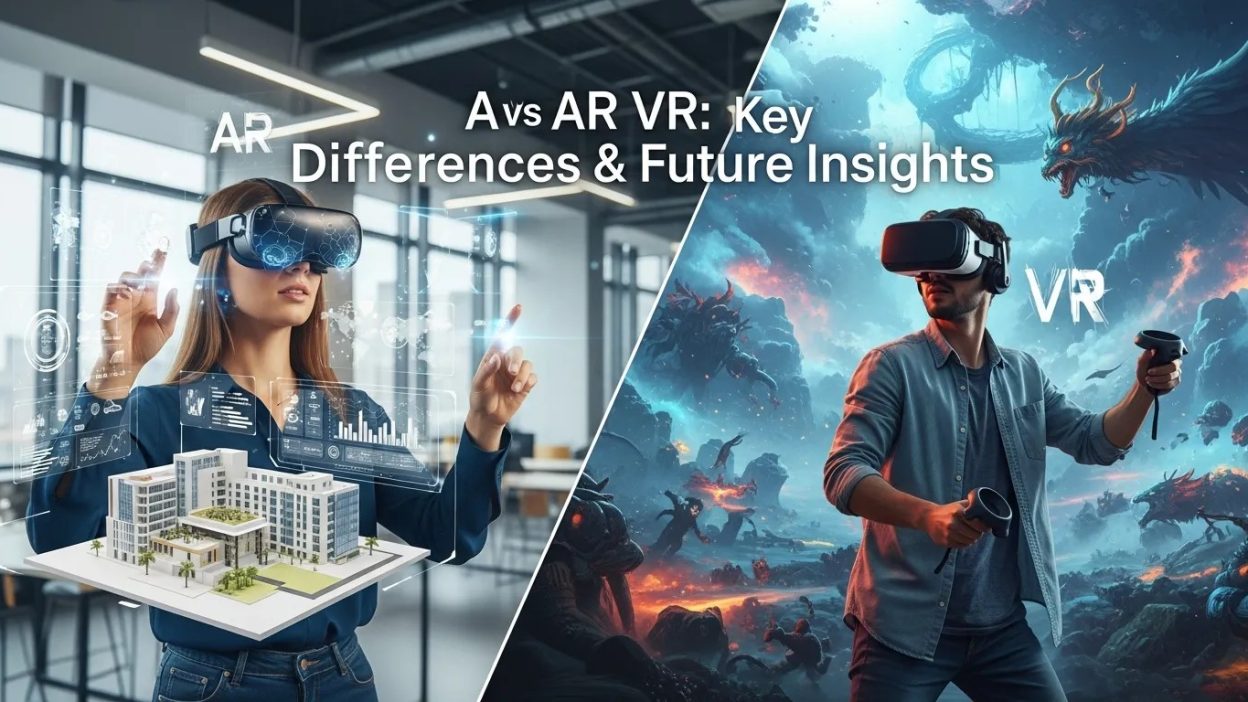
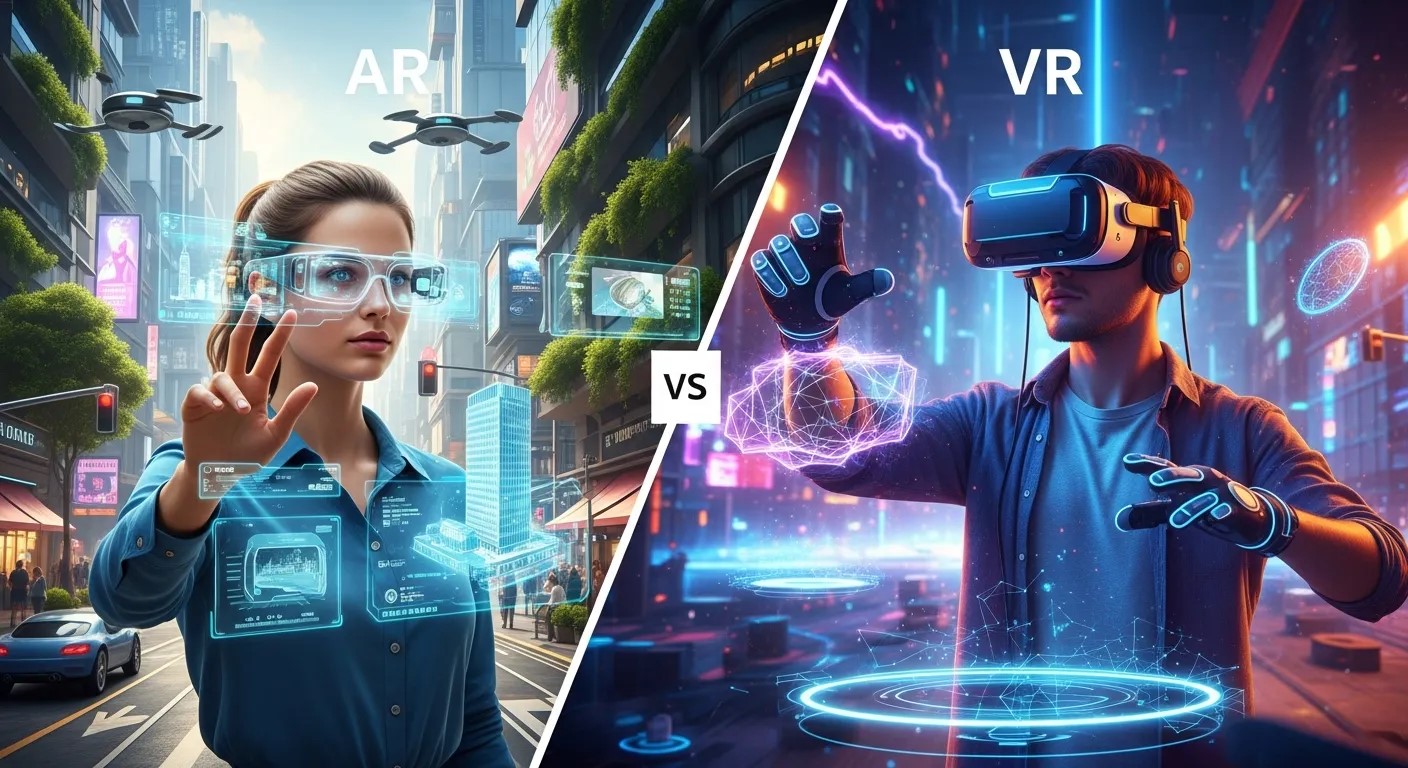
AR vs VR shapes immersive experiences across industries. AR overlays digital content onto reality, while VR offers full immersion. Together with AI and wearables, these technologies transform entertainment, education, healthcare, and business operations, creating interactive, engaging, and efficient solutions.
AR vs VR: Key Differences & Future Insights
The world of immersive technology has grown at an unprecedented pace over the past decade, reshaping how we interact with digital content. Among the most discussed technologies are AR vs VR, two terms that often get used interchangeably but represent fundamentally different experiences. Understanding the distinction between AR vs VR is crucial for businesses, educators, and tech enthusiasts alike, as the applications of these technologies span entertainment, education, and professional environments.
What is Augmented Reality (AR)?
Augmented Reality (AR) overlays digital information onto the real world, enhancing the environment rather than replacing it entirely. Through devices like smartphones, tablets, and AR glasses, users can interact with virtual objects while remaining aware of their surroundings. One of the most exciting applications of AR is AR in Music Festivals, where attendees can experience interactive stage visuals, real-time artist information, and immersive light shows that synchronize with live performances. This integration creates a unique blend of the physical and digital worlds, offering new dimensions of engagement.
AR has also made strides in AR Hologram Technology, which allows users to visualize three-dimensional holograms that interact with their real-world environment. Imagine attending a product launch where a holographic model of a new car appears in your living room, letting you examine every angle without stepping into a showroom. This technology is transforming marketing, education, and entertainment, demonstrating the versatility of AR applications.
What is Virtual Reality (VR)?
Virtual Reality, on the other hand, immerses users in a completely digital environment, shutting out the real world entirely. Users wear VR headsets to enter a fully interactive space, whether it’s a virtual classroom, a video game, or a simulated workplace scenario. While VR offers a highly engaging and controlled experience, it requires specialized hardware and dedicated spaces, making it more intensive than AR.
VR is particularly popular in gaming and simulation-based training. However, its potential in education and professional development is also being explored. Unlike AR, VR does not augment reality but creates a separate digital reality, which can be tailored to specific experiences, from exploring historical landmarks to simulating complex surgical procedures.
Key Differences Between AR and VR
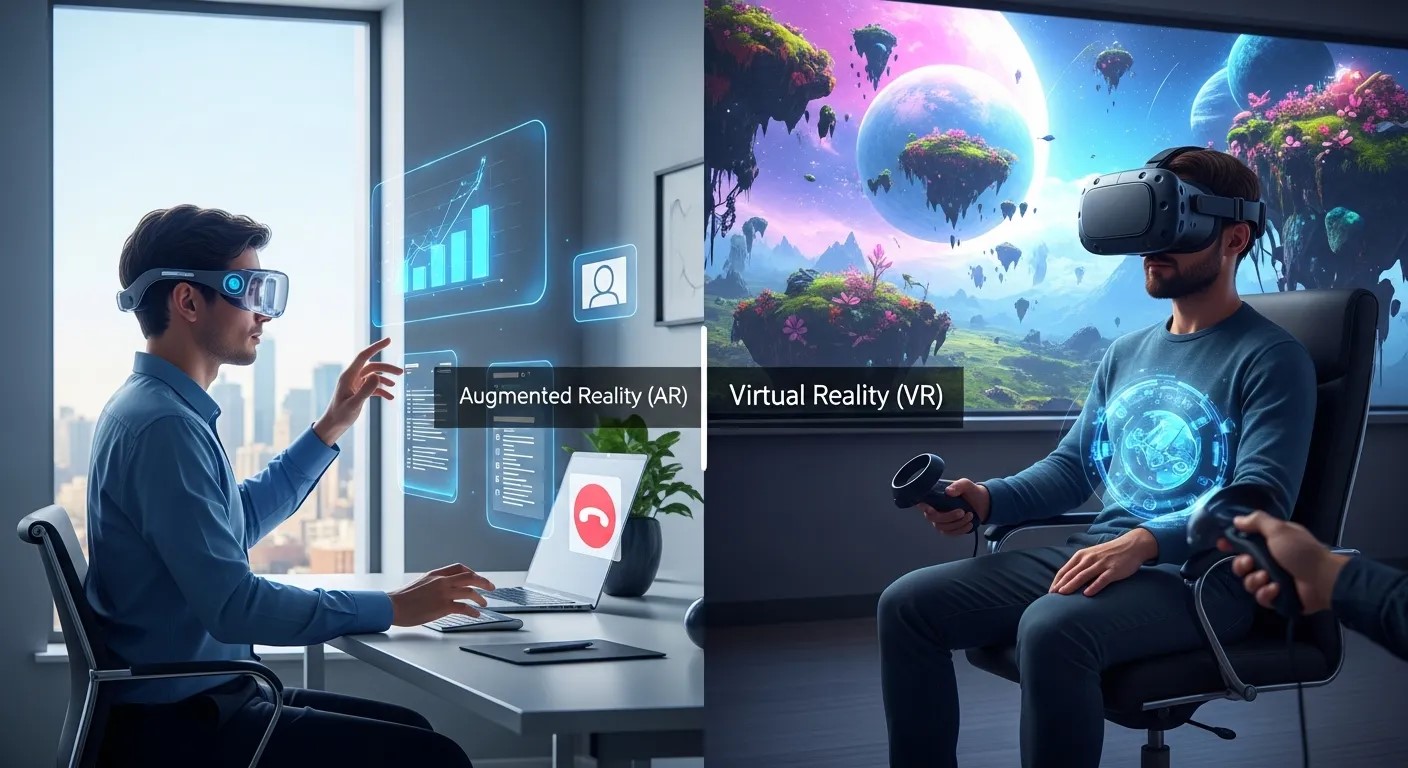
Understanding AR vs VR comes down to the distinction between enhancement and immersion:
| Feature | Augmented Reality (AR) | Virtual Reality (VR) |
|---|---|---|
| Environment | Real world enhanced with digital overlays | Fully digital, immersive world |
| Device Requirement | Smartphones, tablets, AR glasses | VR headsets, motion controllers |
| User Awareness | User remains aware of surroundings | User is fully immersed, unaware of real-world |
| Common Uses | Retail, healthcare, marketing, live events | Gaming, training simulations, virtual tours |
| Interaction | Adds elements to reality | Entirely virtual interaction |
This table helps clarify why businesses and developers often choose AR for applications that require real-world engagement, such as AR Glasses Benefits in workplace productivity or navigation. VR, by contrast, is ideal for situations demanding full immersion, such as architectural walkthroughs or skill training simulations.
Applications in Business and Operations
When considering AR in Business Operations, companies leverage AR to optimize workflows, reduce errors, and enhance training programs. Employees can use AR-enabled devices to access digital manuals overlaid onto physical machinery, receive step-by-step instructions, or even collaborate remotely with experts via live AR annotations. This technology improves efficiency and ensures knowledge retention, especially in complex operational environments.
Moreover, AR can complement Voice Enabled Chatbots and AI Multilingual Bots within business ecosystems. For instance, a warehouse worker could receive voice instructions from an AI assistant while viewing AR overlays that guide them through storage and retrieval tasks. This combination of auditory and visual input enhances learning and minimizes operational errors, providing a seamless human-computer interaction experience.
AR vs VR in Education and Training
Both AR and VR have distinct advantages in education and professional training. AR vs VR debates often center on the balance between accessibility and immersion. AR allows students to interact with digital layers on textbooks, lab equipment, or museum exhibits, enriching their understanding without removing them from the real world. Meanwhile, VR can simulate real-world scenarios that would be too risky, expensive, or logistically impossible, such as virtual chemistry labs or historical reenactments.
Incorporating AR technologies into classrooms, alongside AI-driven tools like AI Multilingual Bots, ensures that learning is inclusive and adaptive. For example, students speaking different languages can receive real-time translation and contextual AR visuals, making lessons more interactive and accessible.
AR vs VR in Entertainment
Entertainment is another sector where AR vs VR showcases its potential. AR experiences, including AR in Music Festivals, provide interactive visuals, social engagement features, and location-based games, enhancing the event experience without removing attendees from the environment. VR experiences, in contrast, transport users into fully immersive games or cinematic experiences, creating a sense of presence that traditional media cannot match.
Furthermore, the development of AR holograms and wearable devices is enabling hybrid entertainment formats, where audiences can experience content both in-person and digitally, merging the best aspects of AR and VR. This trend is likely to grow as hardware becomes more affordable and accessible.
AR vs VR in Healthcare
The healthcare sector is one of the most promising areas for AR vs VR applications. Augmented Reality allows surgeons to overlay digital scans directly onto a patient during surgery, providing real-time guidance that can reduce errors and improve outcomes. With AR Glasses Benefits, medical professionals can view critical information hands-free, enhancing precision without interrupting their workflow.
Virtual Reality, on the other hand, offers immersive simulations for training medical students and practicing complex procedures. By creating controlled digital environments, VR reduces risks and allows repeated practice of high-stakes scenarios. Comparing AR vs VR in healthcare shows that while AR enhances real-world interactions, VR offers a safe space for experimentation and skill-building.
Additionally, integrating Voice Enabled Chatbots into healthcare workflows can improve patient engagement. Patients can receive post-operative instructions, medication reminders, or even virtual consultations, combining voice AI with AR overlays to create a more interactive and supportive care experience.
AR vs VR in Retail and Marketing
Retail and marketing are areas where AR vs VR technologies provide tangible business value. Augmented Reality can bring products to life in a customer’s environment. For example, furniture retailers now allow buyers to place digital versions of sofas or tables in their homes before purchase, helping customers make confident decisions. Similarly, AR holograms in stores can showcase product features in an engaging and interactive way, blending digital storytelling with physical shopping experiences.
VR, by contrast, enables immersive shopping experiences from home. Users can explore virtual stores, try on clothing in simulated fitting rooms, or attend exclusive virtual product launches. The difference in AR vs VR application here is clear: AR bridges the gap between online and offline, while VR creates entirely new digital shopping realms.
Moreover, AI-powered solutions such as AI Multilingual Bots can guide international customers through these experiences, translating product details and assisting with navigation, which enhances accessibility and user satisfaction.
AR vs VR in Travel and Tourism
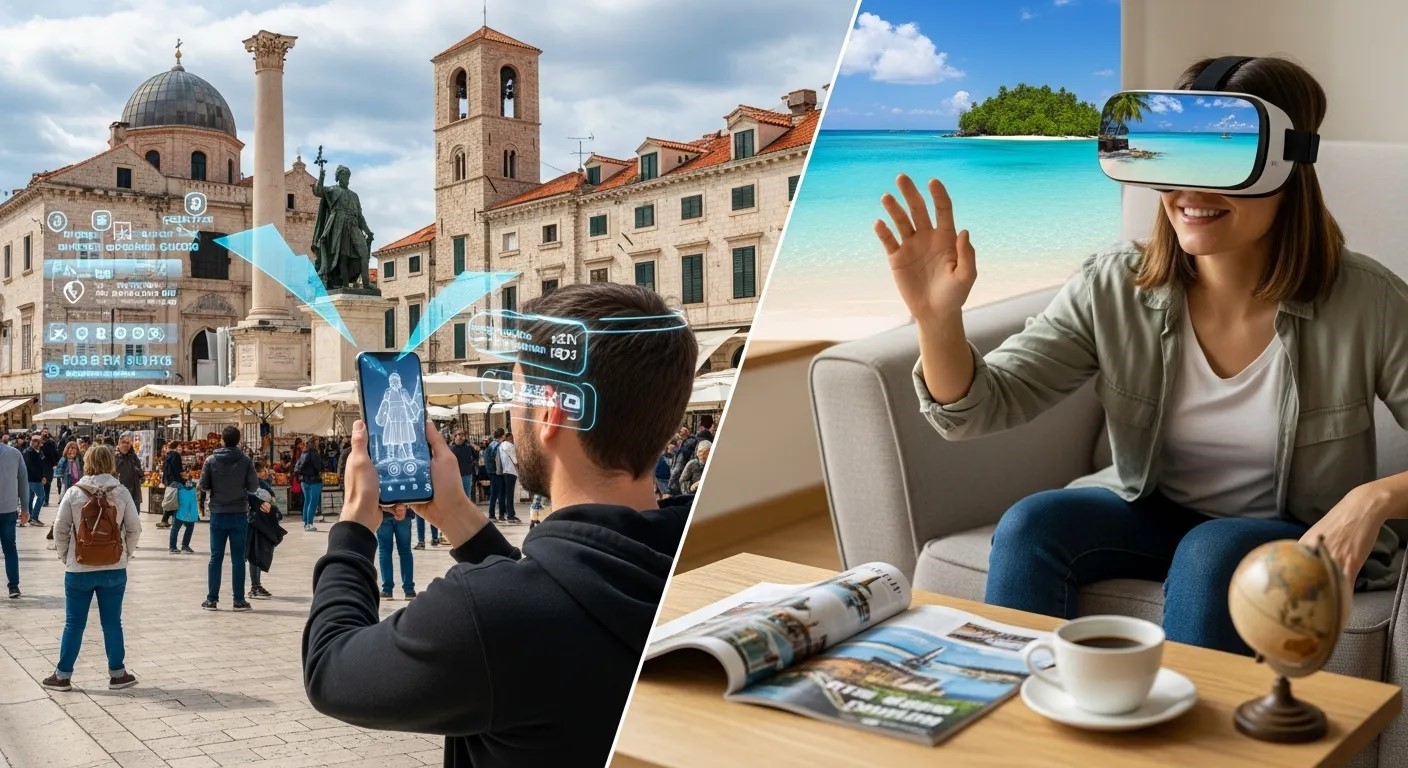
Travel and tourism are increasingly adopting AR vs VR technologies to engage audiences before, during, and after their trips. AR apps can overlay historical facts, navigation tips, or interactive guides onto real-world landmarks, enriching the visitor experience. Imagine standing in front of an ancient monument and seeing a historical reconstruction appear through your smartphone or AR glasses — a clear example of AR enhancing reality.
Virtual Reality, meanwhile, allows users to “preview” destinations or embark on virtual tours from anywhere in the world. Travel agencies and tourism boards are using VR to create immersive experiences of resorts, cruise ships, or cultural events, helping potential travelers make informed decisions. Comparing AR vs VR in this context highlights AR’s ability to complement real-world exploration, while VR offers completely immersive previews that inspire travel.
AR vs VR in Workplace Collaboration
Modern workplaces are increasingly using AR vs VR to improve collaboration and productivity. AR applications allow employees to visualize complex data, collaborate on 3D models, and receive on-site guidance, all while remaining present in their actual environment. Integrating these solutions with Voice Enabled Chatbots ensures that instructions and updates can be delivered in real-time, boosting efficiency.
VR, on the other hand, provides virtual meeting spaces where teams can collaborate remotely in a fully immersive environment. Instead of relying solely on video calls or traditional screen sharing, participants can interact with 3D objects, manipulate data, and brainstorm ideas as if they were in the same room. This shows that AR vs VR solutions are not competing but rather complementary, each serving specific collaboration needs.
AR vs VR in Education Reimagined
Education is another domain where AR vs VR is transforming learning experiences. Augmented Reality allows students to overlay interactive content on textbooks, lab equipment, or real-world locations. This approach improves engagement, retention, and comprehension, especially in STEM subjects. For instance, AR can bring complex molecular structures to life, making abstract concepts tangible.
Virtual Reality, in contrast, immerses students in fully simulated worlds. Whether exploring ancient civilizations, performing virtual science experiments, or walking through virtual anatomical models, VR provides experiences that would be impossible in a traditional classroom. By comparing AR vs VR in education, it’s evident that AR enhances real-world learning, while VR enables entirely new educational environments.
Integrating tools like AI Multilingual Bots into these experiences further democratizes learning, providing translation and personalized support for students of diverse linguistic backgrounds.
AR vs VR in Entertainment and Gaming
Entertainment is one of the most dynamic areas where AR vs VR technologies are making a profound impact. Augmented Reality transforms live events, concerts, and gaming experiences by layering digital content over the physical world. For example, AR in Music Festivals allows attendees to interact with 3D visuals, access real-time artist information, and enjoy location-based games that enhance engagement. These experiences create a stronger emotional connection with the audience, bridging physical presence with digital innovation.
Virtual Reality, on the other hand, immerses users in fully digital worlds. VR gaming has grown exponentially, with players exploring expansive virtual environments, engaging in interactive storytelling, and participating in collaborative multiplayer worlds. By comparing AR vs VR in entertainment, it becomes clear that AR extends real-world experiences, while VR creates entirely new ones. Both offer unique ways to captivate audiences and enhance engagement.
Additionally, AR holograms in entertainment venues are beginning to redefine live performances. Using AR Hologram Technology, performers can project 3D visuals, interactive characters, or even recreate historical figures, providing audiences with an unforgettable hybrid experience that blends reality and imagination.
AR vs VR in Sports
Sports organizations are leveraging AR vs VR to improve fan engagement, athlete training, and broadcasting experiences. Augmented Reality overlays statistics, player performance data, and interactive graphics during live games, enhancing the viewing experience for fans. Imagine watching a soccer match where AR provides real-time player stats, heat maps, or predictive plays on your smartphone or AR glasses — an innovation that makes live sports far more interactive.
Virtual Reality takes sports engagement a step further by allowing fans to experience games from a player’s perspective or participate in immersive simulations. VR training programs help athletes visualize plays, practice strategy, and refine techniques without physical strain. In this context, AR vs VR offers complementary solutions: AR enhances live experiences, while VR builds immersive, interactive simulations.
Integrating Voice Enabled Chatbots into stadiums or sports apps further improves accessibility. Fans can ask questions about game schedules, player stats, or ticket availability and receive instant responses, seamlessly combining AR overlays with voice-based AI.
AR vs VR in Real Estate and Architecture
The real estate and architecture sectors are increasingly adopting AR vs VR technologies to visualize projects, reduce risks, and improve client engagement. AR allows prospective buyers to view property layouts and interior designs overlaid on existing spaces, helping them understand scale and design choices. Similarly, architects use AR to present complex building models interactively during client meetings, ensuring clarity and alignment.
Virtual Reality, in contrast, enables clients to walk through fully immersive digital replicas of buildings or developments that are still under construction. By exploring these virtual spaces, clients gain a realistic sense of layout, lighting, and flow, making informed decisions before a single brick is laid. Comparing AR vs VR in real estate demonstrates how AR enhances the real-world view, while VR offers immersive pre-construction experiences.
Combining these technologies with AI Multilingual Bots ensures that clients from different linguistic backgrounds can interact seamlessly with architectural presentations, making property dealings more inclusive and efficient.
AR vs VR in Future Technology Trends
Looking ahead, the distinction between AR vs VR is likely to blur as technologies converge. Mixed Reality (MR) is emerging as a hybrid solution, combining the immersive aspects of VR with the real-world augmentation of AR. This convergence could transform industries ranging from healthcare to entertainment, creating experiences that are both immersive and contextually aware.
Wearable devices and AR glasses are becoming more sophisticated, providing real-time data overlays while remaining unobtrusive. The AR Glasses Benefits extend beyond navigation or communication; they can assist in industrial tasks, education, and collaborative projects, making AR an essential tool for productivity.
Similarly, the integration of AI into immersive experiences is reshaping expectations. Voice AI, like Voice Enabled Chatbots, combined with AR or VR, enables more natural interactions. Multilingual support powered by AI Multilingual Bots ensures global accessibility, breaking language barriers and expanding the reach of immersive technologies.
In sectors such as retail, healthcare, education, and entertainment, understanding AR vs VR and their complementary strengths is essential for organizations seeking to innovate. Businesses that harness these technologies strategically can improve engagement, streamline operations, and offer experiences that resonate deeply with users.
Conclusion
Understanding AR vs VR is essential for businesses, educators, and tech enthusiasts seeking to harness immersive technologies. Augmented Reality enhances the real world, providing interactive overlays, as seen in AR in Music Festivals, workplace solutions, and AR Hologram Technology. Virtual Reality offers complete immersion, transforming gaming, training, and virtual experiences. Both technologies have unique strengths, with applications in healthcare, retail, education, and beyond. As wearables, AR Glasses Benefits, and AI-driven tools like Voice Enabled Chatbots and AI Multilingual Bots evolve, the convergence of AR and VR will redefine how we interact with digital content and the real world.
Frequently Asked Questions (FAQ)
What is the main difference between AR and VR?
AR overlays digital content onto the real world, while VR immerses users in a fully virtual environment.
Where is AR commonly used?
AR is used in live events, retail, healthcare, education, and workplace operations for interactive experiences.
What are VR’s key applications?
VR is widely applied in gaming, training simulations, virtual tours, and immersive educational programs.
How do AR and VR complement each other?
AR enhances real-world interactions, while VR offers controlled immersive experiences. Together, they expand possibilities in entertainment, education, and business.
Can AI tools integrate with AR and VR?
Yes, Voice Enabled Chatbots and AI Multilingual Bots improve interactivity, accessibility, and user engagement across AR and VR platforms.