
Integrating AR into retail marketing enhances engagement, boosts conversions, and reduces returns. By combining immersive technology with strategic planning, retailers can deliver personalized, interactive shopping experiences that drive measurable growth and customer loyalty.
In today’s digital landscape, Augmented Reality in retail marketing has emerged as a transformative technology that bridges the gap between online engagement and in-store experiences. Currently, shoppers expect interactive, personalized encounters that go beyond traditional product displays. By overlaying digital content onto physical environments, retailers can showcase items in ways that were once impossible, from virtual try-ons to real-time product customization. competitive brands are leveraging AR to captivate audiences, drive conversions, and foster lasting loyalty.
As consumers become more discerning, the ability to visualize products before purchase delivers confidence and reduces uncertainty. Whether exploring a new pair of shoes through a smartphone camera or interacting with a 3D model of a piece of furniture in their living space, AR experiences empower buyers to make informed choices. In this guide, we will outline the essential steps for integrating Augmented Reality in retail marketing, from understanding core technologies and defining strategy to designing immersive experiences and measuring success. By following a structured approach, brands can unlock the full potential of AR and secure a leading position in an increasingly immersive commerce ecosystem.
Understanding Augmented Reality in Retail (Expanded)
Integrating AR into Retail Marketing is revolutionizing how brands connect with modern consumers by blending digital innovation with real-world shopping experiences. Augmented Reality (AR) overlays digital elements—such as images, animations, or data—onto a user’s physical environment through smartphones, tablets, or wearable devices. Unlike Virtual Reality, which creates a completely immersive digital world, AR enhances the real environment by adding interactive and context-aware digital layers. This makes it highly practical for retail, where customers want to visualize products without disconnecting from their surroundings.
In today’s competitive retail landscape, Integrating AR into Retail Marketing enables businesses to deliver immersive, personalized experiences that go beyond traditional browsing. For example, shoppers can virtually try on clothing, preview furniture in their homes, or explore 3D product features in real time. These interactive experiences not only capture attention but also build confidence in purchasing decisions. As a result, integrating AR into retail marketing helps reduce uncertainty, improve customer satisfaction, and ultimately drive higher conversion rates.
Moreover, AR bridges the gap between online and offline shopping channels, creating a seamless omnichannel experience. Customers can begin their journey online by interacting with AR features and continue it in-store with enhanced digital displays or smart mirrors. This continuity strengthens brand engagement and encourages repeat interactions. As consumer expectations continue to evolve in and beyond, retailers that embrace AR technologies are better positioned to stand out, foster loyalty, and deliver memorable shopping journeys.
Key AR Technologies (Expanded Overview)
When integrating AR into retail marketing, understanding the different types of AR technologies is essential for choosing the right solution:
- Marker-based AR:
This technology uses visual markers such as QR codes, product packaging, or logos to trigger AR experiences. When scanned, these markers activate 3D models, videos, or animations, making it ideal for interactive advertisements and product packaging. - Markerless AR:
Also known as location-based or spatial AR, this method uses GPS, sensors, and AI to place virtual objects in real-world environments without predefined markers. It is widely used for virtual try-ons, furniture placement, and in-store navigation. - Projection-based AR:
This approach projects digital visuals onto physical surfaces like walls or floors, allowing multiple users to interact simultaneously. Retailers often use it for in-store displays, events, and experiential marketing campaigns. - Superimposition-based AR:
This advanced form replaces or enhances parts of a real-world view with virtual elements. For example, customers can see how a new sofa looks in their living room or how makeup appears on their face in real time.
By understanding these core approaches, retailers can select the right methods to match their audience’s devices and in-store environments. Research from institutions like the Massachusetts Institute of Technology underscores the importance of device-agnostic frameworks to ensure wide compatibility and consistent performance across hardware.
Advantages of AR for Retailers and Shoppers
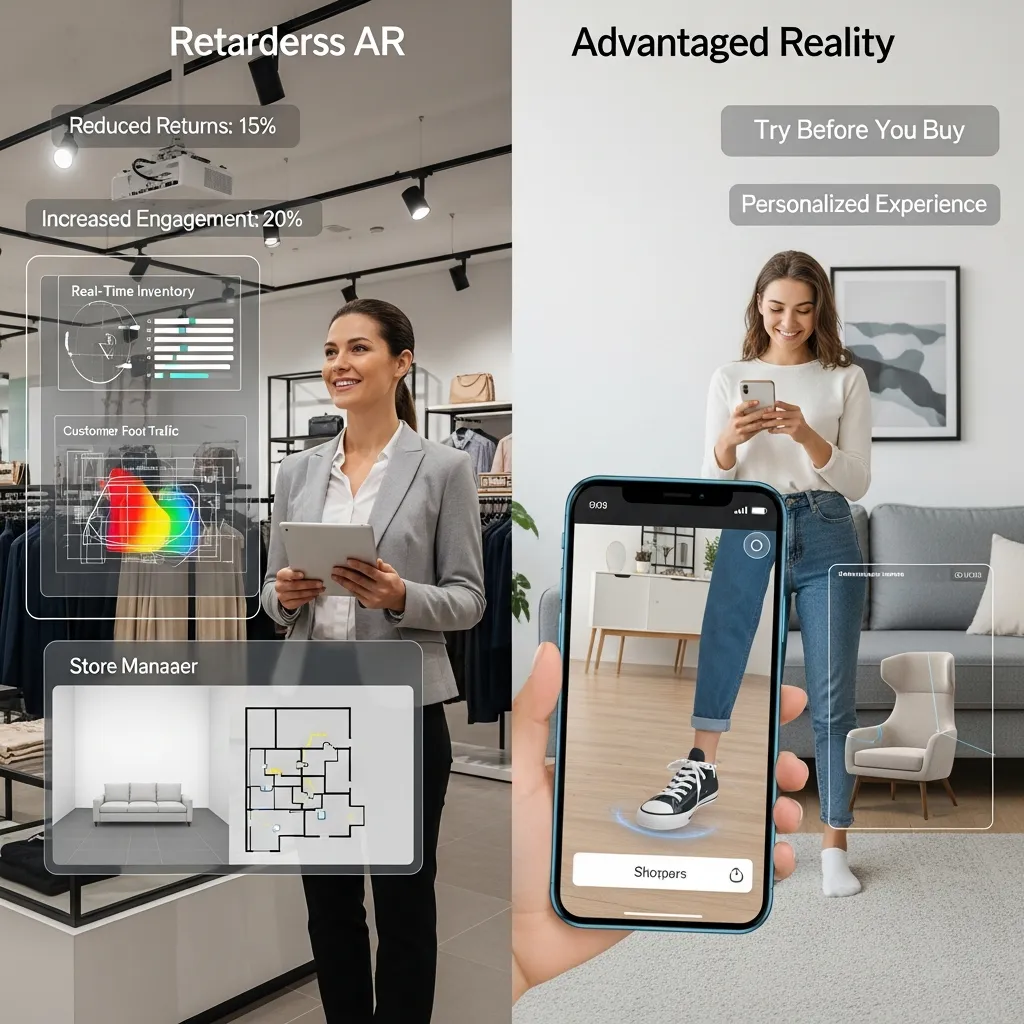
Implementing AR in retail marketing unlocks a range of benefits that span the entire customer journey. For retailers, it can lead to increased foot traffic, higher conversion rates, and reduced return costs. Shoppers, on the other hand, gain a more engaging experience that delivers confidence and customization before they commit to a purchase.
Top Benefits
- Heightened Engagement: Interactive AR experiences command attention longer than static displays, keeping shoppers immersed and curious.
- Personalization at Scale: Virtual try-ons and configurators let customers visualize color options, sizes, or complementary items in real time.
- Lower Return Rates: Accurate visual representations of products reduce surprises and lead to more confident buying decisions.
- Data-Driven Insights: AR platforms can capture metrics such as view counts, click-throughs, and dwell times, offering actionable intelligence for merchandising.
According to a report by the Small Business Administration, businesses that employ AR experiences often see a measurable uplift in average order value, as customers explore additional features and add-ons. In today’s retail environment, these advantages translate directly to stronger ROI and enhanced brand perception.
Crafting Your AR Strategy
To capitalize on Augmented Integrating AR into Retail Marketing, brands must develop a clear roadmap that aligns with their objectives. Start by establishing SMART goals—Specific, Measurable, Achievable, Relevant, and Time-bound—and then map these targets to critical customer touchpoints both online and in-store.
Planning Steps
- Identify Use Cases: Determine where AR can add value, whether it’s improving product discovery in e-commerce, enhancing in-store interactions, or launching hybrid campaigns that bridge the two.
- Understand Your Audience: Conduct surveys and usability tests to uncover the features and formats customers find most intuitive and engaging.
- Select Technology Partners: Evaluate AR development platforms—such as Unity, Vuforia, or 8th Wall—and agencies with proven retail expertise to build scalable solutions.
- Create a Content Roadmap: Plan the creation of 3D assets, animations, and metadata tags for product catalogs, ensuring they align with your brand voice and visual standards.
- Integrate Omnichannel: Seamlessly connect AR initiatives across mobile apps, in-store kiosks, social media filters, and email campaigns to maintain a unified experience.
By following these steps, retailers can ensure that their AR projects are grounded in measurable outcomes and ready to adapt as shopper preferences evolve. In today’s competitive market, a well-defined strategy separates cutting-edge brands from those merely experimenting with novelty features.
Designing Immersive AR Experiences

Exceptional AR implementations balance creativity with usability. Whether customers are exploring a virtual showroom or testing a new makeup shade on a digital mirror, the experience must be intuitive, responsive, and fast-loading to minimize friction and drive adoption.
Best Practices
- Optimize Performance: Compress 3D models and leverage lightweight, device-agnostic frameworks to guarantee smooth rendering on most smartphones and tablets.
- Contextual Triggers: Utilize location-based triggers in-store or image recognition for packaging to launch relevant AR interactions that feel natural.
- Guided Onboarding: Embed short tutorials or overlay prompts so first-time users quickly understand how to position their camera and interact with virtual objects.
- Social Sharing: Incorporate one-click options to share AR snapshots on Instagram, Snapchat, or TikTok, driving user-generated promotion and organic reach.
Furthermore, consistent branding, clear calls-to-action, and fallback experiences for older hardware ensure that all shoppers enjoy a seamless journey. Today, even modest AR features can yield significant returns when designed with the user’s needs and device capabilities in mind.
Evaluating AR Impact and ROI (Expanded Section)
Measuring the performance of Integrating AR into Retail Marketing initiatives is essential for maximizing returns and ensuring long-term success. While Augmented Reality delivers immersive experiences, its true value lies in how effectively it drives measurable business outcomes such as engagement, conversions, and customer retention.
A structured evaluation strategy allows retailers to identify what works, optimize campaigns, and allocate budgets more efficiently. data-driven decision-making has become the backbone of successful AR marketing strategies, making analytics integration more important than ever.
Why Measuring AR ROI Matters
Understanding ROI helps businesses justify their investment in AR technology and refine their strategies for better outcomes.
Key Reasons to Track AR Performance
- Optimize Marketing Spend: Identify high-performing campaigns and reduce waste
- Improve Customer Experience: Analyze user behavior to enhance usability
- Increase Conversion Rates: Understand which AR features drive purchases
- Support Data-Driven Decisions: Replace guesswork with actionable insights
- Scale Successful Campaigns: Replicate winning strategies across channels
Key Performance Indicators (KPIs)
Tracking the right KPIs ensures that your AR initiatives align with business goals and deliver measurable value.
Core Metrics to Monitor
- Activation Rate:
Percentage of users who initiate an AR experience after exposure - Engagement Duration:
Time users spend interacting with AR features (higher = better engagement) - Conversion Lift:
Increase in sales directly influenced by AR interactions - Average Order Value (AOV):
Comparison of purchase value between AR users and non-users - Return Rate:
Percentage of products returned after AR-assisted purchases
Additional Metrics for Deeper Insights
To gain a more comprehensive understanding, retailers should also track:
- Click-Through Rate (CTR): Measures effectiveness of AR call-to-actions
- User Retention Rate: Indicates repeat usage of AR features
- Customer Satisfaction Score (CSAT): Feedback on AR experience quality
- Bounce Rate Reduction: Lower drop-offs due to interactive content
- Social Shares & Virality: Measures organic reach from AR experiences
AR vs Traditional Marketing Performance
Below is a comparison highlighting how AR marketing outperforms traditional retail strategies:
| Metric | Traditional Marketing | AR-Driven Marketing |
|---|---|---|
| Customer Engagement | Low to Moderate | High & Interactive |
| Product Visualization | Limited (images/videos) | Real-time & 3D |
| Conversion Rate | متوسط | Significantly Higher |
| Return Rate | Higher | Lower |
| Personalization | Limited | Highly Customized |
| Data Insights | Basic Analytics | Advanced Real-Time Data |
Best Practices for Measuring AR Success
To maximize ROI, follow these proven strategies:
1. Set Clear Objectives
Define what success looks like—whether it’s increased sales, engagement, or reduced returns.
2. Use Analytics Tools
Leverage platforms like:
- Google Analytics (with AR event tracking)
- AR SDK dashboards (Unity, 8th Wall)
- CRM and eCommerce analytics tools
3. Conduct A/B Testing
Compare AR-enabled experiences with non-AR versions to measure true impact.
4. Integrate Across Channels
Track performance across:
- Mobile apps
- Websites
- In-store kiosks
- Social media campaigns
5. Monitor Continuously
Regular reporting helps identify trends, fix issues, and improve performance over time.
Common Challenges in Measuring AR ROI
Despite its benefits, tracking AR performance can present challenges:
- Attribution Complexity: Linking AR interactions directly to sales
- Data Fragmentation: Multiple platforms generating separate data sets
- Technical Limitations: Inconsistent tracking across devices
- User Privacy Regulations: Compliance with GDPR and data policies
Solution: Use unified analytics dashboards and privacy-compliant tracking systems to overcome these barriers.
FAQ: Integrating AR into Retail Marketing
1. What is integrating AR into retail marketing?
Integrating AR into retail marketing involves using augmented reality technology to enhance shopping experiences by overlaying digital elements onto real-world environments through mobile devices or AR tools.
2. How does AR improve customer engagement in retail?
AR creates interactive and immersive experiences like virtual try-ons and 3D product views, increasing customer engagement, time spent, and overall satisfaction.
3. What are the main types of AR used in retail marketing?
The main types include marker-based AR, markerless AR, projection-based AR, and superimposition-based AR, each offering different levels of interaction and functionality.
4. What devices support AR retail experiences?
Most modern smartphones and tablets support AR through ARKit (iOS) and ARCore (Android), along with advanced devices like AR headsets.
5. Is AR marketing expensive for retailers?
Costs vary depending on complexity. Basic AR features can be affordable, while advanced omnichannel campaigns with custom 3D assets may require higher investment.
6. How can AR reduce product return rates?
AR allows customers to visualize products in real-life contexts, helping them make informed decisions and reducing dissatisfaction and returns.
7. What are the key benefits of integrating AR into retail marketing?
Key benefits include higher engagement, improved conversion rates, personalized experiences, reduced returns, and better customer insights.
8. How do retailers measure AR marketing success?
Retailers track metrics like activation rate, engagement time, conversion rate, average order value (AOV), and return rate to measure AR effectiveness.
9. What industries benefit most from AR in retail?
Fashion, furniture, beauty, electronics, and home decor industries benefit significantly due to the need for visualization before purchase.
10. How can businesses start integrating AR into retail marketing?
Start with a clear strategy, identify use cases, choose the right technology platform, develop 3D content, and launch a pilot campaign before scaling.