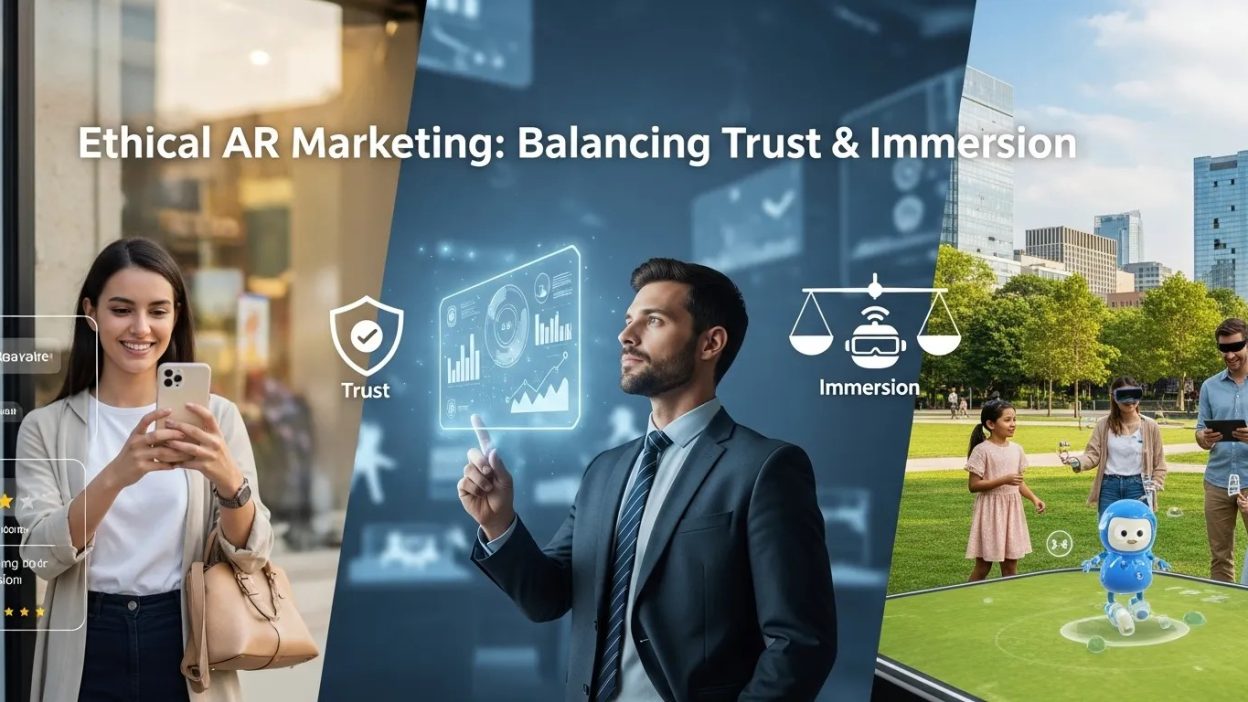
Ethical AR Marketing balances immersive experiences with privacy, transparency, and responsible data use. It builds long-term trust, supports regulatory compliance, and strengthens brand loyalty by aligning innovation with user autonomy and secure AI-driven personalization strategies.
The New Trust Economy in Augmented Experiences
The digital marketing landscape is evolving rapidly, and immersive technologies are reshaping how brands communicate with audiences. Among these innovations, Ethical AR Marketing is emerging as a critical discipline that balances technological immersion with consumer trust. As augmented reality becomes more integrated into everyday digital interactions, users are no longer impressed by novelty alone. They are asking deeper questions: How is my data being used? Is this experience safe? Can I trust this brand?
Modern consumers are psychologically wired to value personalization, but they are equally sensitive to privacy violations. This tension creates both opportunity and responsibility. Ethical AR Marketing addresses this balance by ensuring that immersive brand experiences do not compromise user autonomy or data security. It is no longer enough to design visually engaging AR campaigns; brands must design responsibly.
Trust has become the currency of digital engagement. Research consistently shows that transparency increases brand loyalty, while intrusive practices drive abandonment. When AR overlays digital elements onto physical environments, it accesses contextual data, camera input, behavioral patterns, and sometimes biometric signals. Without ethical boundaries, these capabilities can feel invasive. Ethical AR Marketing therefore operates as a structured framework that integrates compliance, transparency, psychological comfort, and long-term brand credibility.
In 2024 and beyond, ethical responsibility is not optional. It is strategic. Brands that ignore ethical standards risk reputational damage, regulatory penalties, and declining engagement rates. Conversely, those that adopt Ethical AR Marketing principles position themselves as forward-thinking and trustworthy leaders in immersive innovation.
The Psychological Foundations of Immersive Trust

Why Immersion Amplifies Emotional Response
Immersive technologies trigger stronger cognitive and emotional engagement than traditional digital formats. When users interact with AR filters, virtual try-ons, or interactive product visualizations, their brains process the experience as semi-real. This heightened engagement increases memory retention and purchase intent. However, it also increases vulnerability.
Ethical AR Marketing recognizes that immersion intensifies influence. The more realistic and interactive the environment, the greater the psychological impact. Brands must therefore avoid manipulative design patterns. Dark patterns, hidden data collection, and misleading overlays may produce short-term gains, but they erode trust quickly.
When users feel in control, they experience psychological safety. Transparency about permissions, clear consent prompts, and accessible privacy settings reduce anxiety. Ethical AR Marketing aligns immersive power with user empowerment rather than exploitation.
Data Sensitivity in AR Environments
Unlike static web pages, AR systems rely on real-time data streams. These may include:
- Camera feeds
- Spatial mapping
- Location signals
- Device sensors
- Interaction analytics
This data enhances personalization but also increases risk. Ethical AR Marketing ensures that only necessary data is collected and that it is stored securely. Minimization principles—collecting less rather than more create confidence.
For example, a retail brand offering virtual try-ons may use AR Facial Tracking to adjust product placement accurately. While technically impressive, facial data requires careful governance. Ethical AR Marketing frameworks require anonymization, secure storage, and explicit user consent before such features are activated.
Consent Architecture in AR Campaigns
Consent is not just a legal checkbox. It is a psychological contract. Ethical AR Marketing integrates consent architecture directly into user experience design. Instead of burying permissions inside complex policy pages, responsible brands communicate clearly and visually.
A well-designed AR campaign might include:
| Ethical Element | Purpose | Psychological Impact |
|---|---|---|
| Clear Permission Prompt | Explains data usage | Reduces uncertainty |
| Data Usage Summary | Simplifies privacy policy | Builds clarity |
| Opt-Out Controls | Empowers users | Increases control |
| Temporary Data Storage | Minimizes exposure | Enhances safety |
When users understand how their data supports the immersive experience, they are more willing to participate. Ethical AR Marketing transforms compliance into engagement strategy.
Building Trust Through Value Exchange
Trust increases when users perceive fair value exchange. If an AR campaign provides clear benefits—such as convenience, personalization, or entertainment users feel rewarded. However, if data collection outweighs perceived value, suspicion grows.
Consider a scenario where a brand integrates a Lead Generation Chatbot inside an AR shopping interface. When deployed ethically, the chatbot clearly explains how user information will be used and provides meaningful assistance rather than aggressive data capture. Ethical AR Marketing ensures that conversational AI respects boundaries and collects only relevant data.
Value transparency encourages long-term relationships rather than transactional engagement.
Global Privacy Regulations Influencing AR
Governments worldwide are tightening digital privacy laws. While regulations vary by region, the overall direction is clear: more transparency, stronger user rights, and stricter penalties for misuse.
Ethical AR Marketing integrates compliance with frameworks such as:
- Data minimization principles
- User consent documentation
- Right to deletion
- Cross-border data protection standards
Brands that treat compliance as a design pillar rather than an afterthought reduce risk significantly.
Ethical Risk Assessment Framework
To operationalize responsibility, organizations should implement structured risk audits. Ethical AR Marketing encourages brands to evaluate immersive campaigns before launch using the following model:
1. Data Mapping
Identify what data is collected and why.
2. Psychological Impact Analysis
Assess emotional influence and potential manipulation.
3. Security Infrastructure Review
Evaluate encryption, storage, and access control.
4. Transparency Testing
Ensure disclosures are understandable.
5. Crisis Simulation
Test response protocols for data breaches.
When brands adopt these processes, ethical standards become embedded in organizational culture rather than reactive fixes.
Immersion Without Manipulation

Avoiding Dark Patterns in AR Interfaces
Dark patterns exploit cognitive biases. In AR environments, these may include forced camera permissions, misleading visual cues, or disguised data capture mechanisms. Ethical AR Marketing explicitly rejects such tactics.
Immersive persuasion should inspire, not deceive. When brands prioritize clarity over coercion, they protect both users and their own reputation.
Responsible Personalization Through AI
Artificial intelligence significantly enhances AR capabilities. AI-Powered AR Vision enables real-time object recognition, contextual overlays, and predictive recommendations. While these features improve relevance, they must be governed responsibly.
Ethical AR Marketing requires algorithmic transparency. Users should understand when AI is influencing recommendations. Bias mitigation, regular audits, and explainable AI models reduce unintended harm.
Personalization becomes ethical when users can adjust settings, review collected data, and understand recommendation logic.
Real-Time Assistance and Privacy
Immersive platforms increasingly integrate Live Chatbot Support to guide users through AR experiences. This improves usability but introduces additional data processing layers.
Ethical AR Marketing ensures that chatbot transcripts are protected, anonymized when possible, and not repurposed without permission. Clear communication about stored interactions builds confidence.
Users are more willing to engage deeply when they trust that assistance systems are secure.
Crisis Response and Safety Applications
Augmented reality extends beyond retail and entertainment. In sectors like healthcare and public safety, AR Emergency Response systems assist professionals during critical situations. These high-stakes applications highlight why ethical governance is essential.
Ethical AR Marketing principles apply even in emergency-focused implementations. Data collected during crisis simulations must remain secure. Transparency remains important even when urgency is high.
Responsible deployment prevents misuse while preserving life-saving potential.
Measuring Ethical Performance
Key Metrics for Responsible AR
Brands must measure more than engagement. Ethical AR Marketing encourages evaluation across multiple dimensions:
| Metric Category | Example Indicators |
|---|---|
| Trust Metrics | Opt-in rates, privacy satisfaction surveys |
| Security Metrics | Breach incidents, encryption audits |
| Transparency Metrics | Consent clarity ratings |
| Engagement Metrics | Interaction duration, return usage |
| Compliance Metrics | Regulatory adherence reports |
Tracking these metrics ensures accountability.
Long-Term Brand Equity and Ethical Leadership
Ethical positioning strengthens brand equity. When companies consistently apply Ethical AR Marketing standards, they cultivate long-term loyalty. Consumers reward brands that protect their privacy while delivering immersive value.
Trust-driven marketing generates sustainable growth. Ethical leadership differentiates brands in saturated digital markets.
Immersion and privacy do not have to conflict. With intentional design, clear governance, and transparent communication, Ethical AR Marketing becomes a strategic advantage rather than a constraint.
Expanding the Strategic Role of Ethical AR Marketing

As immersive technologies become mainstream, Ethical AR Marketing is transitioning from a compliance-driven necessity to a long-term strategic advantage. Brands are beginning to realize that immersive trust is not created through disclaimers alone. It is built through consistent behavioral alignment between what a brand promises and how it uses technology.
Consumers today operate within what experts call the “trust economy.” In this environment, attention is earned, not forced. Ethical AR Marketing supports this shift by embedding ethical considerations directly into innovation cycles. Instead of asking how far technology can go, responsible brands ask how far it should go.
This subtle shift in mindset has major implications. It influences product design, data policies, AI integration, and even internal team training. Ethical AR Marketing becomes a guiding philosophy rather than a marketing add-on.
Designing Ethical AR from the Ground Up
True immersive trust begins during conceptual development. Ethical AR Marketing requires cross-functional collaboration between developers, legal teams, UX designers, and marketing strategists. Each stakeholder contributes to building an ecosystem where innovation does not override integrity.
A responsible AR architecture includes:
- Data collection limits aligned with purpose
- Transparent user interface prompts
- Clear explanation of AI decision logic
- Secure storage and encrypted transfer systems
- Easy opt-out and deletion options
These components create a structured ethical backbone. Without them, even the most visually stunning experience risks becoming intrusive.
Ethical UX and Behavioral Design
Augmented reality can influence perception in powerful ways. Virtual overlays shape decision-making, product perception, and emotional engagement. Ethical AR Marketing requires that these persuasive elements remain honest and proportionate.
For example, visual enhancements should not distort product accuracy. Lighting simulations should reflect realistic outcomes rather than exaggerated results. When consumers discover discrepancies, trust declines rapidly.
Ethical AR Marketing promotes realism over manipulation. Honest representation sustains long-term credibility.
Biometric Data and Privacy Sensitivity
As AR tools evolve, biometric recognition features are increasingly integrated into consumer applications. Facial mapping, gesture recognition, and spatial tracking enhance immersion. However, they also increase ethical risk.
Ethical AR Marketing enforces strict policies around biometric data handling. If AR Facial Tracking is required for personalization, brands must explain why it is necessary and how it is protected. Data retention timelines should be clearly defined, and anonymization must be prioritized.
When users feel that sensitive data is treated responsibly, psychological comfort increases. Ethical AR Marketing recognizes that comfort drives engagement.
AI Governance and Explainability
AI-driven personalization is central to modern immersive systems. AI-Powered AR Vision allows real-time analysis of environments and behaviors to deliver contextual content. However, opaque algorithms can create bias or confusion.
Ethical AR Marketing integrates explainable AI principles. Users should know when recommendations are automated and how adjustments can be made. Transparency in AI decision-making reduces fear of hidden manipulation.
Algorithm audits, bias detection protocols, and human oversight contribute to responsible deployment. Ethical AR Marketing ensures that AI remains accountable.
Retail and E-Commerce
Retail remains one of the strongest adopters of immersive experiences. Virtual try-ons, interactive product demos, and AR-based store navigation enhance customer journeys. Ethical AR Marketing ensures these innovations prioritize consent and clarity.
For example, integrating a Lead Generation Chatbot within an immersive store interface can streamline customer onboarding. However, it must clearly disclose how collected data supports personalization. Users should not feel trapped in forced sign-up funnels.
When immersive commerce respects privacy, conversion rates increase organically.
Healthcare and Public Services
In healthcare, augmented systems assist professionals with diagnostics and remote collaboration. Ethical AR Marketing principles apply even when commercial intent is minimal. Transparency about collected medical data and secure handling protocols are essential.
In public safety contexts, AR Emergency Response platforms guide responders during crises. Ethical frameworks must ensure that sensitive geolocation and personal data are protected. Even under urgent conditions, privacy must not be ignored.
Ethical AR Marketing demonstrates that responsibility is universal across industries.
Education and Training
Educational institutions use AR to create immersive learning environments. From virtual science labs to historical simulations, engagement levels rise dramatically. Ethical AR Marketing in education focuses on protecting student data and maintaining age-appropriate transparency.
Young users are particularly vulnerable to persuasive design. Clear communication about data usage and guardian consent procedures is essential.
Immersive learning thrives when safety standards are visible and consistent.
Trust Signals in Immersive Platforms

Transparency as a Visible Feature
Modern users actively look for trust indicators. Ethical AR Marketing transforms privacy from a hidden policy page into a visible feature. Examples include:
- Real-time data usage notifications
- Privacy dashboards within AR interfaces
- Instant deletion buttons
- Consent renewal reminders
These signals reinforce brand integrity. Ethical AR Marketing reframes privacy not as an obstacle but as a trust-building tool.
Customer Support and Ethical Communication
Immersive systems increasingly integrate Live Chatbot Support to assist users in real time. While helpful, these tools must align with ethical standards.
Ethical AR Marketing ensures that chatbot interactions are securely stored and never exploited for unrelated marketing campaigns. Clear boundaries between assistance and data mining protect user confidence.
Support channels should empower users rather than extract additional information unnecessarily.
Moving Beyond Vanity Metrics
Traditional digital marketing prioritizes impressions, clicks, and engagement duration. Ethical AR Marketing expands evaluation to include trust-centered metrics.
Below is a structured comparison:
| Traditional Metric | Ethical Expansion |
|---|---|
| Click-Through Rate | Informed Consent Rate |
| Session Duration | Voluntary Interaction Duration |
| Data Capture Volume | Data Minimization Compliance |
| Conversion Rate | Trust Retention Index |
| Engagement Depth | Privacy Satisfaction Score |
By measuring ethical impact alongside performance, organizations align profit with responsibility.
Crisis Management and Ethical Preparedness
No system is immune to risk. Data breaches, algorithmic errors, or design flaws may occur. Ethical AR Marketing requires pre-defined crisis response strategies.
These strategies include:
- Immediate user notification
- Transparent public communication
- Independent security audits
- Corrective action documentation
- Policy refinement
Swift and honest responses often strengthen trust rather than weaken it. Ethical AR Marketing views transparency during crises as an opportunity for accountability.
Organizational Culture and Ethical Alignment
Internal Training and Ethical Awareness
Technology alone cannot guarantee responsible behavior. Ethical AR Marketing must be supported by employee education. Teams should understand data protection laws, psychological design principles, and ethical decision-making frameworks.
Workshops and simulations can help teams identify potential ethical risks before campaigns launch. When ethics become embedded in corporate culture, compliance becomes proactive rather than reactive.
Leadership Commitment and Public Accountability
Leadership plays a central role in shaping immersive trust strategies. Ethical AR Marketing requires executive endorsement and visible commitment to transparency.
Public privacy reports, third-party audits, and open data policies demonstrate accountability. When leadership communicates openly about ethical standards, stakeholder confidence increases.
The Economic Impact of Ethical Innovation
Trust as a Growth Multiplier
Brands that implement Ethical AR Marketing consistently report stronger customer loyalty and reduced churn rates. Trust reduces friction in digital interactions. Users who feel safe are more likely to explore immersive features fully.
Long-term profitability often correlates with ethical stability. While unethical shortcuts may produce temporary gains, they create reputational risk that outweighs immediate benefits.
Ethical AR Marketing aligns financial performance with sustainable trust-building.
Competitive Differentiation Through Responsibility
As immersive experiences become common, ethical differentiation becomes a key competitive factor. Consumers compare brands not only on innovation but also on integrity.
Companies that openly communicate their Ethical AR Marketing practices stand out in crowded markets. Transparency becomes a unique selling proposition.
Responsible innovation is no longer a niche advantage it is a mainstream expectation.
The Future of Ethical AR Marketing
Emerging Technologies and Expanding Responsibilities
As wearable AR devices, spatial computing platforms, and advanced AI systems evolve, ethical considerations will grow more complex. Ethical AR Marketing must adapt to new forms of data collection, including environmental mapping and behavioral analytics.
Future-ready frameworks will require:
- Real-time consent management
- Edge computing for local data processing
- Federated learning to reduce centralized storage
- Independent ethics review boards
Forward-thinking organizations prepare for these shifts now rather than waiting for regulation to force adaptation.
Immersion and Autonomy Can Coexist
The central tension in immersive innovation is balancing engagement with autonomy. Ethical AR Marketing proves that these goals are not mutually exclusive. When users retain control, immersion becomes empowering rather than intrusive.
Ethical AR Marketing ultimately transforms augmented reality from a persuasive tool into a collaborative experience. Brands and users co-create value within transparent boundaries.
As the digital world continues blending with physical reality, ethical responsibility will define which brands earn lasting trust. Immersion may capture attention, but integrity sustains loyalty.
Conclusion
Ethical AR Marketing represents the future of immersive brand communication where innovation and integrity move together. As augmented reality becomes more intelligent and personalized, businesses must prioritize transparency, data protection, and user autonomy. Trust is no longer optional; it is a measurable growth driver. By implementing clear consent systems, secure data governance, explainable AI practices, and responsible personalization, brands can create immersive experiences without compromising privacy. Ethical AR Marketing ensures long-term sustainability, regulatory alignment, and stronger emotional loyalty. When organizations balance immersion with accountability, they transform augmented reality from a novelty into a trusted digital ecosystem.
Frequently Asked Questions (FAQ)
What is Ethical AR Marketing?
Ethical AR Marketing is a responsible approach to augmented reality campaigns that prioritizes user privacy, transparency, data security, and informed consent while delivering immersive brand experiences.
Why is Ethical AR Marketing important?
It builds consumer trust, reduces legal risk, enhances brand reputation, and ensures sustainable growth in immersive digital environments.
How does Ethical AR Marketing protect user data?
It applies data minimization, encryption, anonymization, secure storage systems, and clear consent frameworks to protect personal and biometric information.
Does Ethical AR Marketing limit personalization?
No. It enables responsible personalization by using transparent AI systems and allowing users to control their data preferences.
How can brands implement Ethical AR Marketing?
Brands can integrate privacy-by-design principles, conduct risk assessments, use explainable AI, and regularly audit data governance policies.
What role does consent play in Ethical AR Marketing?
Consent acts as a psychological and legal foundation, ensuring users understand how their data is collected and used before engaging with immersive experiences.
Can Ethical AR Marketing improve customer loyalty?
Yes. Transparent and responsible practices increase trust, which directly strengthens long-term customer relationships and retention.
How does AI impact Ethical AR Marketing?
AI enhances immersive experiences but must be governed with bias monitoring, explainability, and ethical oversight to maintain fairness and trust.
Is Ethical AR Marketing required for regulatory compliance?
While laws vary globally, ethical frameworks help brands comply with privacy regulations and reduce potential penalties.
What industries benefit most from Ethical AR Marketing?
Retail, healthcare, education, public services, and entertainment industries benefit significantly from responsible immersive strategies.
How can companies measure ethical performance?
They can track trust metrics, privacy satisfaction scores, compliance audits, opt-in rates, and data minimization effectiveness.
What is the future of Ethical AR Marketing?
It will evolve alongside AI, spatial computing, and wearable AR technologies, focusing even more on real-time consent management and secure decentralized data systems