NLP for AR enables natural, voice-driven interaction in augmented reality, enhancing accessibility, efficiency, and immersion. By combining AI, computer vision, and edge computing, AR interfaces become intuitive, context-aware, and industry-ready across healthcare, retail, education, and industrial training.
Introduction The Emergence of NLP in AR
The landscape of augmented reality (AR) is evolving at an unprecedented pace, driven by innovations that blend human intuition with machine intelligence. Among the most transformative technologies, NLP for AR has emerged as a key enabler of seamless voice-controlled interactions. Unlike traditional AR interfaces that rely heavily on gestures or touch, voice-driven commands allow users to interact with digital environments more naturally and intuitively. This shift is not just a matter of convenience—it represents a fundamental change in how humans communicate with machines, making AR experiences more immersive and context-aware.
Voice control in AR is no longer a futuristic concept. With advancements in natural language understanding, systems can interpret user intent, recognize conversational nuances, and respond in real time. By integrating NLP for AR, developers can craft experiences where commands, queries, and even casual conversations translate into precise digital actions, opening doors to applications in education, healthcare, retail, and industrial training.
The significance of NLP in these applications becomes even clearer when viewed alongside complementary technologies like Computer Vision in AR. While computer vision enables devices to understand and map the physical environment, NLP ensures that user interactions are meaningful and contextually relevant. Together, they create an ecosystem where AR interfaces are not only visually rich but also communicatively intelligent.
How NLP Transforms Voice-Controlled AR Interfaces

Natural language processing is fundamentally about understanding and generating human language. In the context of AR, it allows systems to interpret spoken commands and conversational inputs with high accuracy. Traditional AR systems required precise gestures or touch-based commands, often limiting user engagement. By incorporating NLP for AR, these systems can now handle complex queries, multi-step instructions, and context-dependent commands.
For instance, consider a manufacturing AR application where a technician needs guidance on assembling a machine. Through voice commands, the technician can ask detailed questions like, “Show me the latest wiring schematic for this module,” and the AR system responds instantly. This fluid interaction is made possible by sophisticated NLP algorithms capable of parsing intent, understanding domain-specific terminology, and generating actionable responses.
Moreover, this voice-driven approach dramatically improves accessibility. Users with mobility challenges or those operating in hands-busy environments can interact with AR seamlessly. This human-centric approach aligns perfectly with the psychological principle of reducing cognitive load. By enabling NLP for AR, designers ensure that users focus on their primary tasks rather than struggling with interface mechanics.
Key Components of NLP in AR Systems
Understanding the inner workings of NLP for AR helps developers design more effective and responsive applications. There are several core components:
-
Speech Recognition: Converts spoken words into machine-readable text. High-quality recognition models are essential for accurate voice control, especially in noisy AR environments.
-
Natural Language Understanding (NLU): Determines the intent behind user commands. For AR, this might include recognizing action verbs like “display,” “zoom,” or “highlight,” and mapping them to interface functions.
-
Context Management: Keeps track of ongoing interactions, enabling multi-step conversations. For example, a user might say, “Show the 3D model,” followed by, “Rotate it 45 degrees clockwise.” Context-aware NLP ensures the system understands the relationship between these commands.
-
Response Generation: Provides feedback in natural language or through AR visuals. Advanced systems may combine voice, text, and visual cues for a richer experience.
Integrating these components into AR interfaces ensures that voice commands are interpreted correctly, responses are timely, and interactions feel intuitive. Many leading-edge AR platforms now combine Transfer Learning in AR techniques to enhance these NLP models. By leveraging pre-trained models and fine-tuning them on AR-specific datasets, developers can achieve high accuracy with significantly reduced training time.
Practical Applications of NLP in AR
The applications of NLP for AR span across multiple industries, demonstrating both versatility and practical impact:
-
Healthcare: Surgeons can use voice commands to navigate patient scans during operations, enabling hands-free interaction and improving procedural efficiency.
-
Education: AR learning tools respond to student queries in real time, creating dynamic and interactive lessons.
-
Retail: Customers can explore products in AR by asking questions about features, prices, or availability. AI-driven conversational agents enhance engagement, similar to Chatbots in B2B Marketing, but within immersive AR environments.
-
Industrial Training: Workers can receive step-by-step guidance via AR headsets, using voice to navigate complex workflows without pausing operations.
Voice-controlled AR interfaces also benefit from Edge Computing in AR, which reduces latency by processing NLP tasks closer to the user. This ensures real-time responsiveness, critical for environments where delays could compromise safety or efficiency.
Technical Challenges in NLP for AR
While NLP for AR offers remarkable possibilities, building reliable voice-controlled AR systems comes with its own set of challenges. One of the primary issues is handling ambient noise. AR applications are often deployed in real-world environments—factories, construction sites, or crowded public spaces—where background noise can interfere with speech recognition. Advanced noise-cancellation algorithms combined with robust NLP models help mitigate this, ensuring commands are interpreted accurately.
Another challenge lies in contextual ambiguity. Users may give commands like “Show me the last diagram” or “Highlight that section,” which require the system to understand prior interactions and spatial context. Integrating memory mechanisms and contextual tracking allows NLP for AR to maintain conversational continuity, avoiding misunderstandings and improving user satisfaction.
Multi-Language and Accent Adaptation
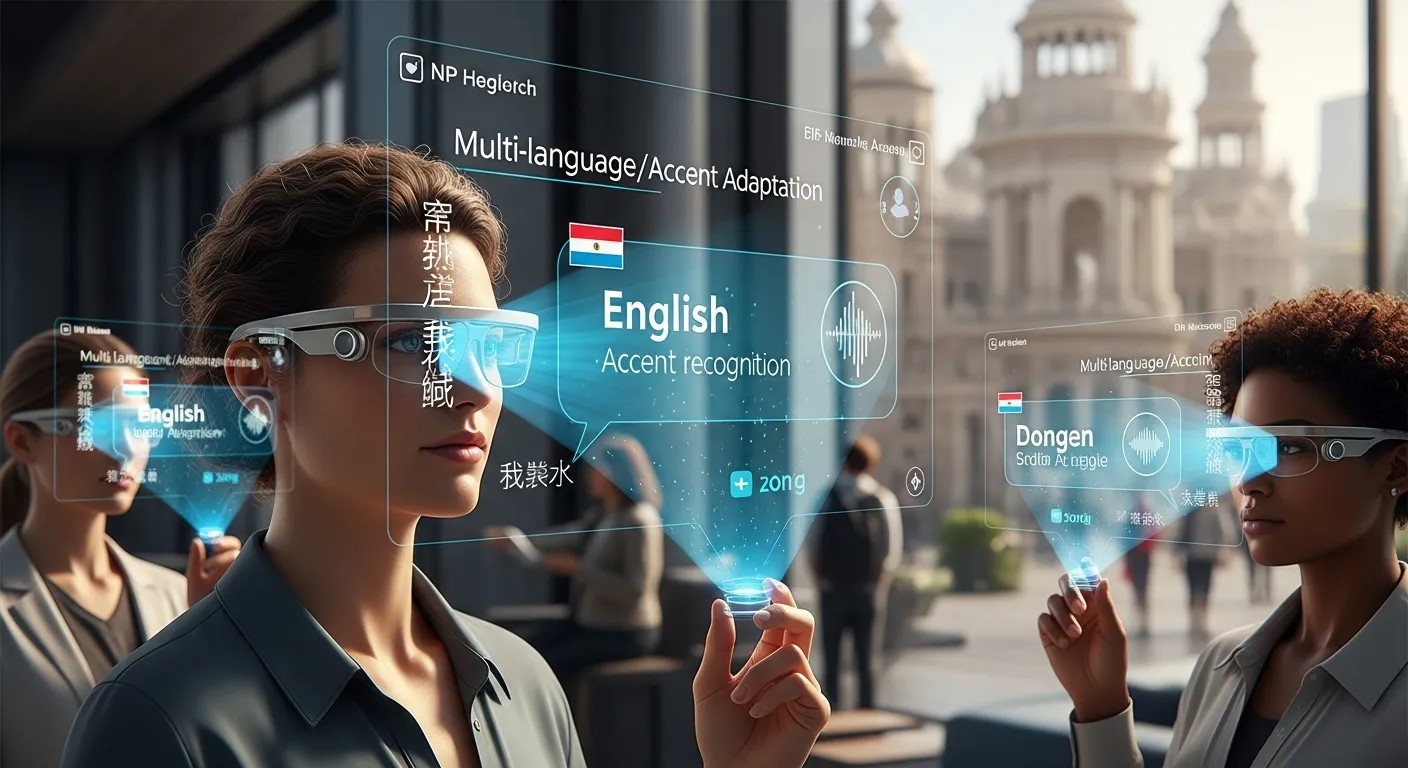
Global adoption of AR requires support for multiple languages and accents. Systems powered by NLP for AR must accurately recognize a wide variety of phonetic patterns while maintaining semantic understanding. Transfer learning plays a crucial role here: pre-trained multilingual models can be fine-tuned on AR-specific voice datasets to improve recognition rates.
For instance, a healthcare AR application may serve medical professionals across different countries. By leveraging Transfer Learning in AR, the system can adapt to specialized vocabulary and local language nuances, ensuring that voice commands are understood and executed precisely. This multi-language support is key to scaling AR solutions worldwide.
Enhancing Real-Time Interaction with Edge AI
Latency is critical for effective voice-controlled AR. When users issue commands, even small delays can disrupt workflow, especially in hands-on environments like manufacturing or medical procedures. By combining NLP for AR with Edge Computing in AR, processing occurs locally on devices or nearby servers, minimizing response times and maintaining smooth interaction.
Edge deployment also improves data privacy, as sensitive voice data does not need to be transmitted to cloud servers. Industries like defense, healthcare, and finance benefit particularly from this approach, making NLP for AR a secure and practical choice for professional applications.
Conversational AI Meets AR
Modern AR interfaces go beyond executing simple commands. With NLP for AR, systems can engage users in meaningful dialogue, answer follow-up questions, and even provide suggestions based on context. Retail AR applications, for example, function similarly to AI Conversational Commerce, guiding customers through product exploration, answering feature-related questions, and making personalized recommendations.
In enterprise environments, integrating principles from Chatbots in B2B Marketing allows AR systems to interact naturally with employees or clients. Voice-driven AR guides can interpret complex instructions, respond to queries about workflows, and maintain conversation history, creating a more interactive and human-centric interface.
Combining NLP and Computer Vision
The integration of NLP for AR with Computer Vision in AR significantly elevates the user experience. Computer vision identifies objects and spatial relationships, while NLP interprets user intent. Together, they allow commands like, “Zoom in on the red valve connected to the main pipeline,” to be executed accurately in real time.
This fusion of vision and language enables AR interfaces to become truly context-aware, where actions respond intelligently to both verbal instructions and visual cues. Industries ranging from industrial maintenance to medical training benefit from this synergy, making AR interactions faster, more precise, and more intuitive than ever.
Practical Applications and Case Examples

Healthcare: Surgeons use voice commands through NLP for AR to navigate patient imaging or display critical information, keeping hands free for procedures.
Education: AR learning platforms respond to student queries in real time, enabling immersive and interactive lessons that adapt dynamically to user input.
Retail: Customers explore products through AR, guided by conversational voice commands, creating experiences similar to AI Conversational Commerce.
Industrial Training: Workers receive step-by-step guidance through AR headsets. Voice-driven instructions reduce the need to reference manuals, enhancing productivity and safety.
Future Trends in NLP for AR
The evolution of NLP for AR is accelerating as researchers and developers explore more advanced AI models and deployment strategies. One prominent trend is multimodal interaction, where voice, gestures, and visual cues are combined to create a richer AR experience. With multimodal NLP, users can speak commands while pointing at objects or making gestures, and the system can integrate these inputs for precise execution. This approach allows AR interfaces to understand user intent more accurately, making interactions seamless and intuitive.
Another significant trend is personalization through adaptive learning. Modern AR applications use NLP to learn individual user preferences over time. For example, in a retail AR environment, the system can adapt to a user’s language style, frequently requested commands, or preferred interaction patterns. By leveraging NLP for AR, these systems become not just responsive but anticipatory, offering suggestions before users explicitly ask.
Enhancing AR with AI Model Optimization
The backbone of effective NLP for AR is the continuous improvement of underlying AI models. Techniques like transfer learning and fine-tuning on AR-specific datasets ensure that language models understand domain-specific vocabulary. For instance, in industrial or medical settings, specialized terminology must be recognized accurately. By integrating Transfer Learning in AR, developers can achieve high precision without training models from scratch, significantly reducing deployment time and resource consumption.
Additionally, optimizing models for low-latency execution is crucial. AR applications often require real-time responses, and combining NLP for AR with Edge Computing in AR ensures that even complex commands are processed instantly, maintaining a smooth user experience. This integration also addresses privacy concerns by keeping sensitive voice data on local devices rather than transmitting it to the cloud.
Cross-Industry Adoption and Real-World Applications
NLP for AR is being adopted across industries with transformative effects:
-
Healthcare: Voice-controlled AR guides assist surgeons during complex procedures, improving efficiency and safety. The system can retrieve patient data, highlight critical areas, or overlay surgical instructions in real time.
-
Education: Students interact with immersive AR lessons using natural language, enabling dynamic exploration of topics, similar to how Chatbots in B2B Marketing engage users with responsive dialogue but within a 3D environment.
-
Retail: AI-driven AR assistants offer personalized shopping experiences, leveraging principles from AI Conversational Commerce. Users ask about product details, availability, or comparisons, and the system responds contextually.
-
Industrial Training: Voice commands powered by NLP for AR allow workers to navigate complex procedures hands-free, enhancing productivity and safety.
The combination of NLP for AR with Computer Vision in AR ensures these applications are context-aware, allowing systems to interpret not just language but also spatial positioning and object relationships.
Multi-Device and Multi-Platform Compatibility
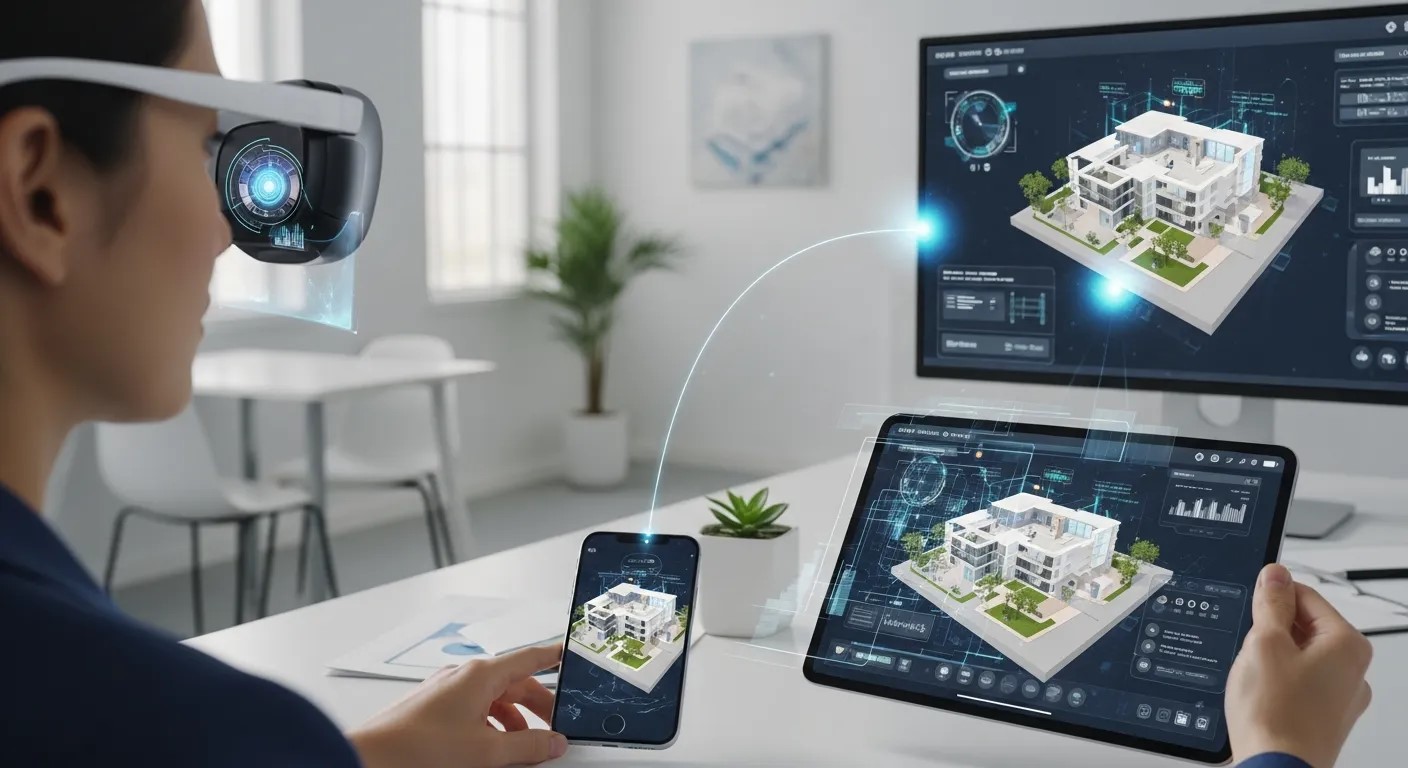
For widespread adoption, NLP for AR must operate across different devices and platforms. From AR glasses to smartphones and tablets, the underlying NLP models need to be consistent in performance. Developers are increasingly using cloud-assisted NLP alongside Edge Computing in AR to balance processing power and responsiveness.
This hybrid approach allows devices with limited computational resources to benefit from powerful NLP models without compromising real-time interaction. Users can move seamlessly between devices, and their voice commands are understood consistently, regardless of the hardware or environment.
Challenges in Scaling NLP for AR
Despite its promise, scaling NLP for AR comes with challenges:
-
Data Diversity: AR environments vary widely, requiring models to handle multiple accents, languages, and terminologies.
-
Privacy and Security: Voice data is sensitive, and integrating NLP while maintaining compliance with privacy standards is critical. Edge processing helps mitigate these concerns.
-
Integration Complexity: Combining NLP with computer vision, spatial mapping, and real-time rendering requires sophisticated engineering.
Addressing these challenges is essential for ensuring that NLP for AR can deliver reliable, intuitive, and safe experiences across industries.
Emerging Models and AI Innovations
Recent innovations in NLP for AR include transformer-based architectures tailored for multimodal input. By combining audio, text, and visual data, these models can interpret complex instructions in real time. For example, a user may say, “Rotate the 3D engine model 90 degrees and highlight the faulty part,” and the system executes the command with precision.
Other developments include contextual memory networks, which allow AR systems to remember previous commands and maintain conversational continuity. This is particularly valuable in training scenarios, where multi-step instructions must be tracked over long interactions.
By continuously refining these models, developers can ensure that NLP for AR delivers highly accurate, responsive, and context-aware experiences.
Next-Gen Voice-Control in Augmented Reality
As NLP for AR continues to evolve, its impact on voice-controlled augmented reality becomes increasingly profound. By enabling systems to understand natural language, maintain context, and respond intelligently, users can interact with digital environments more fluidly than ever before. The integration of Computer Vision in AR further enhances these experiences, allowing AR interfaces to link verbal commands with real-world objects accurately.
Industries from healthcare and education to retail and industrial training are already leveraging these capabilities. In healthcare, surgeons can access critical data hands-free during procedures. In retail, AR systems powered by principles similar to AI Conversational Commerce guide customers through immersive shopping experiences. Training scenarios benefit as well, where Transfer Learning in AR and Edge Computing in AR combine to deliver responsive, context-aware instruction. Even enterprise solutions inspired by Chatbots in B2B Marketing are finding their place in AR, providing intuitive voice-driven assistance to employees and clients.
Despite challenges like ambient noise, multi-language support, and integration complexity, the advancements in AI and NLP models are rapidly addressing these issues. Emerging techniques, including multimodal learning, transformer-based architectures, and adaptive personalization, ensure that NLP for AR continues to push the boundaries of what voice-controlled AR can achieve.
The future promises AR environments that not only respond to commands but anticipate needs, creating experiences that are immersive, interactive, and human-centric. For developers and businesses, embracing NLP for AR today means staying at the forefront of a rapidly transforming digital landscape.
Conclusion
The rise of NLP for AR marks a significant shift in how humans interact with augmented reality. By understanding natural language, maintaining context, and integrating with computer vision, AR systems deliver seamless, responsive experiences. Edge computing and transfer learning optimize performance, while conversational AI and multimodal interaction enhance usability. Industries ranging from healthcare to retail benefit from faster, hands-free operations and immersive training solutions. Despite challenges like noise, language diversity, and integration complexity, ongoing AI innovations ensure NLP for AR continues to evolve. Adopting these technologies positions businesses at the forefront of next-generation augmented reality experiences.
Frequently Asked Questions (FAQ)
What is NLP for AR?
NLP for AR is the integration of natural language processing into augmented reality systems, enabling voice-controlled, context-aware interactions with digital environments.
How does NLP improve AR experiences?
It allows AR systems to understand user intent, respond accurately, and maintain conversational context, making interactions seamless, immersive, and intuitive.
Which industries benefit most from NLP in AR?
ealthcare, education, retail, industrial training, and enterprise environments benefit by enabling hands-free guidance, personalized interactions, and real-time decision-making.
How is latency handled in voice-controlled AR?
Edge computing processes commands locally, reducing delays and ensuring real-time responsiveness while protecting user privacy.
What role does transfer learning play in NLP for AR?
Transfer learning adapts pre-trained AI models to AR-specific tasks, improving accuracy in specialized vocabulary and domain-specific applications.