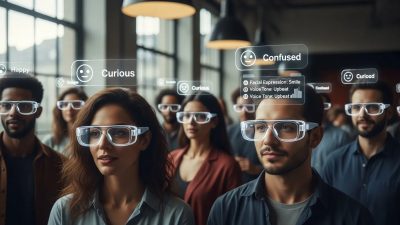
Introduction to Federated Learning in AR
In recent years, augmented reality (AR) has grown beyond entertainment into sectors like healthcare, education, and enterprise solutions. The rise of AR technologies brings immense benefits but also a pressing challenge: how to process and utilize sensitive user data without compromising privacy. This is where federated learning in AR emerges as a transformative solution. By enabling devices to collaboratively train AI models locally without sharing raw data, federated learning ensures that privacy is preserved while maintaining high-quality data processing.
Unlike traditional centralized AI training, federated learning distributes the computational task across multiple devices. Each device processes its data independently, only sharing model updates with a central server. This decentralized approach is especially crucial in AR applications, where real-time data streams—from cameras, sensors, and user interactions carry personal and often sensitive information. By keeping data on-device, federated learning mitigates risks associated with breaches or misuse while still improving the overall intelligence of AR systems.
Why Privacy Matters in AR
AR applications constantly collect vast amounts of data, including location, biometric details, and interaction patterns. Without privacy-focused approaches, this data could easily be exploited for unauthorized purposes. Implementing federated learning in AR ensures that users retain control over their data while developers benefit from aggregated insights. This balance of privacy and utility is key to building trust in AR platforms.
Moreover, emerging trends such as AR Quantum Computing hint at even more complex computations in the future. Quantum-powered AR devices could enhance the speed and accuracy of real-time data processing, but they also amplify the stakes regarding user privacy. By integrating federated learning, AR developers can prepare for these advanced technologies without compromising ethical standards or regulatory compliance.
Applications of Federated Learning in AR

The potential applications of federated learning in AR are vast and cross-industry:
-
Healthcare AR Solutions – AR-assisted surgeries or patient monitoring systems can leverage federated learning to train models on sensitive medical data without exposing individual patient records.
-
Education and Training – Personalized AR learning experiences can adapt in real-time based on student interactions, improving outcomes while maintaining privacy.
-
Retail and Marketing – AR product visualization and personalized recommendations can be powered by local data aggregation, reducing the risk of exposing customer behavior externally.
-
Emotion Recognition AI – Advanced AR interfaces can analyze facial expressions and gestures to create adaptive experiences. With federated learning, sensitive emotional data stays on the device, ensuring privacy while refining AI accuracy.
-
Enterprise Collaboration – AR Autonomous Agents in corporate environments can leverage federated learning to optimize workflows, task management, and virtual meetings without leaking sensitive organizational data.
These applications highlight how federated learning in AR can balance innovation with privacy, a combination increasingly valued by users and regulators alike.
How Federated Learning Works in AR
At its core, federated learning in AR is designed to train machine learning models collaboratively across multiple devices without centralizing raw data. Each AR device whether a headset, smartphone, or wearable sensor—locally computes updates based on its own dataset. These updates, usually in the form of model gradients or parameters, are then securely transmitted to a central server. The server aggregates these updates and refines a global model, which is then redistributed to the devices.
This process enables continuous learning in AR applications. For example, an AR navigation app can learn user preferences for routes or landmarks without ever storing location data centrally. Similarly, AR-based gaming environments can adapt difficulty levels and interactive elements based on aggregated player behavior, all while maintaining user privacy.
Key Components in AR Federated Learning
-
Local Model Training – Each device trains a local version of the AI model using its own AR-generated data. This reduces the need to share raw images, spatial data, or sensor readings externally.
-
Secure Aggregation – Updates from devices are encrypted and aggregated to prevent reverse-engineering of individual data points. Techniques like homomorphic encryption and differential privacy are commonly used.
-
Global Model Update – After aggregation, the global model is updated and sent back to each device, allowing the system to learn collectively while keeping sensitive AR data on-device.
-
Iterative Refinement – Continuous cycles of local training and global aggregation enhance model accuracy and responsiveness, which is particularly important for real-time AR interactions.
Addressing Challenges in AR Data Privacy
While federated learning in AR provides a robust privacy framework, several challenges must be addressed:
-
Communication Overhead – Frequent updates between devices and servers can strain networks, particularly in AR systems with high data rates. Efficient compression and update scheduling are essential.
-
Heterogeneous Devices – AR devices vary in processing power and sensors. Ensuring consistent learning across heterogeneous devices requires adaptive strategies.
-
Data Quality and Bias – Local datasets may be uneven or biased. Techniques to balance contributions from diverse users help improve fairness and model robustness.
-
AR Inequality – Not all users have access to high-performance AR hardware. Federated learning can exacerbate AR inequality if resource-constrained devices are underrepresented in model training. Developers must account for this to maintain inclusive experiences.
Integrating Federated Learning with Advanced AR Technologies
The future of AR is increasingly tied to other cutting-edge technologies. AR Quantum Computing, for instance, promises exponential improvements in processing complex AR data, enabling real-time analysis of vast datasets. When combined with federated learning, this can lead to highly sophisticated AR systems that respect privacy while performing advanced computations on-device.
Similarly, AI vs Human in Market Research is a trend where AR-enabled tools can collect consumer insights more intelligently. Federated learning ensures that sensitive survey or behavior data remains private, even when aggregating across thousands of users for analytics. This approach maintains ethical standards while enhancing decision-making accuracy.
Real-World Use Cases of Federated Learning in AR
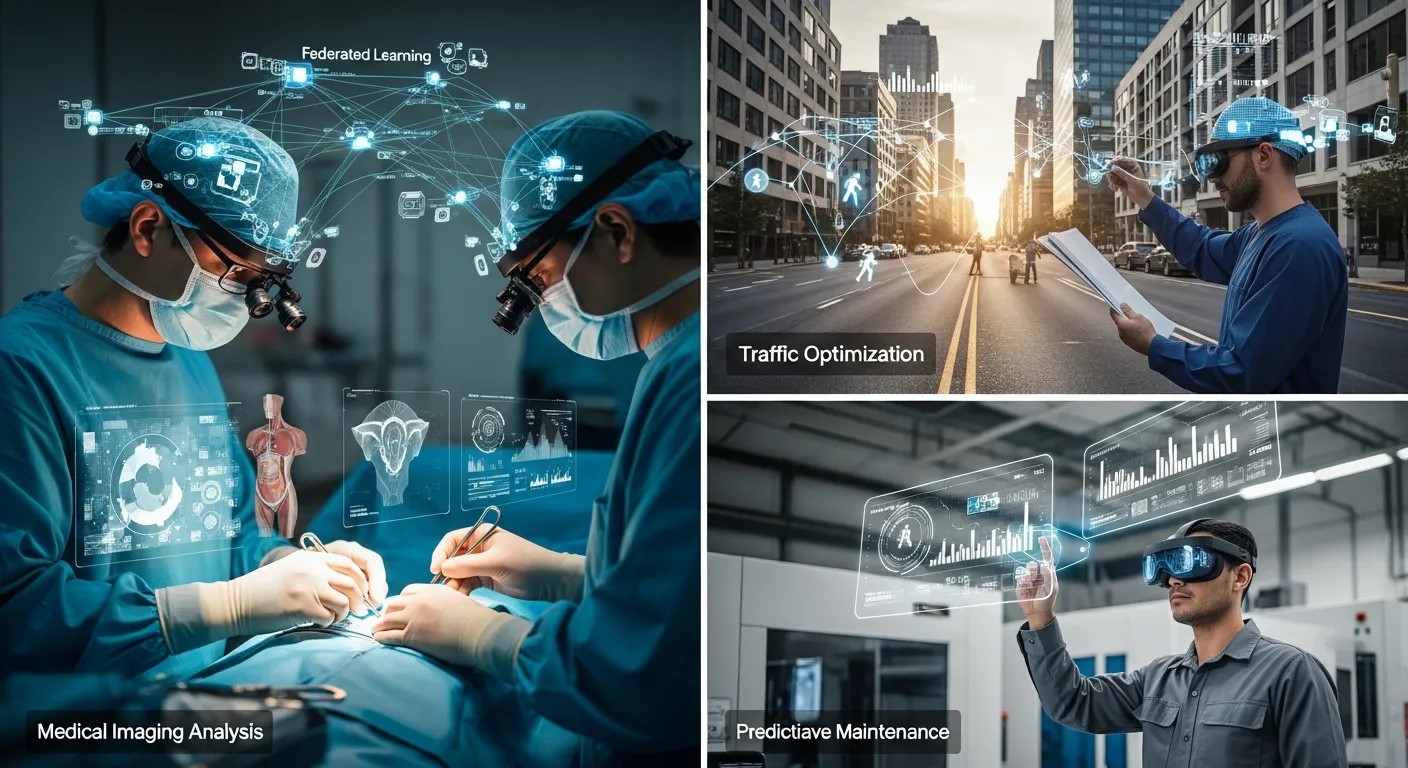
The potential of federated learning in AR extends across multiple industries, combining privacy, intelligence, and immersive experiences. By keeping user data on-device, organizations can harness actionable insights without compromising trust.
Healthcare and Medical Training
Healthcare is one of the most sensitive domains where AR applications thrive. AR-assisted surgeries, patient monitoring, and medical training simulations generate massive volumes of personal data. Implementing federated learning in AR allows hospitals and medical institutions to collaboratively train AI models across multiple sites without sharing raw patient information.
For instance, an AR-based surgical training platform can analyze hand movements and procedural accuracy in real-time, adapting guidance and feedback. By leveraging federated learning, hospitals maintain patient privacy while continuously improving AI performance. Additionally, when integrated with Emotion Recognition AI, AR systems can gauge trainee stress or engagement levels, enhancing personalized learning without exposing sensitive biometric data.
Retail, Marketing, and Consumer Insights
Retailers are increasingly adopting AR experiences to engage consumers. AR try-on solutions for fashion, virtual product visualization, and interactive shopping environments all rely on personal user data. Federated learning in AR enables these platforms to analyze behavior and preferences across a broad user base while ensuring individual privacy.
Moreover, combining these insights with AI vs Human in Market Research allows brands to refine campaigns, predict trends, and optimize AR-driven shopping experiences. This balance between automation and human intelligence ensures brands stay relevant without compromising user trust.
Collaborative Workspaces and AR Autonomous Agents
Modern enterprises are embracing AR for collaborative work, training, and virtual prototyping. AR Autonomous Agents are intelligent systems that assist users in these virtual spaces, performing tasks, providing contextual suggestions, or managing workflows. When federated learning is applied, these agents continuously learn from distributed user interactions while keeping sensitive business data local.
For example, in a multinational company, AR Autonomous Agents can optimize meeting agendas, track project progress, and recommend resources, all without transmitting confidential documents or user activity logs to central servers. This approach ensures both operational efficiency and privacy compliance.
Education and Personalized Learning
AR-powered classrooms are transforming education. Through immersive learning, students can explore historical sites, conduct virtual experiments, or visualize complex scientific concepts. Federated learning in AR allows these platforms to adapt lessons to each student’s learning pace and style, using local interaction data.
In addition, integrating AR Quantum Computing can dramatically enhance simulation accuracy and performance, enabling real-time adaptive learning environments. The combination of quantum computational power and federated learning ensures that educational content remains both personalized and private.
Technical Advantages of Federated Learning in AR
Implementing federated learning in AR provides multiple advantages:
-
Data Privacy Compliance – Meets GDPR, HIPAA, and other data protection regulations by keeping sensitive AR data on-device.
-
Reduced Latency – Local processing reduces the need for continuous cloud communication, improving responsiveness in real-time AR applications.
-
Scalable Learning – Distributed training enables AI models to learn from diverse user data without central storage limitations.
-
Enhanced Personalization – Systems can tailor AR content based on local data, improving user engagement while safeguarding privacy.
Additionally, federated learning ensures that AR Inequality is addressed by allowing even lower-powered devices to contribute to global models without sharing heavy data streams. This encourages inclusivity across diverse user bases, reducing gaps in access to cutting-edge AR experiences.
Advanced Technical Strategies for Federated Learning in AR

The effectiveness of federated learning in AR depends not only on preserving privacy but also on optimizing the technical frameworks that power distributed AI. Developers and researchers are exploring multiple strategies to enhance learning efficiency, model accuracy, and scalability.
Model Optimization Techniques
AR applications often rely on deep neural networks to interpret complex sensor data, spatial information, and user interactions. To ensure efficient federated learning:
-
Gradient Compression – Reduces the size of model updates sent to the server, lowering communication overhead without compromising learning quality.
-
Adaptive Learning Rates – Dynamically adjusts local training rates based on device performance, ensuring consistent convergence across heterogeneous AR devices.
-
Split Learning – Segments the model into smaller components, allowing heavy computations to be handled locally while lighter layers are processed centrally, balancing performance and privacy.
These optimizations are particularly relevant when AR applications involve high-dimensional data streams, such as real-time video feeds or multi-sensor spatial mapping.
Secure Data Aggregation
Ensuring the security of aggregated model updates is crucial for maintaining privacy in federated learning in AR. Techniques include:
-
Differential Privacy – Adds controlled noise to updates, making it statistically impossible to infer individual user data.
-
Homomorphic Encryption – Enables computation on encrypted updates without decrypting them, protecting sensitive AR datasets.
-
Secure Multiparty Computation (SMPC) – Distributes computation across multiple nodes to prevent any single party from accessing raw data.
These security strategies make federated learning ideal for AR use cases involving Emotion Recognition AI, where sensitive biometric or emotional data must remain on-device.
Frameworks and Platforms
Several frameworks now support federated learning in AR development:
-
TensorFlow Federated (TFF) – An open-source framework for building scalable federated learning models compatible with mobile and AR devices.
-
PySyft – Focused on privacy-preserving AI, enabling federated learning with differential privacy and encryption.
-
Flower – Lightweight, flexible platform for deploying federated learning across heterogeneous devices, ideal for AR applications with varying hardware capabilities.
By leveraging these frameworks, developers can build secure, efficient, and adaptive AR experiences while ensuring compliance with privacy standards.
Emerging Trends and Future Directions
The intersection of federated learning and AR is rapidly evolving. Several trends are shaping the future:
-
AR Quantum Computing Integration – Quantum computing could dramatically accelerate on-device computations, enabling complex real-time AR processing without centralizing data.
-
AR Autonomous Agents Expansion – Intelligent agents in collaborative AR environments can learn continuously from local interactions, improving productivity and personalization while maintaining confidentiality.
-
Hybrid AI Approaches – Combining AI vs Human in Market Research, AR platforms can intelligently leverage insights from human analysts and federated AI models, achieving more nuanced decisions while protecting user data.
-
Reducing AR Inequality – Innovations in lightweight federated learning models make high-quality AR accessible to users with lower-end devices, reducing gaps in adoption and experience.
These advancements highlight how federated learning in AR not only enhances privacy but also unlocks the potential for more sophisticated, immersive, and inclusive applications across industries.
Case Studies of Federated Learning in AR
Practical implementations of federated learning in AR demonstrate how privacy-preserving techniques can drive real-world value across sectors. These case studies highlight the scalability, efficiency, and ethical advantages of decentralized AI.
Healthcare: Remote Patient Monitoring
A leading healthcare provider implemented federated learning in AR to enhance remote patient monitoring systems. AR headsets tracked patient movement and vital signs during physical therapy sessions. By processing data locally on each headset, the system maintained strict compliance with HIPAA regulations.
Moreover, integrating Emotion Recognition AI allowed therapists to monitor patient engagement and emotional responses without transmitting raw data externally. The result was a highly personalized rehabilitation program that continuously improved while protecting sensitive information.
Retail: AR-Powered Virtual Try-On
An international fashion retailer adopted federated learning in AR for its AR try-on solution. Customers could visualize clothing on their devices in real-time. By aggregating model updates instead of raw images, the platform improved outfit recognition algorithms while ensuring customer privacy.
Additionally, combining insights from AI vs Human in Market Research, the system adjusted virtual displays based on aggregated behavioral data. This hybrid approach enhanced predictive recommendations while respecting individual user confidentiality.
Education: Adaptive Learning Platforms
A global ed-tech company deployed federated learning in AR to create adaptive learning experiences. Students used AR tablets to interact with virtual labs and historical simulations. The system trained AI models locally to tailor content to each student’s pace and style.
Integration with AR Quantum Computing enabled complex simulations to run in real-time, enhancing learning outcomes. Federated learning ensured that sensitive student data stayed private, addressing concerns around AR Inequality by allowing even lower-end devices to participate in training.
Enterprise Collaboration: AR Autonomous Agents
A multinational firm implemented federated learning in AR to optimize AR Autonomous Agents in virtual workspaces. These agents analyzed project workflows, monitored collaboration, and suggested task improvements based on local interactions.
By keeping all data on-device, the system maintained corporate confidentiality and allowed continuous improvement of agent intelligence. This approach demonstrated how federated learning in AR could support complex, privacy-sensitive enterprise environments while improving productivity.
Performance Metrics and Optimization
Measuring the effectiveness of federated learning in AR involves multiple metrics:
-
Model Accuracy – Evaluates how well the AI model predicts or interprets AR data across devices.
-
Communication Efficiency – Assesses network usage and the effectiveness of gradient compression techniques.
-
Latency and Responsiveness – Critical for real-time AR experiences, ensuring minimal delays in rendering and interaction.
-
Privacy Compliance Score – Measures adherence to data protection regulations like GDPR and HIPAA.
-
Device Contribution Balance – Ensures heterogeneous devices contribute effectively, mitigating AR Inequality.
These metrics provide actionable insights for developers to fine-tune federated learning in AR implementations and maintain high performance without compromising user privacy.
Industry Adoption Trends

Across industries, federated learning in AR is gaining traction due to growing privacy concerns and the need for personalized AR experiences. Key adoption trends include:
-
Healthcare and Telemedicine – Hospitals and clinics prioritize privacy-preserving AR solutions for patient care.
-
Retail and Marketing – Brands leverage federated learning to personalize AR experiences without collecting sensitive customer data.
-
Education and Training – Adaptive AR learning platforms are being widely deployed globally.
-
Corporate Collaboration – Companies adopt AR Autonomous Agents powered by federated learning to improve productivity while keeping data secure.
As AR technology becomes more widespread, federated learning ensures that growth is sustainable, inclusive, and ethical.
Conclusion
Federated learning in AR represents a paradigm shift in how augmented reality systems process data. By keeping sensitive information on-device, it ensures privacy, security, and compliance while enabling smarter, adaptive, and personalized AR experiences. From healthcare to education, retail, and enterprise, federated learning enhances efficiency and inclusivity, addresses AR Inequality, and prepares the AR ecosystem for future innovations like AR Quantum Computing and AR Autonomous Agents. As technology evolves, adopting privacy-first strategies ensures AR remains trustworthy, ethical, and transformative across industries.
Frequently Asked Questions (FAQ)
What is federated learning in AR?
Federated learning in AR is a decentralized AI approach where AR devices train models locally using on-device data, sharing only model updates with a central server. This ensures privacy while improving AR system intelligence.
How does federated learning protect user privacy?
By keeping sensitive data on individual devices, federated learning prevents raw AR data from being stored centrally. Techniques like differential privacy and encryption further secure updates, maintaining confidentiality in applications like Emotion Recognition AI and AR analytics.
Which industries benefit most from federated learning in AR?
Healthcare, education, retail, and enterprise collaboration are primary beneficiaries. Applications include remote patient monitoring, adaptive learning platforms, AR try-on solutions, and AR Autonomous Agents for workflow optimization.
Can federated learning reduce AR inequality?
Yes. By enabling lower-end devices to contribute to model training without heavy data transfer, federated learning mitigates AR Inequality, ensuring more inclusive access to advanced AR experiences.
How does federated learning integrate with emerging technologies?
It complements AR Quantum Computing by enabling complex computations on-device and enhances AR Autonomous Agents’ intelligence while maintaining privacy. It also supports hybrid AI approaches, like AI vs Human in Market Research, for more accurate insights.
Is federated learning in AR scalable?
Absolutely. Distributed training allows large-scale learning across millions of devices while maintaining privacy. Optimizations like gradient compression and adaptive learning rates ensure efficient communication and consistent model performance.