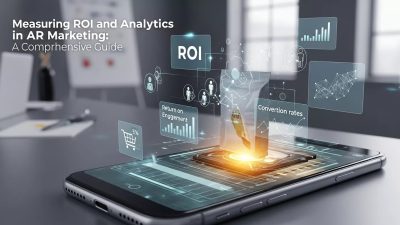
AR marketing creates deeper, high-intent engagement beyond traditional metrics. By integrating AR analytics across the buyer journey and focusing on meaningful interactions, brands can achieve clearer ROI and sustainable growth.
Measuring AR Marketing ROI : A Comprehensive Guide

Augmented Reality (AR) has transformed how brands connect with audiences by blending digital experiences into the physical world. What began as an experimental technology has matured into a measurable, performance-driven marketing channel used across retail, real estate, automotive, healthcare, education, and entertainment industries.
As AR adoption grows, one critical question continues to surface: How do you accurately measure AR marketing ROI?
Unlike traditional digital campaigns, AR experiences generate deeper behavioral signals—interaction depth, spatial engagement, dwell time, and feature usage—making ROI measurement both more complex and more powerful.
This comprehensive guide explores how to measure, analyze, and optimize AR marketing ROI using evergreen frameworks, proven metrics, real-world strategies, and scalable analytics models designed to remain relevant for years to come.
What Is AR Marketing ROI?
Return on Investment (ROI) is a fundamental performance metric that compares the value generated from a campaign against the resources invested. In AR marketing, ROI extends beyond immediate sales and includes engagement quality, decision confidence, brand perception, and long-term customer value.
Core AR ROI Formula
AR Marketing ROI = (Total Value Generated – Total AR Investment) ÷ Total AR Investment
What Counts as Investment?
-
AR experience design and UX planning
-
3D modeling, animation, and optimization
-
Platform licensing or software subscriptions
-
WebAR or app development
-
Media spend and distribution costs
-
Analytics implementation and maintenance
What Counts as Value?
-
Direct sales and assisted conversions
-
Increased average order value (AOV)
-
Reduced product return rates
-
Lead generation and data capture
-
Higher engagement and brand recall
-
Improved buyer confidence and reduced friction
AR should be evaluated as both a technology layer and a storytelling medium. When measured holistically, AR provides insights into how users explore products, compare options, and make decisions—data that traditional formats cannot capture.
Why Measuring AR ROI Is Different from Traditional Marketing

Traditional digital marketing often focuses on surface-level metrics such as impressions, clicks, and bounce rates. AR marketing introduces immersive interaction, which requires a more nuanced approach.
Unique Characteristics of AR Measurement
-
Multi-dimensional engagement: Users don’t just view content—they manipulate it
-
Spatial behavior tracking: Movement, scale, placement, and orientation matter
-
Intent signaling: Longer interaction often correlates with higher purchase intent
-
Assisted conversion paths: AR frequently influences decisions without being the final click
Because of this, AR ROI should be evaluated using both quantitative and qualitative metrics.
Essential Metrics for Measuring AR Marketing ROI
To measure AR performance accurately, metrics must align with campaign objectives and funnel stages.
Awareness Metrics
Impressions & Reach
Measures how many users are exposed to the AR experience across platforms.
Share Rate
Tracks how often users share AR experiences organically, indicating virality and brand affinity.
Engagement Metrics
Engagement Rate
Percentage of users who actively interact with AR elements such as tapping, rotating, resizing, or scanning.
Session Duration (Dwell Time)
Average time spent within the AR experience. Longer dwell time often reflects stronger interest.
Interaction Depth
Number of actions performed per session (feature clicks, object manipulation, customization).
Feature Utilization Rate
Tracks which AR features users engage with most, revealing content effectiveness.
Conversion Metrics
Click-Through Rate (CTR)
Measures engagement with CTAs, product links, or navigation elements inside AR.
Conversion Rate
Tracks purchases, form submissions, downloads, or inquiries influenced by AR interactions.
Assisted Conversion Value
Identifies revenue generated when AR played a role earlier in the buyer journey.
Cost Efficiency Metrics
Cost Per Engagement (CPE)
Total AR spend divided by meaningful user interactions.
Cost Per Conversion
Evaluates how efficiently AR drives revenue compared to other channels.
Incremental Revenue Lift
Measures additional revenue generated by AR users compared to non-AR users.
Mapping AR Experiences to the Buyer Journey

High-ROI AR campaigns are strategically placed at critical decision points.
Awareness Stage
-
Interactive AR ads
-
Social AR filters and lenses
-
Gamified brand activations
Objective: Capture attention and increase brand recall
Consideration Stage
-
Virtual product demos
-
3D product visualizations
-
Feature exploration experiences
Objective: Educate users and reduce uncertainty
Decision Stage
-
Virtual try-ons
-
In-home product placement
-
Customization and configuration tools
Objective: Increase confidence and accelerate conversions
Post-Purchase & Retention
-
AR onboarding guides
-
Product tutorials
-
Loyalty-based AR experiences
Objective: Improve satisfaction and lifetime value
Proven Strategies to Maximize AR Marketing ROI

Personalization & Contextual Relevance
AR experiences that adapt to user location, preferences, or behavior consistently outperform generic executions.
Social Sharing & Organic Amplification
Branded AR filters and lenses encourage user-generated content, reducing acquisition costs and increasing reach.
E-Commerce Integration
Embedding AR directly into product pages shortens the path to purchase and captures real-time intent data.
Retargeting Based on AR Signals
Use interaction depth, dwell time, and feature usage to build high-intent retargeting audiences.
Continuous Testing & Optimization
A/B test AR creatives, CTAs, 3D models, and UX flows to identify performance drivers.
Tools and Platforms for AR Analytics
A scalable AR analytics stack is essential for long-term ROI measurement.
AR-Specific Analytics Platforms
-
Social AR analytics tools for filters and lenses
-
WebAR analytics dashboards for session tracking
-
Location-based AR measurement tools
General Analytics Integration
-
Event-based analytics platforms
-
Tag management systems
-
CRM and BI tool integration
Unified reporting ensures AR performance is evaluated alongside other marketing channels.
Best Practices for Data-Driven AR Campaigns

-
Define KPIs before development begins
-
Use consistent event naming conventions
-
Validate tracking across devices and platforms
-
Perform cohort analysis by audience segment
-
Refresh creative assets to prevent fatigue
-
Align marketing, analytics, and development teams
Strong data governance protects measurement accuracy and long-term insights.
Real-World AR ROI Use Cases
Retail Virtual Try-On
Brands implementing AR fitting rooms report higher conversion rates, increased order values, and reduced returns.
Interactive Packaging & Print
AR-enabled packaging and print campaigns increase engagement and drive measurable digital traffic.
Event & Experiential Marketing
AR activations at events consistently outperform static displays in lead capture and brand recall.
Overcoming Common AR Marketing Challenges
High Development Costs
Use modular assets and reusable components across campaigns.
Device Compatibility
Optimize experiences for common devices and browsers.
User Onboarding Friction
Keep instructions simple and intuitive.
Privacy & Compliance
Ensure transparency and compliance with global data regulations.
Analytics Silos
Centralize AR data within existing analytics infrastructure.
The Long-Term Future of AR Marketing ROI
AR continues to evolve with advancements in:
-
Wearable and hands-free AR devices
-
Spatial computing and environment understanding
-
AI-driven real-time personalization
-
Seamless cross-platform AR ecosystems
Brands that invest in flexible, future-proof measurement frameworks will sustain competitive advantage.
Actionable AR Strategies for Higher Engagement and Measurable Returns

Augmented Reality marketing has become a high-impact channel for brands seeking deeper interaction rather than surface-level visibility. Unlike traditional formats, AR allows users to explore products, environments, and features in real time, creating stronger emotional connections and more reliable intent signals that static content often fails to deliver. Instead of passively consuming information, users actively participate in the experience, which leads to higher attention retention and more meaningful engagement.
When applied thoughtfully, AR Marketing Tips to Drive Real Engagement and ROI are not about adding more features or visual complexity, but about designing purposeful interactions that feel intuitive and valuable. Fast load times, smooth performance, and clear interaction cues play a critical role in keeping users engaged. Simple actions such as rotating a product, placing it in a real environment, or switching between variations often outperform overly complex AR mechanics. Brands that focus on usability, relevance, and storytelling are more likely to see longer session durations, higher engagement rates, and improved conversion signals.
From a performance perspective, actionable AR strategies also emphasize alignment with business objectives. Whether the goal is awareness, consideration, or conversion, AR experiences should guide users toward a clear next step. By continuously testing interaction flows, refining CTAs, and analyzing engagement depth, marketers can transform immersive experiences into measurable returns rather than treating AR as a purely experimental channel.
How to Accurately Measure Performance and ROI in AR Campaigns
As immersive campaigns grow in complexity, marketers must rethink how success is measured across the funnel. AR does not always produce instant conversions, but it plays a powerful role in shaping buyer confidence, product understanding, and decision-making. Because of this, relying solely on last-click attribution often undervalues the true contribution of AR experiences.
That is why a Practical Guide to Measuring ROI on Your AR Marketing Campaigns focuses on combining engagement-focused metrics—such as dwell time, interaction depth, and feature usage—with assisted conversion and downstream performance data. These signals reveal how users interact with AR, which features influence intent, and how engagement translates into real business outcomes over time. For example, a longer AR session or repeated feature interaction may indicate higher purchase readiness, even if the final conversion occurs later through another channel.
Accurate measurement also depends on integrating AR analytics into broader marketing and analytics systems. When AR events are tracked consistently and connected with CRM, e-commerce, or lead management platforms, marketers gain a clearer view of how AR impacts revenue, lead quality, and customer lifetime value. This holistic approach ensures AR performance is evaluated fairly and strategically, rather than in isolation.
Understanding AR Marketing and Its Impact on Brand Growth
To measure performance accurately, it is essential to understand the foundation of the channel itself. What Is AR Marketing and How It Can Elevate Your Brand becomes clear when AR is viewed not just as a technology, but as a powerful communication tool that bridges the gap between digital and physical experiences. AR marketing enables brands to present information in a more engaging, interactive, and memorable way.
By allowing users to visualize products in real-world contexts, interact with features before purchasing, or explore branded stories through immersive elements, AR reduces uncertainty and builds trust. This is particularly valuable in industries where customers rely heavily on visual confirmation or experiential reassurance before making decisions. As a result, AR often improves brand perception, increases confidence, and strengthens emotional connections with the audience.
Over time, consistent use of AR can position a brand as innovative, customer-centric, and forward-thinking. These brand-level benefits may not always be immediately measurable through direct conversions, but they contribute significantly to long-term brand growth, loyalty, and competitive differentiation in crowded markets.
Key AR Developments Shaping the Future of Marketing

Looking ahead, long-term success in AR marketing depends on how effectively brands adapt to ongoing changes in immersive technology. As adoption increases across industries, AR Marketing Trends Your Business Can’t Ignore are no longer experimental concepts but practical advancements that influence scalability, performance, and ROI.
Key developments include improvements in spatial computing, which allow AR content to interact more naturally with real-world environments, and AI-driven personalization, which enables experiences to adapt in real time based on user behavior and preferences. Cross-platform AR experiences—spanning web, mobile apps, social platforms, and physical locations—are also making campaigns more accessible and measurable.
Businesses that align early with these developments are better positioned to build reusable AR assets, streamline production costs, and optimize campaigns continuously. Rather than reacting to change, forward-thinking brands treat these advancements as opportunities to strengthen long-term ROI, maintain relevance, and future-proof their AR marketing strategies.
Frequently Asked Questions (FAQ)
1. What is AR marketing ROI?
AR marketing ROI refers to the measurable value generated from augmented reality campaigns compared to the total investment required to build, launch, and promote those experiences. This value may include direct sales, assisted conversions, higher engagement, reduced return rates, and improved brand perception.
2. How is AR marketing ROI different from traditional digital marketing ROI?
Unlike traditional digital marketing, AR marketing ROI focuses heavily on immersive engagement metrics such as interaction depth, dwell time, feature usage, and spatial behavior. AR often influences purchasing decisions indirectly, making assisted conversion tracking more important than last-click attribution.
3. Which metrics are most important for measuring AR marketing ROI?
Key AR ROI metrics include engagement rate, session duration, interaction depth, click-through rate, conversion rate, cost per engagement (CPE), and incremental revenue lift. The importance of each metric depends on whether the campaign goal is awareness, consideration, or conversion.
4. Can AR marketing directly increase sales and conversions?
Yes. AR experiences such as virtual try-ons, in-home product previews, and interactive demos can significantly increase buyer confidence. This often results in higher conversion rates, increased average order value, and lower product return rates.
5. How do you attribute revenue to AR marketing campaigns?
Revenue attribution in AR marketing typically uses multi-touch attribution models. AR engagement data is integrated with analytics platforms to track assisted conversions, comparing user journeys with and without AR interactions to calculate incremental impact.
6. Is AR marketing ROI measurable without an e-commerce store?
Absolutely. Even without direct online sales, AR ROI can be measured through lead generation, form submissions, session duration, engagement quality, brand recall studies, and offline conversion tracking tied to AR interactions.
7. What tools are commonly used to track AR marketing performance?
AR performance is tracked using a combination of AR platform analytics, event-based analytics tools, tag management systems, and business intelligence dashboards. Integrating AR events into existing analytics frameworks enables unified performance reporting.
8. How expensive is it to achieve positive ROI with AR marketing?
AR marketing costs vary based on complexity, platform choice, and asset quality. However, ROI improves significantly when brands reuse modular 3D assets, leverage web-based AR, and scale successful experiences across multiple campaigns.
9. What are the biggest challenges in measuring AR marketing ROI?
Common challenges include data fragmentation across platforms, inconsistent event tracking, device compatibility issues, and privacy compliance requirements. These challenges can be mitigated through standardized measurement frameworks and integrated analytics systems.
10. Is AR marketing a long-term strategy or a short-term trend?
AR marketing is a long-term growth strategy. As devices, platforms, and spatial computing technologies evolve, brands with established AR measurement frameworks and reusable assets will continue to see compounding ROI over time.