

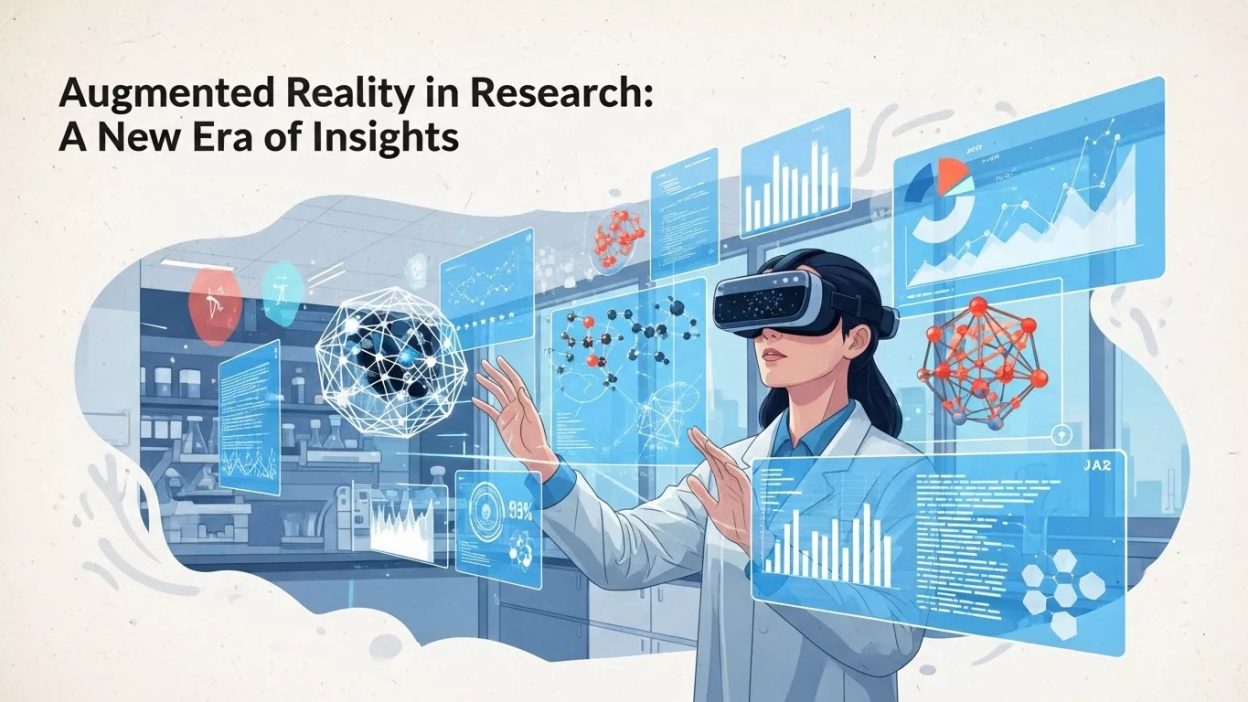
Augmented Reality in Research: A New Lens for Understanding Consumers
Augmented Reality in marketing research has moved far beyond experimental pilots and novelty campaigns. In 2026, it is becoming a serious research tool used by brands, agencies, and product teams to understand consumer behavior in ways traditional surveys and focus groups never could. As digital experiences become more immersive and consumers demand authenticity, marketing research must evolve alongside them.
This article explores how Augmented Reality in Marketing Research is reshaping data collection, insight quality, and decision-making. You’ll learn where AR delivers measurable value, how it fits into modern research frameworks, and why forward-thinking brands are integrating it into their long-term research strategies.
What Makes Augmented Reality Different in Marketing Research
Traditional marketing research relies heavily on self-reported data. Surveys, interviews, and questionnaires often suffer from recall bias, low engagement, and artificial environments. Augmented Reality changes this by placing consumers inside simulated yet realistic contexts where behavior can be observed instead of guessed.
With AR, participants can interact with virtual products, environments, or store layouts in real time. Researchers capture behavioral signals such as movement, attention, dwell time, and choice patterns. This creates richer datasets and reduces the gap between what consumers say and what they actually do.
Why Augmented Reality in Marketing Research Is Gaining Momentum
Several factors explain why AR-based research is accelerating:
- Mobile devices now support AR at scale
- Consumers are more comfortable with immersive digital experiences
- Brands need faster, more predictive insights
- Remote research has become a permanent requirement
Together, these forces make Augmented Reality in Marketing Research not just innovative, but necessary.
Key Use Cases of Augmented Reality in Marketing Research
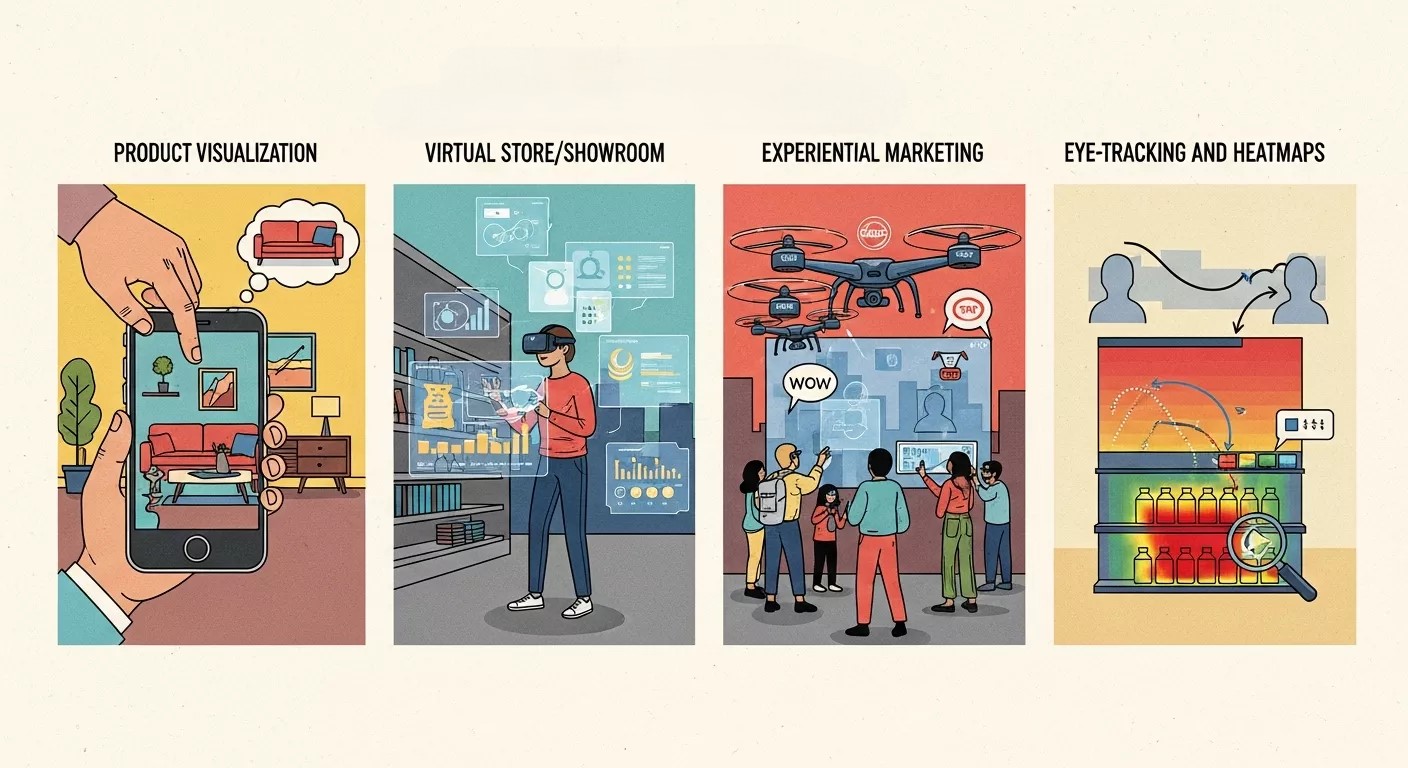
Product Testing Before Physical Production
AR allows brands to test product designs, packaging, and features before manufacturing. Participants can examine size, color, placement, and usability in their own environments. This significantly reduces prototyping costs and speeds up validation cycles.
Shopper Behavior Simulation
Retail brands use AR to recreate shelf layouts or store environments. Researchers observe how consumers navigate, what catches attention, and where friction occurs. This insight is invaluable for merchandising and layout optimization.
Advertising and Creative Testing
Augmented Reality in Marketing Research enables brands to test immersive ads, interactive storytelling, and experiential formats before launch. Engagement metrics go far beyond impressions or clicks, offering deeper insight into emotional response.
Enhancing Product Marketing with Augmented Reality
One of the strongest benefits of AR research lies in enhancing product marketing with augmented reality experiences. When consumers interact with a virtual product in their real environment, their feedback becomes more concrete and actionable.
For example, furniture brands can test placement, size perception, and aesthetic fit. Beauty brands can analyze shade selection and confidence levels. These insights directly inform positioning, messaging, and go-to-market strategies.
Augmented Reality Marketing Strategy and Research Alignment
An effective Augmented Reality Marketing Strategy must be grounded in research, not assumptions. AR-based research closes the loop between strategy and execution by validating ideas before they reach the market.
Research insights from AR experiences help marketers:
- Identify high-impact features
- Refine value propositions
- Reduce campaign risk
- Improve personalization accuracy
When research and strategy are aligned, AR becomes a growth multiplier rather than a gimmick.
Data Quality: Why AR Research Delivers Better Insights
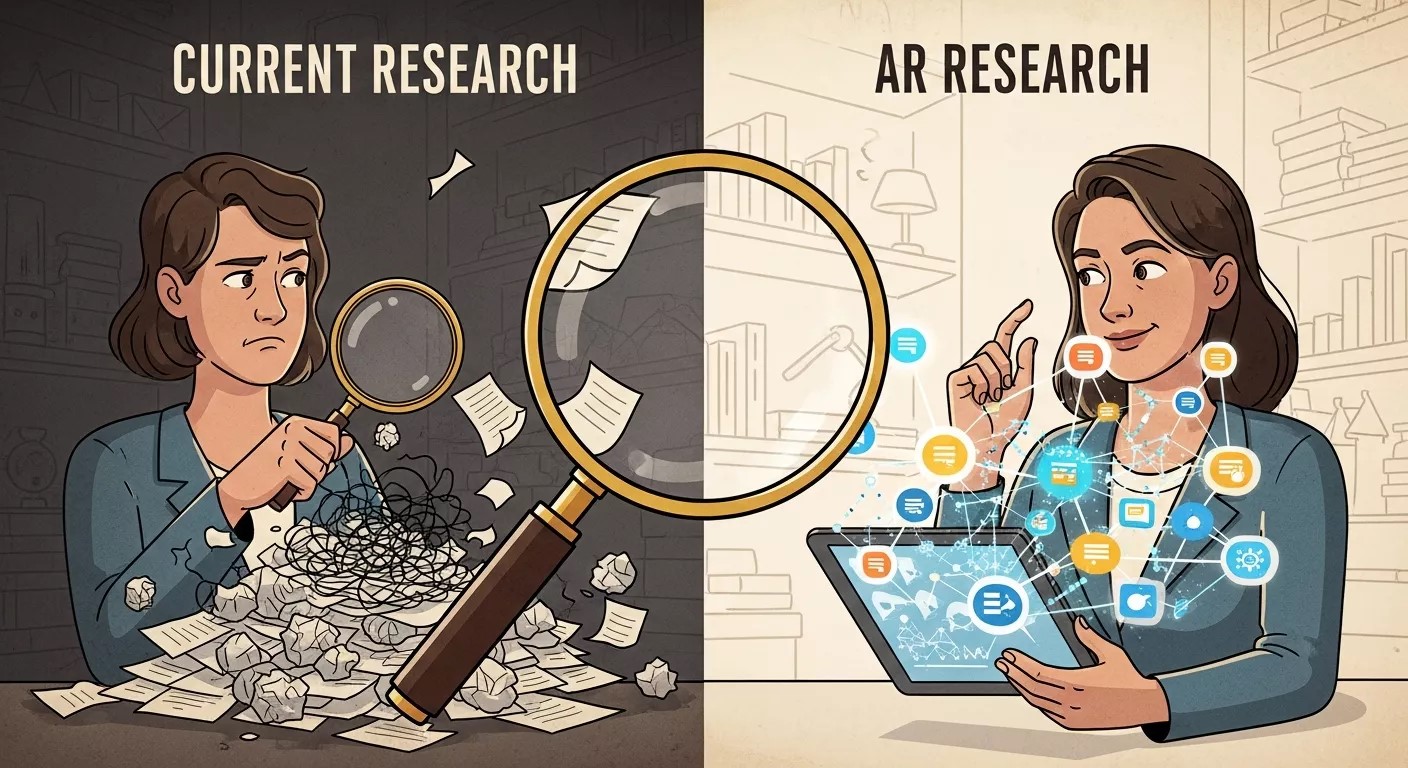
Augmented Reality in Marketing Research improves data quality in three critical ways:
- Contextual realism – Participants respond within realistic environments
- Behavioral tracking – Actions are observed, not just reported
- Higher engagement – Interactive experiences reduce fatigue and dropout
These factors lead to insights that are more predictive of real-world behavior.
Augmented Reality Marketing Impacts in Online Reputation
Beyond research efficiency, AR also influences brand perception. Augmented Reality Marketing Impacts in Online Reputation are increasingly visible as consumers associate immersive, transparent experiences with innovation and trust.
When brands invite users to explore products virtually, they signal confidence and openness. Research-driven AR experiences reduce post-purchase dissatisfaction, which in turn lowers negative reviews and strengthens long-term reputation.
Ethical and Methodological Considerations
As with any research method, AR must be used responsibly. Transparency, consent, and data privacy are essential. Researchers should also ensure that AR experiences do not manipulate participants or create misleading perceptions.
Methodologically, AR research should complement not replace traditional methods. The strongest insights come from mixed-method approaches that combine qualitative depth with quantitative scale.
Measuring ROI of Augmented Reality in Marketing Research
ROI measurement is critical in competitive environments. Brands typically evaluate AR research ROI through:
- Reduced product development costs
- Faster insight cycles
- Improved campaign performance
- Higher customer satisfaction
When these metrics are tracked properly, the business case for AR research becomes clear.
Industry Examples and Applications
Across industries, Augmented Reality in Marketing Research is proving its value:
- Retail: Shelf testing and assortment optimization
- CPG: Packaging and claims validation
- Automotive: Feature prioritization and interior design testing
- Real estate: Space perception and buyer intent analysis
These applications highlight AR’s versatility as a research tool.
Challenges Brands Still Face
Despite its advantages, AR research adoption faces obstacles:
- Initial setup costs
- Technical complexity
- Participant device compatibility
- Internal skill gaps
However, as platforms mature and costs decrease, these barriers continue to fall.
The Future of Augmented Reality in Marketing Research
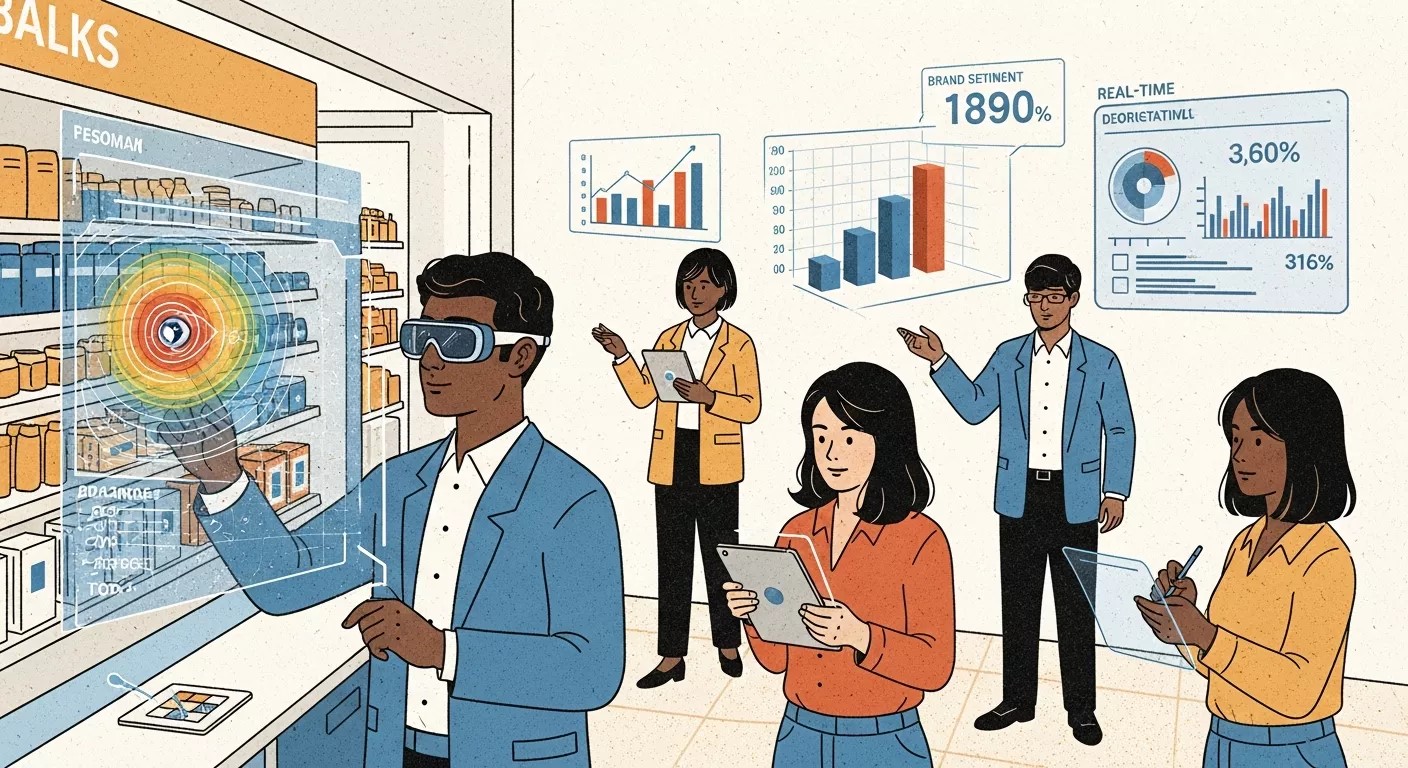
Looking ahead, AR research will integrate more deeply with artificial intelligence, biometric analysis, and predictive modeling.
Emerging developments include:
- Eye-tracking and facial expression analysis
- Sentiment detection through interaction patterns
- Real-time experience optimization
- Predictive simulations of market response
Brands that invest early will build institutional knowledge and proprietary insight frameworks that competitors cannot easily replicate.
Integrating Augmented Reality in Research With AI and Analytics
As datasets grow richer, the real power of Augmented Reality in Research emerges when it is combined with artificial intelligence and advanced analytics. AI models can process behavioral signals collected through AR such as gaze patterns, interaction sequences, and dwell time to uncover insights that human analysis alone might miss.
When AR-generated data feeds into machine learning systems, brands can identify patterns across segments, predict future behavior, and simulate alternative outcomes. This integration transforms Augmented Reality in Research from a descriptive tool into a predictive intelligence engine.
Augmented Reality in Research for Customer Journey Mapping
Traditional customer journey mapping relies heavily on assumptions and retrospective feedback. Augmented Reality in Research enables brands to observe how consumers move through decision stages in realistic, simulated journeys.
By placing consumers inside AR-powered touchpoints such as virtual stores, product demos, or service scenarios researchers gain a clearer view of friction points, emotional triggers, and moments of hesitation. This results in journey maps grounded in real behavior rather than theory.
Using Augmented Reality in Research to Reduce Market Risk
Every product launch and campaign carries risk. Augmented Reality in Research helps brands reduce this risk by stress-testing ideas before they reach the market.
By exposing concepts to real consumer interaction early, brands can identify potential failures, misaligned messaging, or usability issues. This proactive approach lowers costly post-launch corrections and increases confidence in decision-making.
Organizational Readiness for Augmented Reality in Research
Adopting Augmented Reality in Research is not only a technical decision but an organizational one. Teams must be prepared to interpret behavioral data, collaborate across research and marketing functions, and integrate insights into strategy.
Brands that succeed invest in training, cross-functional alignment, and clear governance models. This ensures that AR research insights translate into action rather than remaining isolated experiments.
Augmented Reality in Research as a Long-Term Competitive Advantage
As adoption increases, Augmented Reality in Research will move from differentiation to expectation. Brands that develop internal expertise early will benefit from cumulative learning effects that competitors cannot easily replicate.
Over time, AR research becomes embedded into decision-making culture, enabling faster responses to market change and deeper understanding of consumer behavior.
Augmented Reality in Research for Emotional and Sensory Analysis
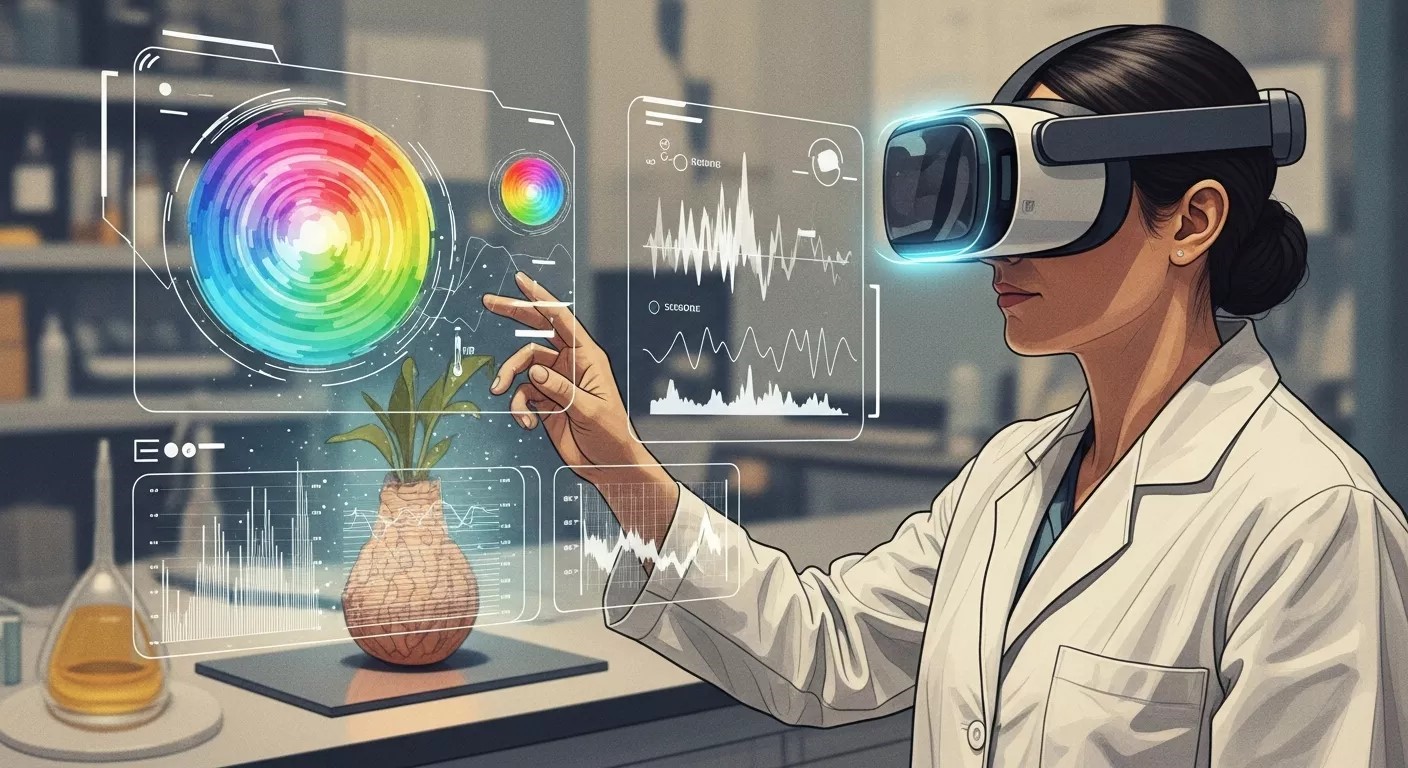
Beyond observable actions, Augmented Reality in Research is increasingly used to understand emotional and sensory responses. By combining AR environments with sentiment tracking, facial expression analysis, and interaction intensity, researchers gain insight into how consumers feel not just what they choose.
This is particularly valuable in categories where emotion drives decisions, such as luxury, fashion, entertainment, and lifestyle products. Emotional response data adds depth to behavioral insights and strengthens creative and positioning decisions.
Cross Cultural Insights Through Augmented Reality in Research
Global brands often struggle with cultural context. Augmented Reality in Research allows the same product or experience to be tested across markets while maintaining consistent stimuli.
Researchers can observe how cultural differences influence navigation, attention, trust, and preference without relying solely on translation-heavy surveys. This makes Augmented Reality in Research a powerful tool for global insight alignment.
Augmented Reality in Research for Concept Validation and Innovation
Innovation fails most often due to poor concept validation. Augmented Reality in Research enables brands to expose early-stage ideas to realistic consumer interaction before large investments are made.
Participants can explore future concepts, react to hypothetical features, and reveal hidden friction points. This reduces innovation risk while encouraging bolder experimentation supported by evidence.
The Role of Augmented Reality in Research for B2B Markets
While AR is often associated with consumer brands, Augmented Reality in Research is equally valuable in B2B contexts. Complex products, long sales cycles, and multiple stakeholders benefit from immersive research environments.
B2B buyers can evaluate solutions, workflows, and value propositions in simulated operational settings. This helps researchers understand decision dynamics that traditional B2B surveys fail to capture.
Scaling Augmented Reality in Research Across Organizations
For AR research to deliver sustained value, it must scale beyond isolated pilots. Augmented Reality in Research becomes most effective when integrated into standard research workflows.
This requires platform standardization, clear metrics, internal education, and leadership support. Brands that scale AR research systematically gain compounding insight advantages over time.
Augmented Reality in Research and the Evolution of Insight Teams
As AR adoption grows, the role of insight teams evolves. Researchers become experience designers, behavioral analysts, and strategic advisors.
Augmented Reality in Research encourages closer collaboration between research, marketing, product, and technology teams breaking silos and accelerating insight-to-action cycles.
Conclusion
Augmented Reality is redefining how brands understand consumers. By moving research from abstract questioning to immersive observation, AR delivers insights that are richer, faster, and more reliable.
In a world where consumer behavior is increasingly complex, Augmented Reality in Marketing Research provides clarity. It bridges the gap between intention and action, strategy and execution, innovation and trust.
For brands willing to embrace it thoughtfully and ethically, AR is not just a research tool it is a strategic advantage.
Frequently Asked Questions (FAQ)
What is Augmented Reality in Marketing Research?
Augmented Reality in Marketing Research is the use of AR technology to study consumer behavior in realistic, interactive environments. It allows researchers to observe real-time interactions instead of relying only on surveys or self-reported feedback.
How does Augmented Reality in Research improve consumer insights?
Augmented Reality in Research improves insights by capturing actual behavior such as attention, movement, interaction, and hesitation. This reduces bias and delivers more accurate, predictive data than traditional research methods.
How is AR-based research different from traditional marketing research?
Traditional research relies on what consumers say, while Augmented Reality in Research focuses on what consumers do. AR places participants in simulated real-world contexts, producing more authentic and actionable insights.
Which industries benefit most from Augmented Reality in Marketing Research?
Industries such as retail, CPG, automotive, real estate, beauty, fashion, and B2B benefit significantly from Augmented Reality in Marketing Research especially where visual evaluation and contextual decision-making matter.
Is Augmented Reality in Marketing Research cost-effective?
Yes. With mobile-based AR platforms, Augmented Reality in Marketing Research is often more cost-effective than physical prototyping, lab studies, or repeated focus groups, while delivering faster insights.
Can Augmented Reality in Research be combined with surveys and interviews?
Absolutely. Augmented Reality in Research works best as part of a mixed-method approach, where behavioral data from AR is combined with qualitative and quantitative research for deeper understanding.
How does Augmented Reality in Research support marketing strategy?
Insights from Augmented Reality in Research help brands validate ideas before launch, reduce campaign risk, improve personalization, and align marketing strategy with real consumer behavior.
Is Augmented Reality in Research ethical?
When implemented responsibly, Augmented Reality in Research is ethical. Researchers must ensure informed consent, transparency, data privacy, and avoid misleading or manipulative experiences.
What is the future of Augmented Reality in Marketing Research?
The future includes integration with AI, biometric analysis, sentiment detection, and predictive modeling making Augmented Reality in Marketing Research a standard tool for strategic decision-making.


