The Intelligent Shift Toward Context-Aware Digital Experiences
The digital world is undergoing a rapid transformation, and one of the most powerful forces driving this change is the AI Revolution in Augmented Reality. As artificial intelligence and augmented reality converge, they are redefining how humans interact with digital information, physical environments, and intelligent systems. This evolution is not just a technological upgrade; it represents a shift in perception, experience, and decision-making across industries.
Augmented reality enhances the real world by overlaying digital elements, while artificial intelligence enables systems to learn, predict, and adapt. Together, they create intelligent, context-aware experiences that feel natural and intuitive. The AI Revolution in Augmented Reality is shaping next-generation applications in education, healthcare, retail, manufacturing, research, and beyond, making digital interactions more immersive, responsive, and human-centered.
Understanding the AI Revolution in Augmented Reality
At its core, the AI Revolution in Augmented Reality is about intelligence-driven augmentation. Traditional AR systems relied heavily on predefined markers and static overlays. With AI integration, AR platforms can now recognize objects, interpret environments, understand user intent, and respond dynamically in real time.
Artificial intelligence empowers augmented reality systems through machine learning, computer vision, natural language processing, and predictive analytics. These capabilities allow AR applications to evolve from simple visual enhancements into intelligent systems that learn from user behavior and environmental context.
The result is an ecosystem where digital content adapts seamlessly to real-world conditions. This fusion is accelerating innovation and unlocking new possibilities that were previously limited by hardware or static programming.
How Artificial Intelligence Enhances Augmented Reality Systems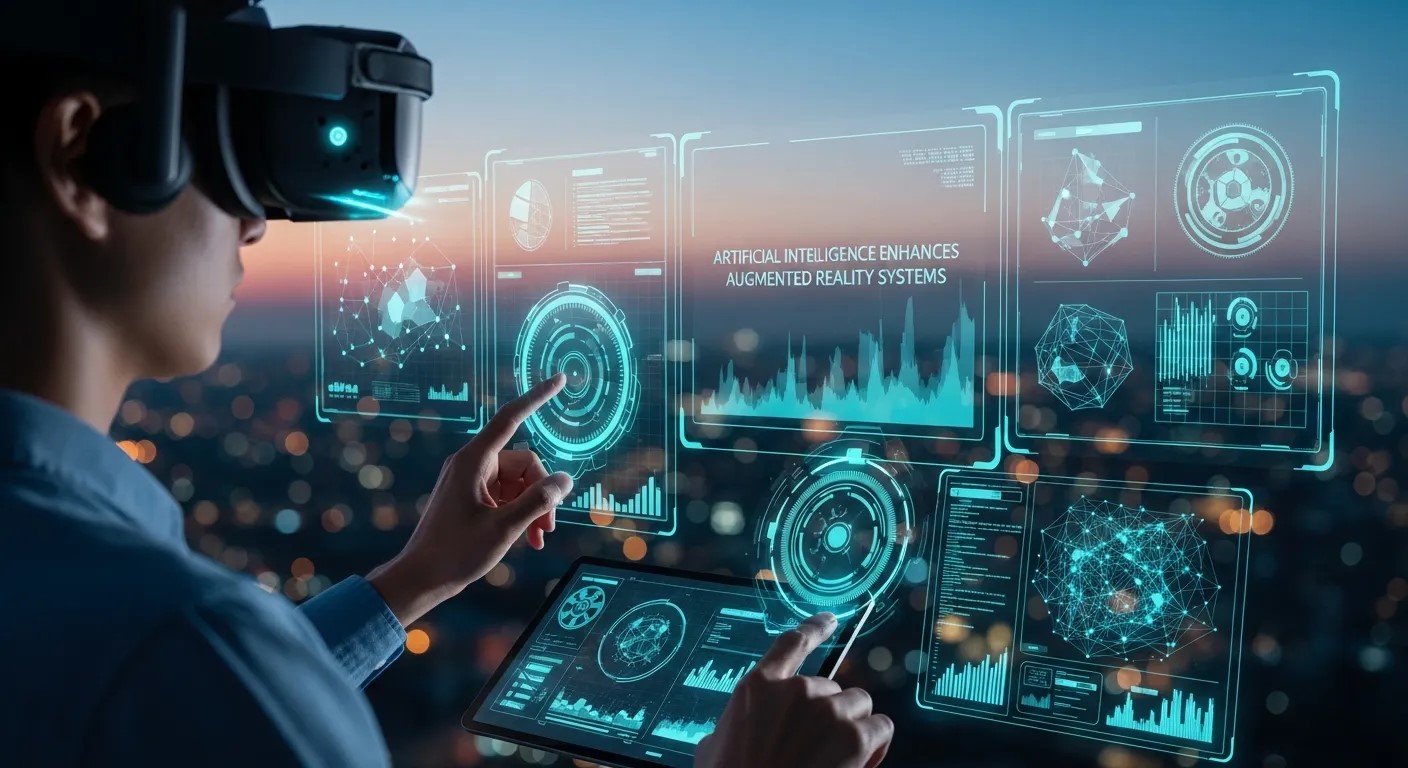
The AI Revolution in Augmented Reality is fueled by several AI-driven capabilities that enhance performance, accuracy, and usability.
Computer Vision and Environmental Understanding
Computer vision allows AR systems to interpret physical surroundings accurately. AI-driven object recognition enables real-time identification of surfaces, depth, lighting, and movement. This allows virtual objects to interact realistically with the physical world.
Machine Learning for Personalization
Machine learning models analyze user interactions to tailor AR experiences. Over time, systems adapt content, recommendations, and interactions based on individual preferences, improving engagement and usability.
Natural Language and Voice Interaction
AI enables AR platforms to understand spoken commands and contextual language. Users can interact naturally with augmented environments through voice, reducing friction and improving accessibility.
Predictive Analytics and Real-Time Adaptation
Predictive algorithms anticipate user needs and environmental changes. This proactive behavior is a defining characteristic of the AI Revolution in Augmented Reality, enabling smoother and more intelligent interactions.
Core Technologies Driving AI-Powered Augmented Reality
The advancement of the AI Revolution in Augmented Reality depends on a combination of hardware and software innovations working together.
| Technology Area | Role in AI-Driven AR |
|---|---|
| Computer Vision | Scene recognition, object tracking, spatial mapping |
| Machine Learning | Personalization, prediction, behavioral analysis |
| Edge Computing | Low-latency processing for real-time AR |
| Cloud AI | Data storage, model training, shared intelligence |
| Sensors & Cameras | Environmental input and motion detection |
These technologies form the foundation for intelligent AR systems capable of learning and adapting continuously.
Industry Applications of AI Revolution in Augmented Reality
The AI Revolution in Augmented Reality is reshaping multiple industries by enhancing efficiency, accuracy, and user engagement.
Education and Skill Development
AI-powered AR enables adaptive learning experiences where content adjusts based on learner performance. Virtual simulations help students visualize complex concepts, while intelligent feedback improves knowledge retention.
Healthcare and Medical Training
In healthcare, AI-enhanced AR supports diagnostics, surgical planning, and training simulations. Medical professionals benefit from real-time data overlays and intelligent guidance, reducing errors and improving outcomes.
Retail and E-Commerce
Retailers leverage the AI Revolution in Augmented Reality to offer personalized virtual try-ons, smart product recommendations, and immersive shopping experiences that bridge online and offline commerce.
Manufacturing and Industrial Operations
AR systems guided by AI assist workers with real-time instructions, predictive maintenance insights, and safety alerts. These systems reduce downtime and improve operational accuracy.
Software Ecosystem Supporting Intelligent AR Development
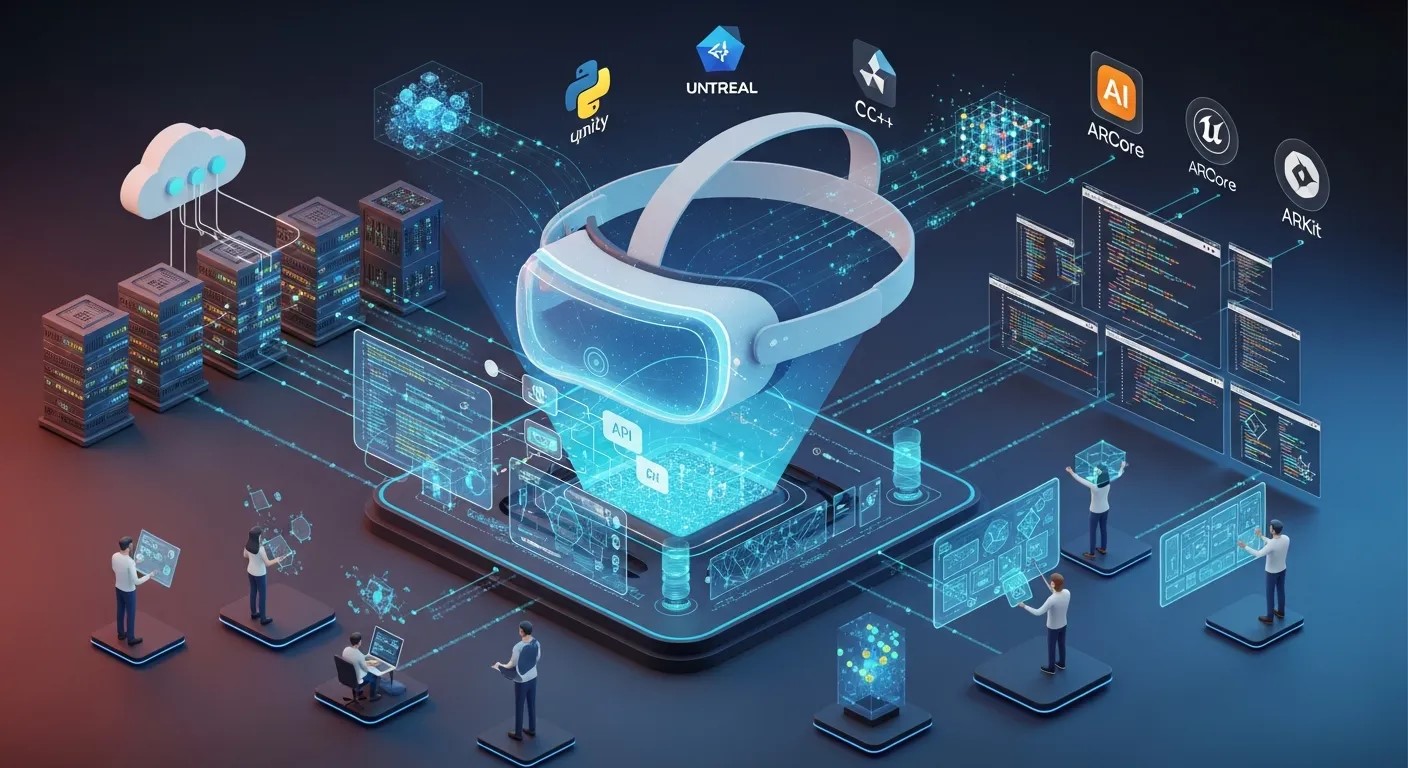
A critical component of the AI Revolution in Augmented Reality is the growing ecosystem of development platforms and tools. Modern AR applications rely on advanced frameworks, engines, and AI integrations to function effectively.
Many enterprises and developers utilize specialized platforms and toolkits that streamline content creation, object recognition, and AI model deployment. The availability of robust development environments has accelerated innovation and lowered entry barriers across industries.
Within this ecosystem, the role of Software Used for Augmented Reality has expanded significantly, enabling developers to integrate AI models seamlessly into AR workflows and deliver scalable, intelligent experiences.
AI Revolution in Augmented Reality for Research and Innovation
Scientific discovery and experimentation are being transformed by intelligent AR systems. The AI Revolution in Augmented Reality enables researchers to visualize complex datasets, simulate environments, and collaborate across geographic boundaries.
In laboratories and academic institutions, augmented environments allow scientists to manipulate data models in three dimensions, uncover patterns, and test hypotheses interactively. This approach enhances comprehension and accelerates discovery.
The integration of Augmented Reality in Research has proven particularly valuable in fields such as biomedical science, engineering, and environmental studies, where spatial understanding and real-time visualization are critical.
Human-Centered Design and User Experience in AI-Driven AR
A defining strength of the AI Revolution in Augmented Reality is its focus on human-centered experiences. AI enables AR systems to respond to emotions, gestures, and contextual cues, creating more intuitive interactions.
User experience design in intelligent AR emphasizes minimal cognitive load, seamless transitions, and adaptive interfaces. AI-driven insights ensure that content appears when and where it is most relevant, improving usability and satisfaction.
This shift toward empathy-driven technology aligns AR systems with natural human behavior, making digital augmentation feel less intrusive and more supportive.
Ethical Considerations and Data Responsibility
As the AI Revolution in Augmented Reality advances, ethical responsibility becomes increasingly important. Intelligent AR systems collect vast amounts of visual, spatial, and behavioral data.
Key concerns include data privacy, algorithmic bias, and transparency. Responsible AR deployment requires secure data handling, informed consent, and ethical AI practices to ensure trust and long-term adoption.
Balancing innovation with accountability is essential to maintaining user confidence and societal acceptance of AI-driven augmented technologies.
Market Growth and Economic Impact
The AI Revolution in Augmented Reality is also reshaping global markets. Increased adoption across industries is driving investment, job creation, and technological advancement.
Businesses recognize AR as a strategic tool for differentiation, efficiency, and customer engagement. As adoption accelerates, the competitive landscape continues to evolve rapidly.
Insights into The Future of Augmented Reality Market indicate strong growth driven by AI integration, enterprise adoption, and expanding consumer use cases across sectors.
Challenges Slowing Mass Adoption
Despite rapid progress, the AI Revolution in Augmented Reality faces several challenges:
-
High development and hardware costs
-
Limited standardization across platforms
-
Technical complexity in AI model integration
-
Concerns around privacy and surveillance
-
Accessibility and digital divide issues
Addressing these challenges requires collaboration between developers, policymakers, and industry leaders to ensure inclusive and scalable growth.
The Role of AI in Real-Time Context Awareness
Context awareness is a defining feature of the AI Revolution in Augmented Reality. AI enables AR systems to understand location, time, behavior, and intent simultaneously.
This intelligence allows applications to deliver relevant information without overwhelming users. Whether in navigation, training, or decision support, context-aware AR enhances efficiency and reduces cognitive friction.
Real-time adaptability ensures AR systems remain useful across dynamic environments and unpredictable conditions.
Interoperability and Cross-Platform Intelligence
Future-ready AR ecosystems depend on interoperability. The AI Revolution in Augmented Reality encourages shared intelligence across devices, platforms, and environments.
Cloud-based AI models allow AR systems to learn collectively, improving accuracy and performance over time. Cross-platform compatibility ensures seamless experiences across smartphones, wearables, and enterprise hardware.
This interconnected intelligence accelerates innovation and expands the reach of augmented experiences globally.
Preparing for the Next Phase of Intelligent Augmentation
The evolution of the AI Revolution in Augmented Reality signals a shift toward ambient computing, where digital intelligence blends invisibly into daily life. AR systems will become lighter, smarter, and more predictive.
As AI models improve and hardware becomes more accessible, intelligent AR will transition from novelty to necessity. Organizations that adopt early will gain strategic advantages in efficiency, engagement, and innovation.
The convergence of AI and AR represents a long-term transformation, redefining how humans learn, work, and interact with technology.
AI Revolution in Augmented Reality and Spatial Intelligence
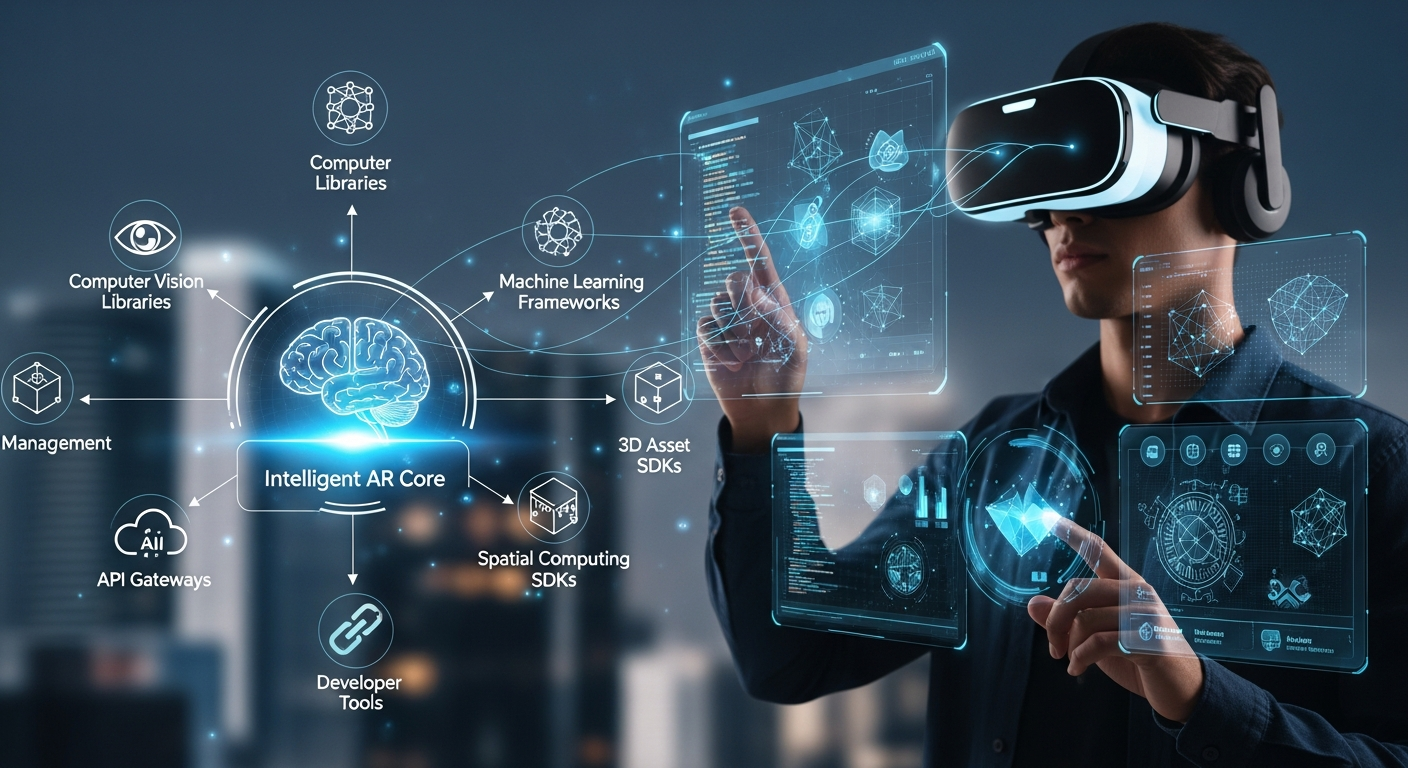
One of the most impactful advancements within the AI Revolution in Augmented Reality is the rise of spatial intelligence. This capability allows AR systems to understand three-dimensional environments with near-human accuracy. Instead of simply overlaying visuals, intelligent AR platforms can map spaces, identify objects, and predict movement patterns in real time.
Spatial intelligence enables augmented reality experiences that feel grounded and responsive. AI models process depth, distance, and orientation data to ensure digital objects behave realistically within physical environments. This advancement is critical for navigation, architectural visualization, and immersive simulations.
As the AI Revolution in Augmented Reality matures, spatial intelligence will allow systems to anticipate user actions before they occur. This predictive awareness reduces friction, enhances safety, and improves efficiency across both consumer and enterprise applications. The result is an augmented environment that feels intuitive rather than intrusive.
Role of AI Revolution in Augmented Reality for Workforce Training
Workforce development is being reshaped by the AI Revolution in Augmented Reality through immersive, adaptive training environments. Traditional training methods often lack real-world context, leading to slower learning curves and higher error rates. Intelligent AR changes this dynamic entirely.
AI-powered AR systems analyze worker behavior, skill gaps, and task performance in real time. Based on these insights, training content adapts instantly, offering contextual guidance exactly when needed. This reduces downtime and increases knowledge retention.
The AI Revolution in Augmented Reality enables hands-free learning through visual overlays, voice guidance, and interactive simulations. Employees can practice complex tasks in safe, controlled environments before executing them in real-world conditions. This approach improves productivity while minimizing operational risks, especially in high-stakes industries like manufacturing, energy, and logistics.
AI Revolution in Augmented Reality and Real-Time Decision Support
Decision-making is becoming faster and more accurate due to the AI Revolution in Augmented Reality. Intelligent AR systems deliver contextual data overlays precisely when decisions must be made, reducing cognitive overload.
AI analyzes incoming data streams and filters information based on relevance. Instead of presenting raw data, AR systems visualize insights in an actionable format. This allows users to interpret complex situations instantly.
The AI Revolution in Augmented Reality plays a critical role in fields where timing and accuracy are essential. From emergency response to industrial inspections, real-time decision support improves outcomes and reduces human error. By merging analytics with visual context, intelligent AR systems empower users to act confidently and efficiently in dynamic environments.
Personalization at Scale Through AI Revolution in Augmented Reality
Personalized experiences are a defining advantage of the AI Revolution in Augmented Reality. AI enables AR systems to adapt content based on individual behavior, preferences, and environmental context.
Machine learning models continuously refine experiences by learning from user interactions. Over time, augmented environments become more aligned with personal needs, improving engagement and satisfaction. This level of customization was previously impossible at scale.
The AI Revolution in Augmented Reality allows businesses to deliver highly tailored experiences without manual configuration. Whether in education, retail, or enterprise workflows, personalization enhances usability and drives long-term adoption. As AI models evolve, personalization will become increasingly subtle, seamless, and deeply integrated into daily interactions.
AI Revolution in Augmented Reality for Predictive Maintenance
Predictive maintenance is a powerful application of the AI Revolution in Augmented Reality. Intelligent AR systems analyze equipment data, detect anomalies, and visualize potential failures before they occur.
AI-driven insights are overlaid directly onto physical machinery, allowing technicians to identify issues instantly. This reduces guesswork and improves maintenance accuracy. By predicting failures early, organizations can prevent costly downtime and extend equipment lifespan.
The AI Revolution in Augmented Reality transforms maintenance from a reactive process into a proactive strategy. Real-time diagnostics, combined with visual guidance, empower teams to resolve issues faster and with greater confidence. This shift improves operational efficiency and enhances safety across industrial environments.
Long-Term Impact of AI Revolution in Augmented Reality on Digital Society

The long-term implications of the AI Revolution in Augmented Reality extend beyond technology into social and cultural transformation. As intelligent AR becomes more integrated into daily life, it will reshape how people perceive information and interact with the world.
AI-driven augmentation blurs the line between physical and digital realities. This convergence influences communication, learning, and collaboration on a global scale. Augmented environments will become adaptive spaces that respond to human needs dynamically.
The AI Revolution in Augmented Reality is not just a technological trend; it is a foundational shift in human-computer interaction. As adoption grows, society will move toward more immersive, intelligent, and context-aware digital experiences that enhance rather than replace human capabilities.
Conclusion
The AI Revolution in Augmented Reality marks a significant shift in how digital and physical worlds intersect. By embedding intelligence into immersive environments, AI-powered AR delivers experiences that are adaptive, predictive, and deeply personalized. This convergence enhances efficiency, understanding, and decision-making across industries such as education, healthcare, retail, manufacturing, and scientific research.
As advancements in machine learning, computer vision, and real-time data processing continue, augmented reality systems will become increasingly intuitive and human-centric. While challenges related to ethics, data privacy, and scalability remain, responsible innovation will unlock sustainable growth. Ultimately, the AI Revolution in Augmented Reality is not just shaping next-generation technology it is redefining how humans perceive, interact with, and benefit from intelligent digital experiences.
Frequency Asked Question (FAQ)
What is the AI Revolution in Augmented Reality?
The AI Revolution in Augmented Reality refers to the integration of artificial intelligence with AR systems to create intelligent, adaptive, and context-aware digital experiences layered onto the real world.
How does AI improve augmented reality experiences?
AI enhances AR by enabling object recognition, real-time data analysis, spatial understanding, and personalized interactions, making AR applications more accurate, responsive, and user-centric.
Which industries benefit most from AI-powered augmented reality?
Industries such as education, healthcare, retail, manufacturing, research, and entertainment benefit significantly from AI-driven AR through improved training, visualization, decision-making, and customer engagement.
What role does AI play in real-time AR interaction?
AI processes environmental data instantly, allowing AR systems to adjust digital overlays dynamically based on user behavior, surroundings, and contextual changes.
Is AI-powered augmented reality used in research?
Yes, AI-enhanced AR supports advanced data visualization, simulation, and experimentation, helping researchers analyze complex information and accelerate innovation across scientific fields.
What challenges exist in adopting AI-driven augmented reality?
Key challenges include high development costs, technical complexity, data privacy concerns, ethical considerations, and the need for skilled professionals to build and maintain intelligent AR systems.
What does the future hold for the AI Revolution in Augmented Reality?
The future includes smarter wearable devices, deeper AI integration, real-time personalization, and broader adoption across industries, shaping more immersive and intelligent digital experiences.